

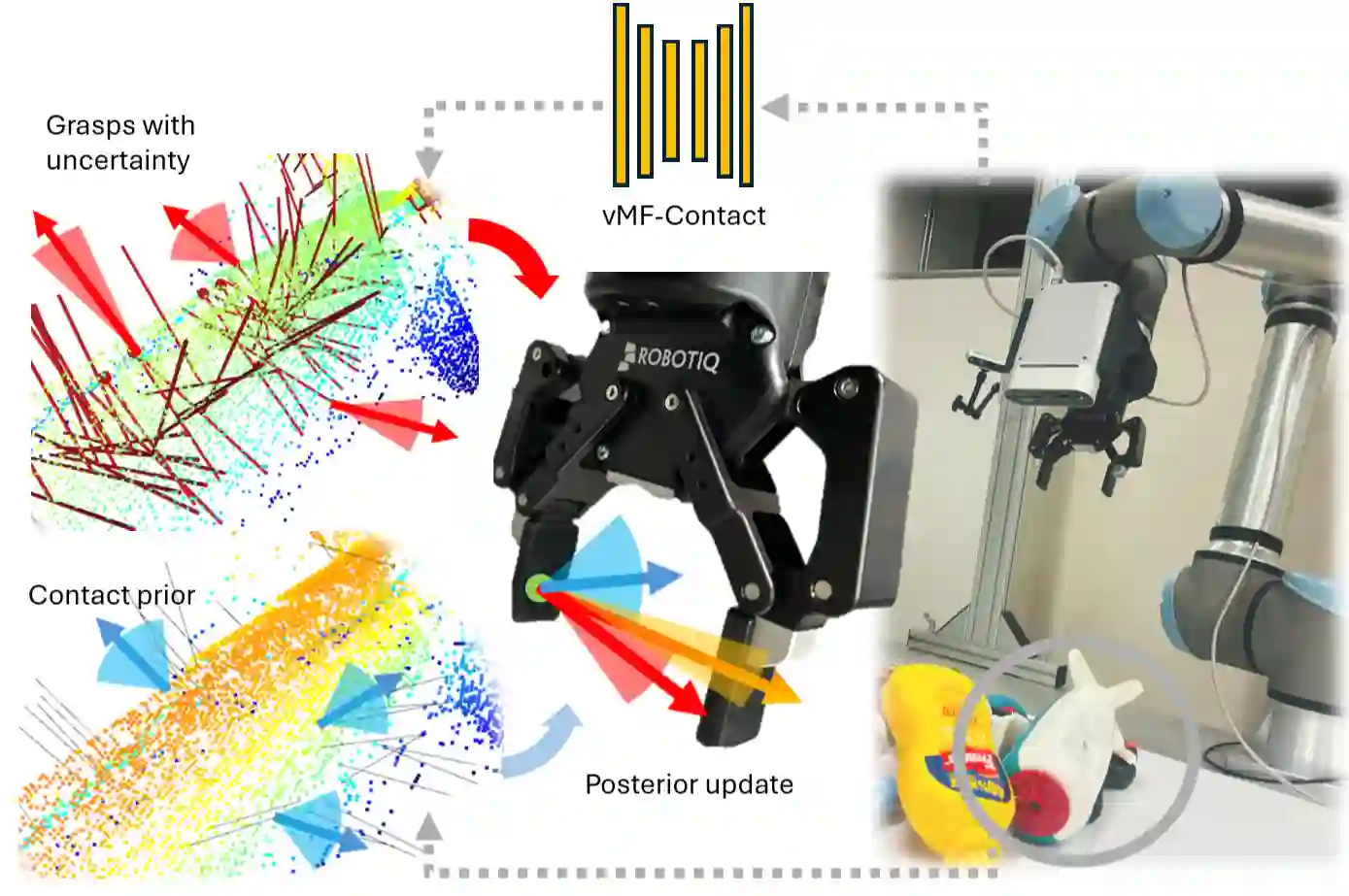
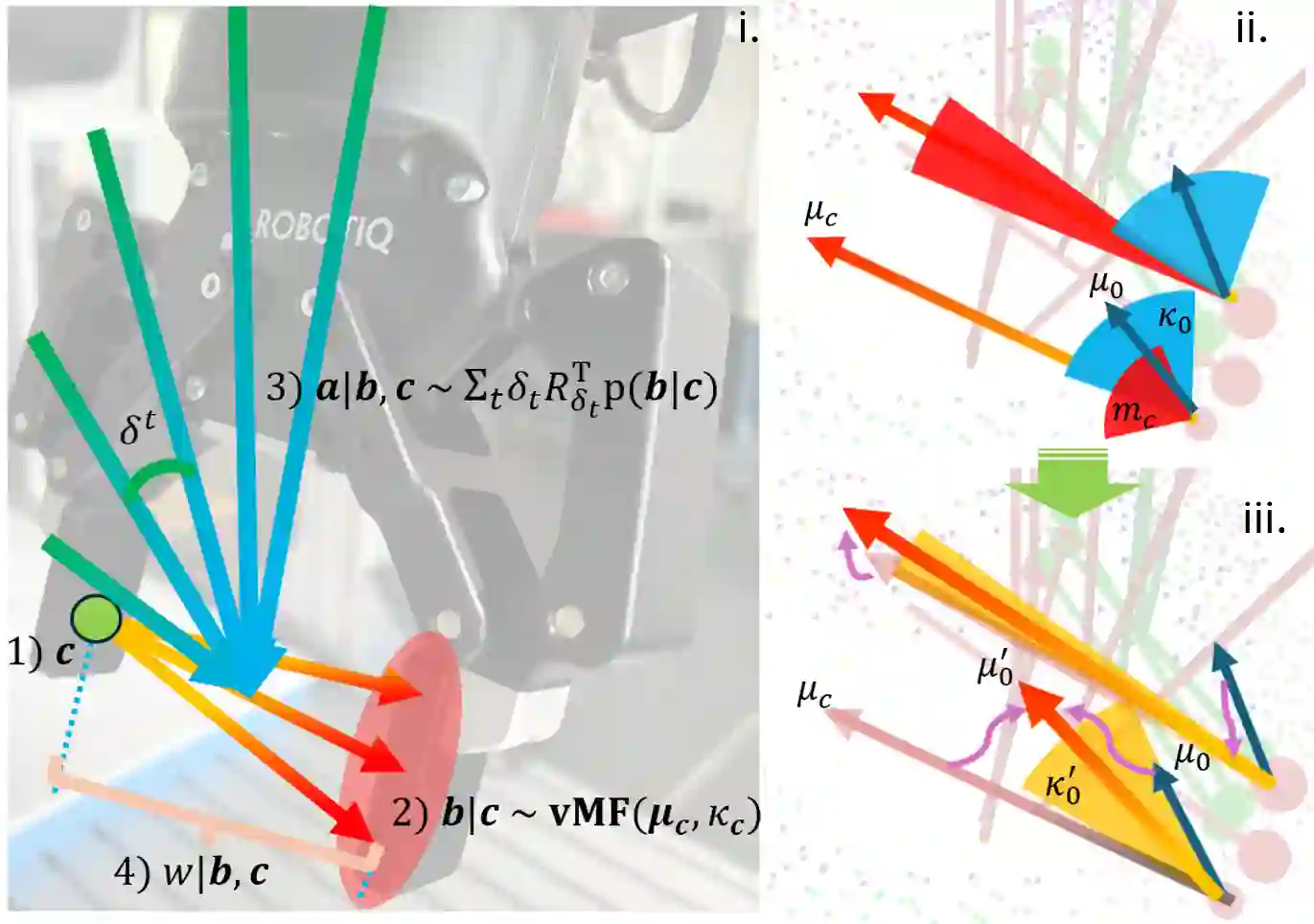
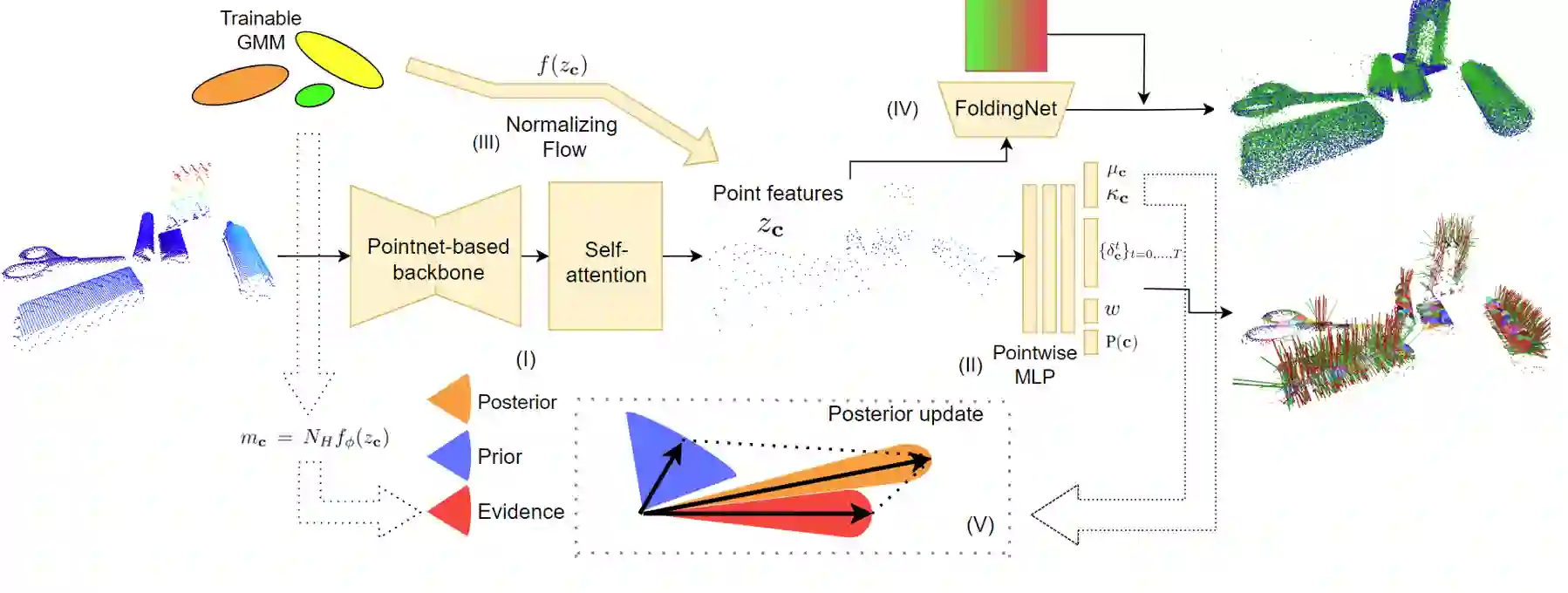
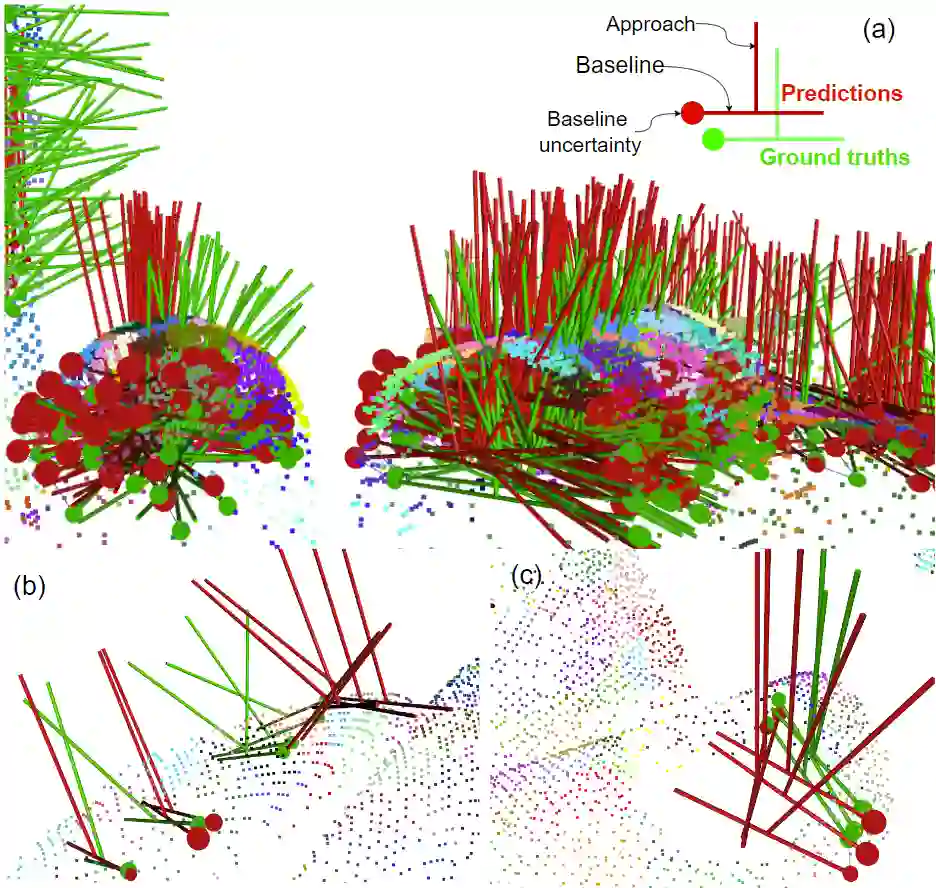
Grasp learning in noisy environments, such as occlusions, sensor noise, and out-of-distribution (OOD) objects, poses significant challenges. Recent learning-based approaches focus primarily on capturing aleatoric uncertainty from inherent data noise. The epistemic uncertainty, which represents the OOD recognition, is often addressed by ensembles with multiple forward paths, limiting real-time application. In this paper, we propose an uncertainty-aware approach for 6-DoF grasp detection using evidential learning to comprehensively capture both uncertainties in real-world robotic grasping. As a key contribution, we introduce vMF-Contact, a novel architecture for learning hierarchical contact grasp representations with probabilistic modeling of directional uncertainty as von Mises-Fisher (vMF) distribution. To achieve this, we derive and analyze the theoretical formulation of the second-order objective on the posterior parametrization, providing formal guarantees for the model's ability to quantify uncertainty and improve grasp prediction performance. Moreover, we enhance feature expressiveness by applying partial point reconstructions as an auxiliary task, improving the comprehension of uncertainty quantification as well as the generalization to unseen objects. In the real-world experiments, our method demonstrates a significant improvement by 39% in the overall clearance rate compared to the baselines. Video is under https://www.youtube.com/watch?v=4aQsrDgdV8Y&t=12s
翻译:在存在遮挡、传感器噪声以及分布外(OOD)物体等噪声环境中进行抓取学习,面临着重大挑战。当前基于学习的方法主要侧重于从固有的数据噪声中捕捉偶然不确定性。而表征OOD识别的认知不确定性,通常通过具有多个前向路径的集成方法来解决,这限制了实时应用。本文提出一种不确定性感知方法,用于6自由度抓取检测,该方法利用证据学习来全面捕捉现实世界机器人抓取中的两种不确定性。作为核心贡献,我们提出了vMF-Contact,这是一种新颖的架构,用于学习分层接触抓取表示,并将方向不确定性以冯·米塞斯-费舍尔(vMF)分布的形式进行概率建模。为此,我们推导并分析了后验参数化二阶目标的理论公式,为模型量化不确定性和提升抓取预测性能提供了形式化保证。此外,我们通过将部分点云重建作为辅助任务来增强特征表达能力,从而提升了对不确定性量化的理解以及对未见物体的泛化能力。在真实世界实验中,与基线方法相比,我们的方法在总体清空率上实现了39%的显著提升。视频见 https://www.youtube.com/watch?v=4aQsrDgdV8Y&t=12s




相关内容




 微信扫码咨询专知VIP会员