

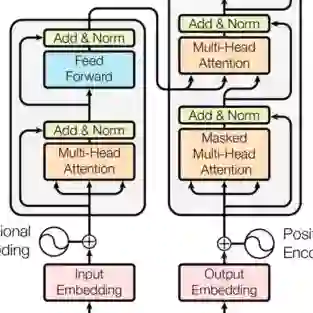
In this work, we address the problem of computation time for trajectory generation in quadrotors. Most trajectory generation methods for waypoint navigation of quadrotors, for example minimum snap/jerk and minimum-time, are structured as bi-level optimizations. The first level involves allocating time across all input waypoints and the second step is to minimize the snap/jerk of the trajectory under that time allocation. Such an optimization can be computationally expensive to solve. In our approach we treat trajectory generation as a supervised learning problem between a sequential set of inputs and outputs. We adapt a transformer model to learn the optimal time allocations for a given set of input waypoints, thus making it into a single step optimization. We demonstrate the performance of the transformer model by training it to predict the time allocations for a minimum snap trajectory generator. The trained transformer model is able to predict accurate time allocations with fewer data samples and smaller model size, compared to a feedforward network (FFN), demonstrating that it is able to model the sequential nature of the waypoint navigation problem.
翻译:本文针对四旋翼飞行器轨迹生成中的计算时间问题展开研究。目前大多数用于四旋翼飞行器航路点导航的轨迹生成方法(例如最小加加速度/最小急动度轨迹及最小时间轨迹)均采用双层优化结构:第一层优化所有输入航路点间的时间分配,第二层则在既定时间分配下最小化轨迹的加加速度/急动度。这类优化问题的求解计算成本高昂。本文提出将轨迹生成视为输入输出序列的监督学习问题,通过改进Transformer模型学习给定航路点集的最优时间分配,从而将双层优化转化为单步优化。我们通过训练该模型预测最小加加速度轨迹生成器的时间分配来验证其性能。实验表明,相较于前馈神经网络(FFN),经过训练的Transformer模型能以更少的训练样本和更小的模型规模准确预测时间分配,证明其能够有效建模航路点导航问题的序列特性。




相关内容


 微信扫码咨询专知VIP会员