

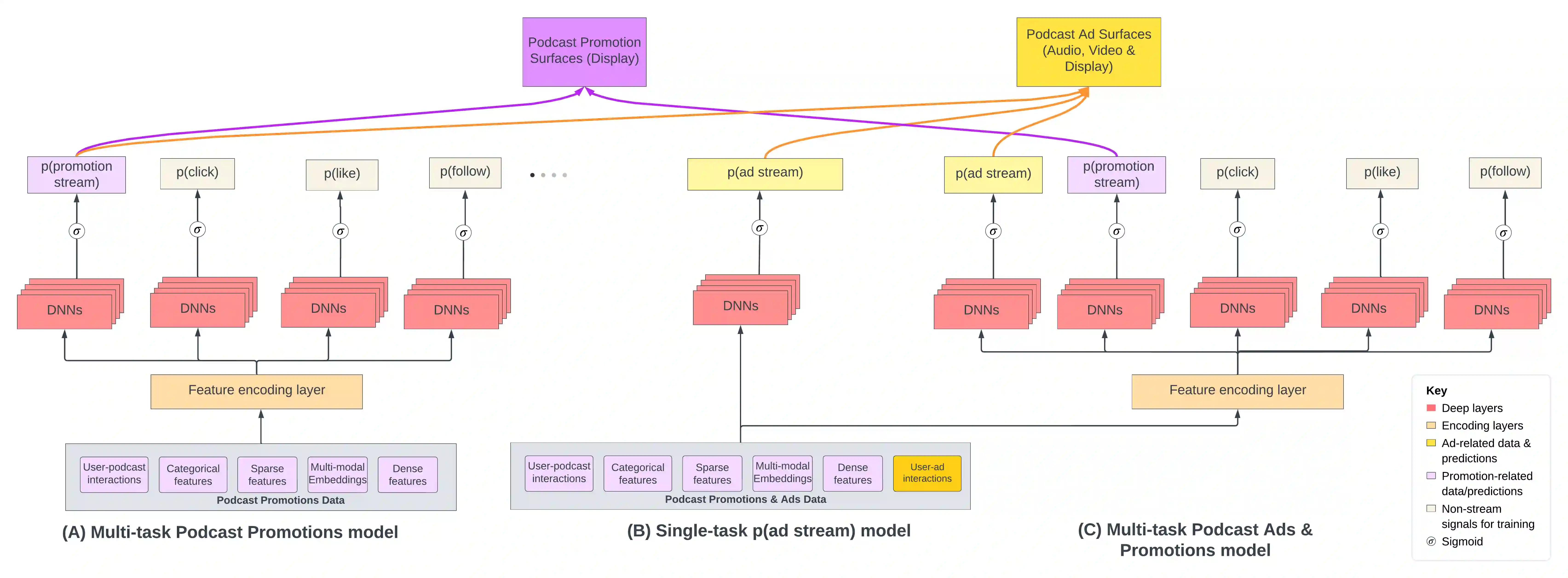
We present a unified multi-objective model for targeting both advertisements and promotions within the Spotify podcast ecosystem. Our approach addresses key challenges in personalization and cold-start initialization, particularly for new advertising objectives. By leveraging transfer learning from large-scale ad and content interactions within a multi-task learning (MTL) framework, a single joint model can be fine-tuned or directly applied to new or low-data targeting tasks, including in-app promotions. This multi-objective design jointly optimizes podcast outcomes such as streams, clicks, and follows for both ads and promotions using a shared representation over user, content, context, and creative features, effectively supporting diverse business goals while improving user experience. Online A/B tests show up to a 22% reduction in effective Cost-Per-Stream (eCPS), particularly for less-streamed podcasts, and an 18-24% increase in podcast stream rates. Offline experiments and ablations highlight the contribution of ancillary objectives and feature groups to cold-start performance. Our experience shows that a unified modeling strategy improves maintainability, cold-start performance, and coverage, while breaking down historically siloed targeting pipelines. We discuss practical trade-offs of such joint models in a real-world advertising system.
翻译:本文提出了一种统一的多目标模型,用于在Spotify播客生态系统中同时实现广告投放与内容推广。该方法解决了个性化推荐与冷启动初始化中的关键挑战,尤其针对新兴广告目标。通过在多任务学习框架中利用大规模广告与内容交互数据的迁移学习,该联合模型能够对新出现的或数据稀疏的定向任务(包括应用内推广)进行微调或直接部署。这种多目标设计基于用户、内容、上下文及创意特征的共享表示,联合优化广告与推广任务中的播客效果指标(如播放量、点击量与关注量),在提升用户体验的同时有效支持多样化的商业目标。在线A/B测试表明,该方法使有效单次播放成本最高降低22%(对低播放量播客效果尤为显著),并将播客播放率提升18-24%。离线实验与消融研究验证了辅助目标与特征组对冷启动性能的贡献。实践表明,统一建模策略提升了系统的可维护性、冷启动性能与覆盖范围,同时打破了历史上相互割裂的定向流程。本文进一步探讨了此类联合模型在实际广告系统中面临的权衡问题。




相关内容



 微信扫码咨询专知VIP会员