

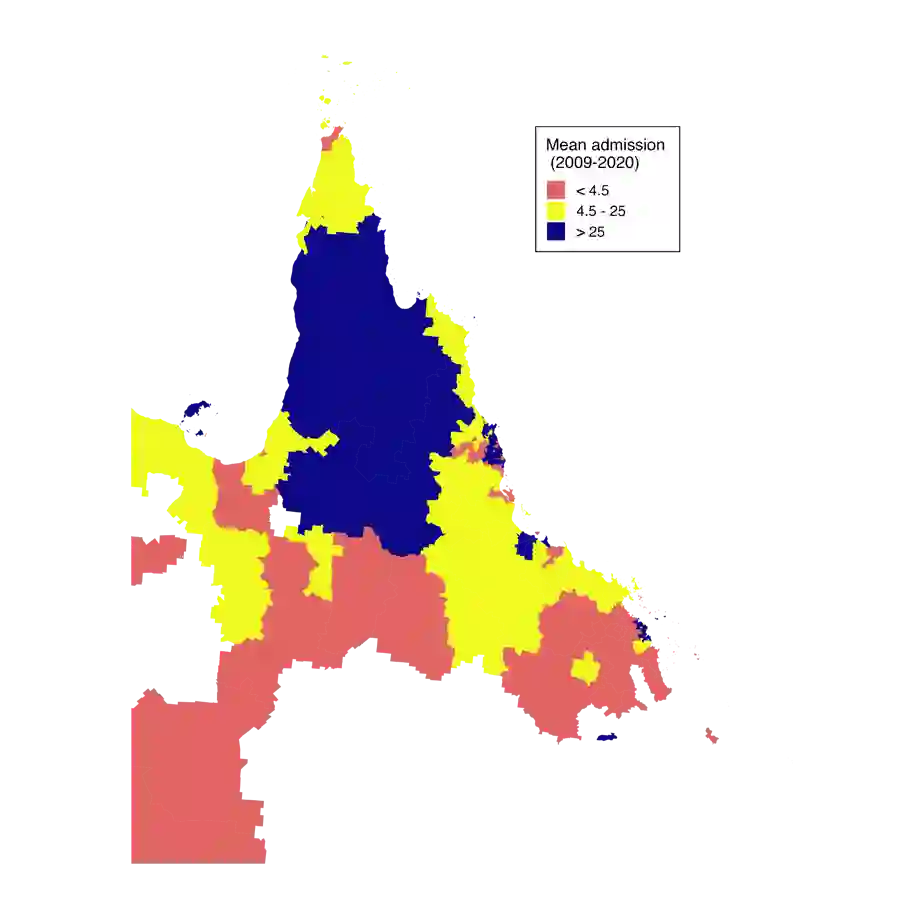
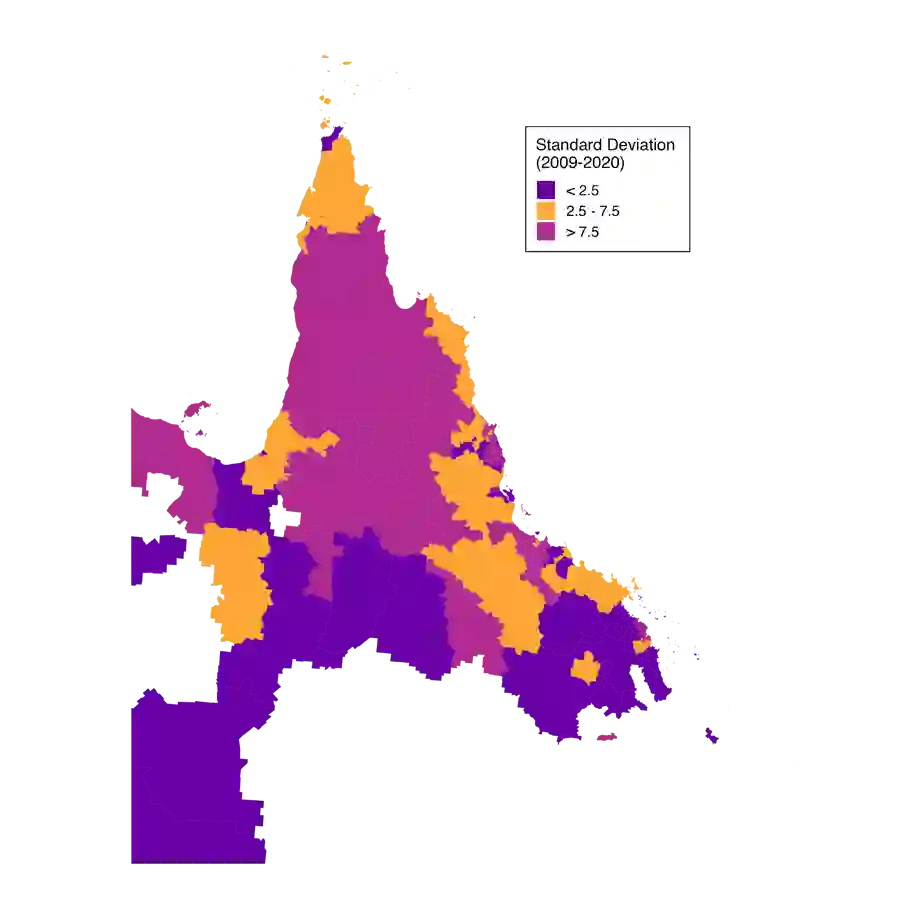
This study examined the spatial-temporal dynamics of Emergency Examination Order or Authority (EE-O/A) admissions in Far Northern Queensland (FNQ) from 2009 to 2020, using 13,035 unique police records aggregated across 83 postcodes. A two-stage modelling framework was used: Lasso was used to identify a parsimonious set of socio economic and health-service covariates, and a Conditional Autoregressive (CAR) model incorporated these predictors with structured spatial and temporal random effects. This research demonstrates that socio-economic disadvantage and service accessibility drive EE-O/A incidence, underscoring the need for targeted mental-health interventions and resource allocation in impoverished FNQ communities. Limitations include reliance on cross-sectional census data for covariates and potential ecological bias from data fusion.
翻译:本研究利用13,035条跨83个邮政编码区聚合的警方记录,分析了2009至2020年间远北昆士兰地区紧急检查令入院案例的时空动态。采用两阶段建模框架:首先通过Lasso方法筛选出精简的社会经济与医疗服务协变量集合,继而构建条件自回归模型,将上述预测变量与结构化时空随机效应相结合。研究表明,社会经济劣势与医疗服务可及性是驱动紧急检查令发生率的关键因素,凸显了在远北昆士兰贫困社区实施针对性心理健康干预与资源调配的必要性。研究局限包括协变量依赖横截面普查数据,以及数据融合可能产生的生态学偏倚。






相关内容





 微信扫码咨询专知VIP会员