

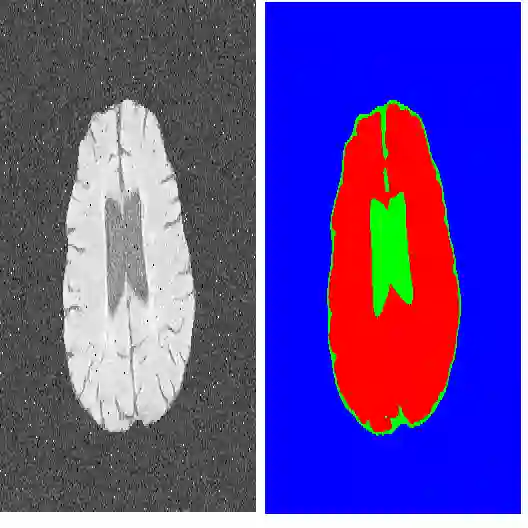
Medical image segmentation (MIS) plays an instrumental role in medical image analysis, where considerable efforts have been devoted to automating the process. Currently, mainstream MIS approaches are based on deep neural networks (DNNs) which are typically trained on a dataset that contains annotation masks produced by doctors. However, in the medical domain, the annotation masks generated by different doctors can inherently vary because a doctor may unnecessarily produce precise and unique annotations to meet the goal of diagnosis. Therefore, the DNN model trained on the data annotated by certain doctors, often just a single doctor, could undesirably favour those doctors who annotate the training data, leading to the unsatisfaction of a new doctor who will use the trained model. To address this issue, this work investigates the utilization of multi-expert annotation to enhance the adaptability of the model to a new doctor and we conduct a pilot study on the MRI brain segmentation task. Experimental results demonstrate that the model trained on a dataset with multi-expert annotation can efficiently cater for a new doctor, after lightweight fine-tuning on just a few annotations from the new doctor.
翻译:医学图像分割(MIS)在医学图像分析中扮演着关键角色,大量研究致力于实现该过程的自动化。当前主流的医学图像分割方法基于深度神经网络(DNN),这些网络通常使用包含医生标注掩码的数据集进行训练。然而,在医学领域,不同医生生成的标注掩码本质上可能存在差异,因为医生无需为满足诊断目标而生成精确且唯一的标注。因此,基于特定医生(往往仅一位)标注数据训练的DNN模型,可能会不理想地偏向于该标注医生,导致新的使用该训练模型的医生产生不满。为解决这一问题,本研究探索了利用多专家标注增强模型对新医生的适应性,并围绕MRI脑部分割任务开展了初步研究。实验结果表明,基于多专家标注数据集训练的模型,在对新医生的少量标注进行轻量微调后,能够高效适应其需求。




相关内容




 微信扫码咨询专知VIP会员