

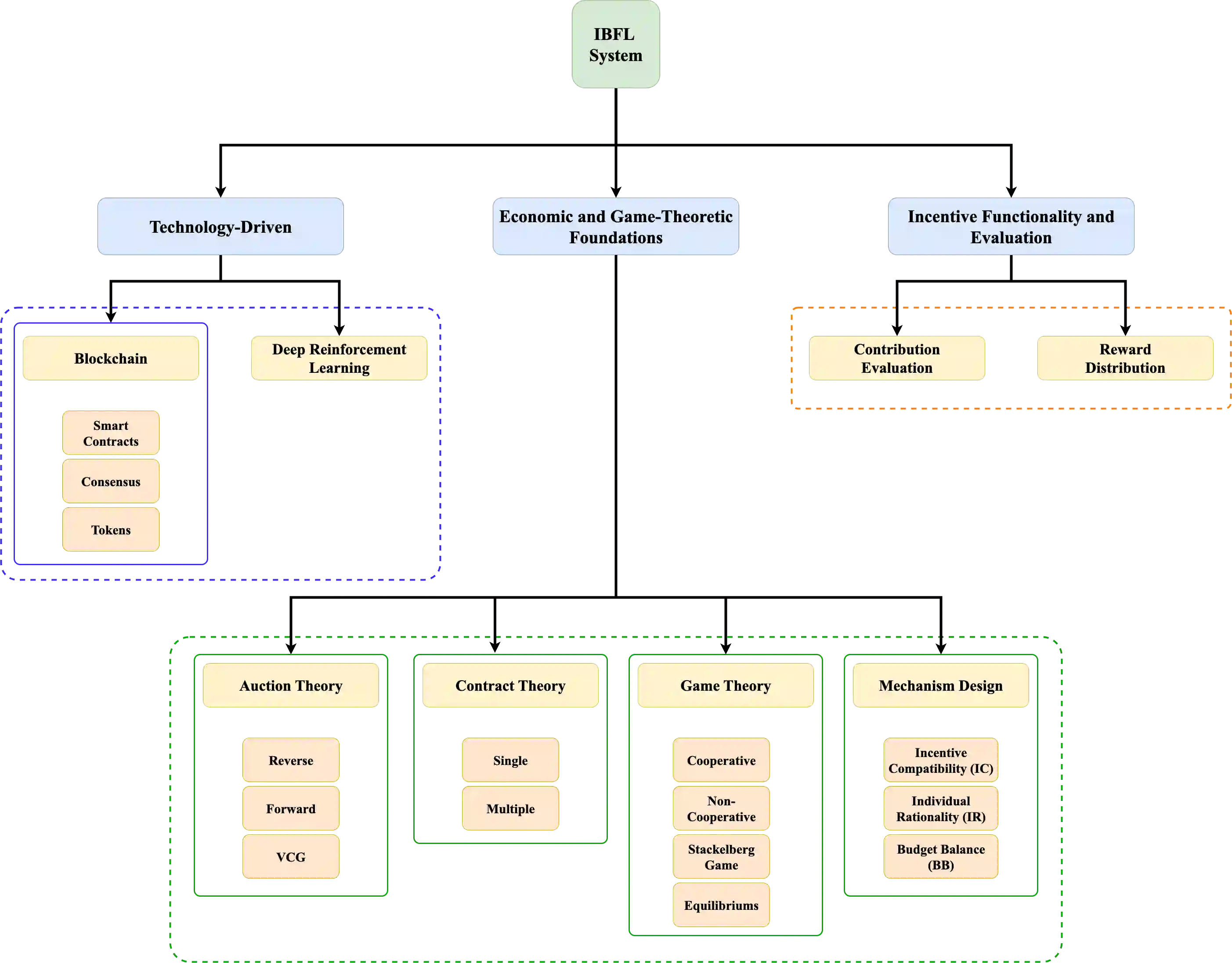
Federated learning promises to revolutionize machine learning by enabling collaborative model training without compromising data privacy. However, practical adaptability can be limited by critical factors, such as the participation dilemma. Participating entities are often unwilling to contribute to a learning system unless they receive some benefits, or they may pretend to participate and free-ride on others. This chapter identifies the fundamental challenges in designing incentive mechanisms for federated learning systems. It examines how foundational concepts from economics and game theory can be applied to federated learning, alongside technology-driven solutions such as blockchain and deep reinforcement learning. This work presents a comprehensive taxonomy that thoroughly covers both centralized and decentralized architectures based on the aforementioned theoretical concepts. Furthermore, the concepts described are presented from an application perspective, covering emerging industrial applications, including healthcare, smart infrastructure, vehicular networks, and blockchain-based decentralized systems. Through this exploration, this chapter demonstrates that well-designed incentive mechanisms are not merely optional features but essential components for the practical success of federated learning. This analysis reveals both the promising solutions that have emerged and the significant challenges that remain in building truly sustainable, fair, and robust federated learning ecosystems.
翻译:联邦学习有望通过实现协作式模型训练而不损害数据隐私,从而彻底改变机器学习。然而,实际适应性可能受到关键因素的限制,例如参与困境。参与实体通常不愿意为学习系统做出贡献,除非它们获得一些好处,或者它们可能假装参与并搭便车。本章确定了设计联邦学习系统激励机制的基本挑战。它探讨了如何将经济学和博弈论的基础概念应用于联邦学习,以及区块链和深度强化学习等技术驱动的解决方案。这项工作提出了一个全面的分类法,基于上述理论概念,彻底涵盖了集中式和分散式架构。此外,所描述的概念从应用角度呈现,涵盖了新兴的工业应用,包括医疗保健、智能基础设施、车载网络和基于区块链的分散式系统。通过这一探索,本章表明,精心设计的激励机制不仅仅是可选功能,而是联邦学习实际成功的关键组成部分。这一分析揭示了已出现的有前景的解决方案,以及在构建真正可持续、公平和稳健的联邦学习生态系统方面仍然存在的重大挑战。






相关内容




 微信扫码咨询专知VIP会员