

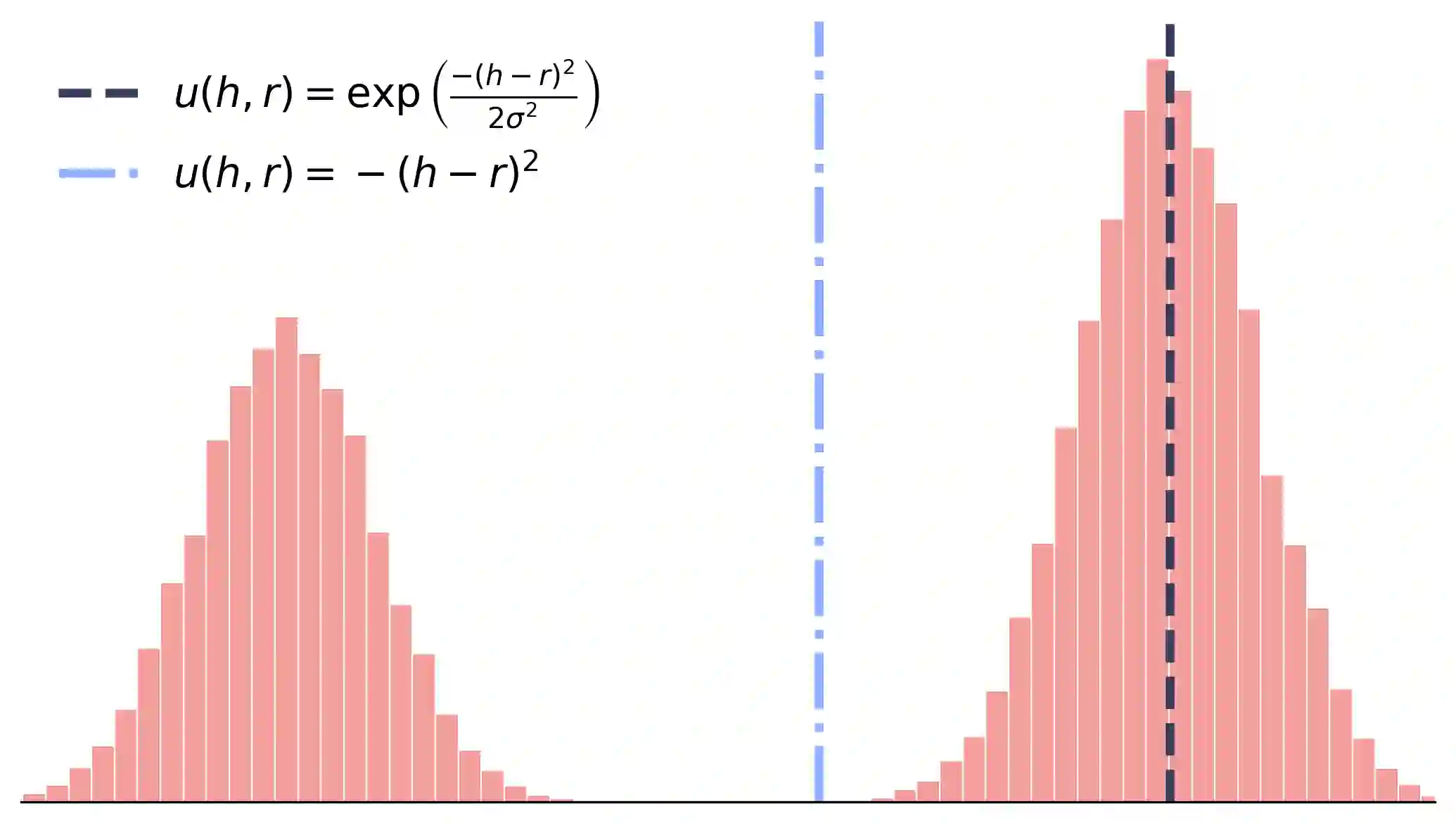
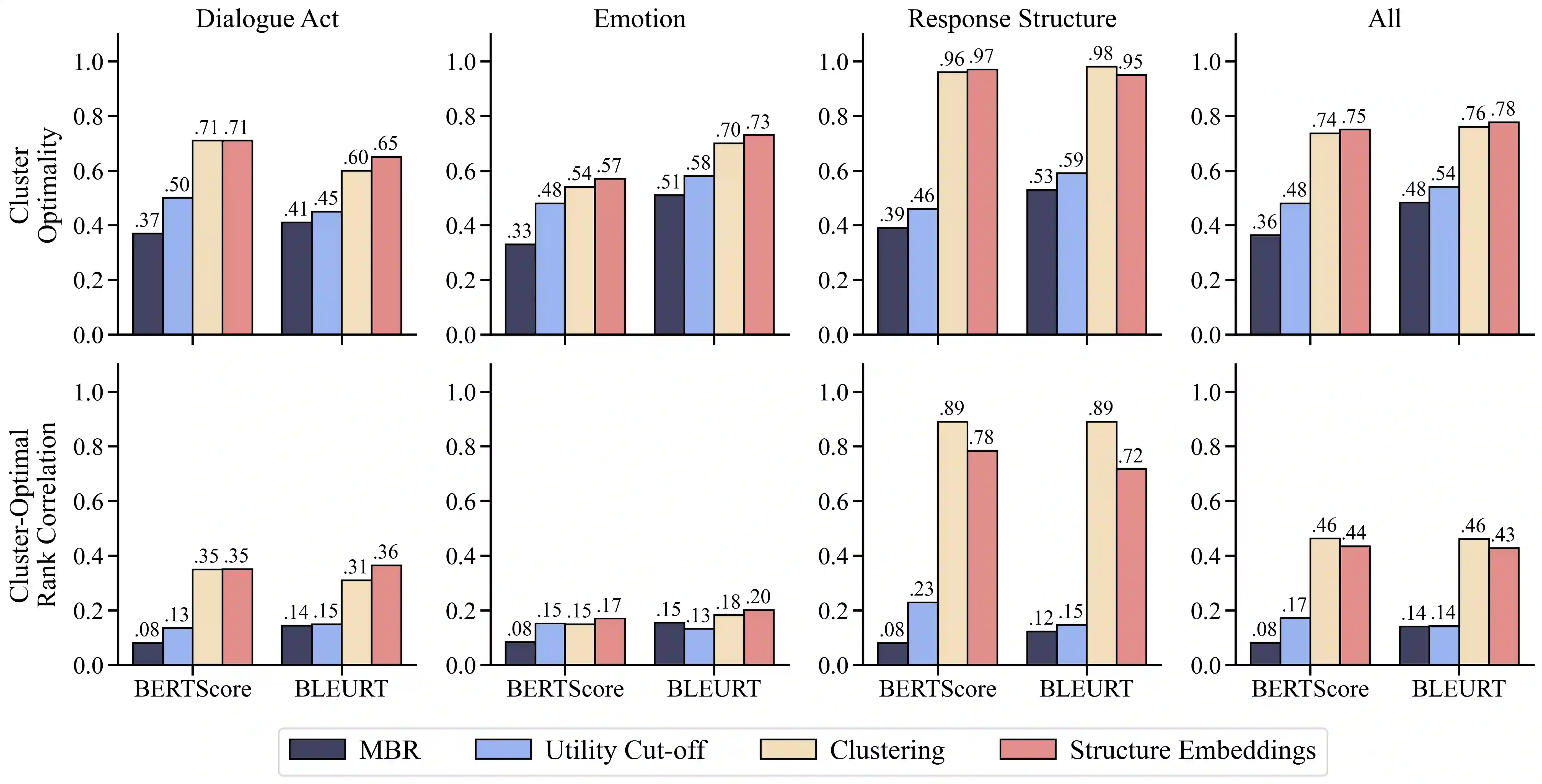
Minimum Bayes Risk (MBR) decoding has seen renewed interest as an alternative to traditional generation strategies. While MBR has proven effective in machine translation, where the variability of a language model's outcome space is naturally constrained, it may face challenges in more open-ended tasks such as dialogue or instruction-following. We hypothesise that in such settings, applying MBR with standard similarity-based utility functions may result in selecting responses that are broadly representative of the model's distribution, yet sub-optimal with respect to any particular grouping of generations that share an underlying latent structure. In this work, we introduce three lightweight adaptations to the utility function, designed to make MBR more sensitive to structural variability in the outcome space. To test our hypothesis, we curate a dataset capturing three representative types of latent structure: dialogue act, emotion, and response structure (e.g., a sentence, a paragraph, or a list). We further propose two metrics to evaluate the structural optimality of MBR. Our analysis demonstrates that common similarity-based utility functions fall short by these metrics. In contrast, our proposed adaptations considerably improve structural optimality. Finally, we evaluate our approaches on real-world instruction-following benchmarks, AlpacaEval and MT-Bench, and show that increased structural sensitivity improves generation quality by up to 13.7 percentage points in win rate.
翻译:最小贝叶斯风险(MBR)解码作为一种替代传统生成策略的方法,近来重新受到关注。尽管MBR在机器翻译领域已被证明有效——该领域语言模型输出空间的变异性天然受限,但在对话或指令跟随等更开放的任务中可能面临挑战。我们假设在此类场景下,使用基于标准相似性的效用函数进行MBR解码,可能导致选择那些虽能广泛代表模型分布、但对于共享潜在底层结构的特定生成分组而言并非最优的响应。本研究针对效用函数提出了三种轻量化改进方案,旨在增强MBR对输出空间结构变异性的敏感性。为验证假设,我们构建了一个涵盖三种典型潜在结构类型的数据集:对话行为、情感及响应结构(如单句、段落或列表)。进一步提出两个评估MBR结构最优性的指标。分析表明,常见的基于相似性的效用函数在这些指标上表现不足。相比之下,我们提出的改进方案显著提升了结构最优性。最后,我们在真实世界指令跟随基准测试(AlpacaEval和MT-Bench)上评估了所提方法,结果显示增强结构敏感性可使生成质量在胜率指标上提升高达13.7个百分点。





相关内容



 微信扫码咨询专知VIP会员