

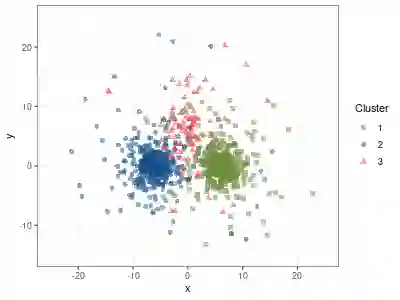
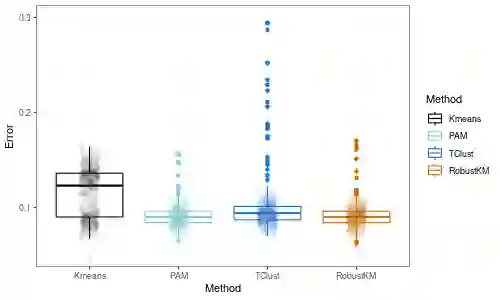
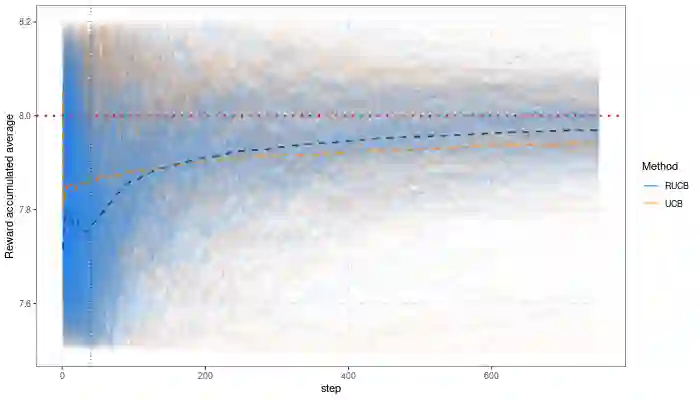
A new, very general, robust procedure for combining estimators in metric spaces is introduced GROS. The method is reminiscent of the well-known median of means, as described in \cite{devroye2016sub}. Initially, the sample is divided into $K$ groups. Subsequently, an estimator is computed for each group. Finally, these $K$ estimators are combined using a robust procedure. We prove that this estimator is sub-Gaussian and we get its break-down point, in the sense of Donoho. The robust procedure involves a minimization problem on a general metric space, but we show that the same (up to a constant) sub-Gaussianity is obtained if the minimization is taken over the sample, making GROS feasible in practice. The performance of GROS is evaluated through five simulation studies: the first one focuses on classification using $k$-means, the second one on the multi-armed bandit problem, the third one on the regression problem. The fourth one is the set estimation problem under a noisy model. Lastly, we apply GROS to get a robust persistent diagram.
翻译:本文提出了一种新颖且通用的鲁棒方法GROS,用于在度量空间中组合估计量。该方法类似于著名的均值中位数法(如文献\cite{devroye2016sub}所述)。首先,将样本划分为$K$组;其次,对每组计算一个估计量;最后,通过鲁棒过程组合这$K$个估计量。我们证明该估计量具有次高斯性,并得到其在Donoho意义下的崩溃点。该鲁棒过程涉及一般度量空间上的最小化问题,但研究表明,若将最小化范围限定于样本内,可得到相同(至多相差常数因子)的次高斯性结果,从而使得GROS在实践中可行。通过五项仿真实验评估GROS性能:第一项聚焦于基于$k$-均值的分类问题,第二项研究多臂赌博机问题,第三项针对回归问题,第四项涉及噪声模型下的集合估计问题,最后将GROS应用于稳健持久图生成。





相关内容



 微信扫码咨询专知VIP会员