

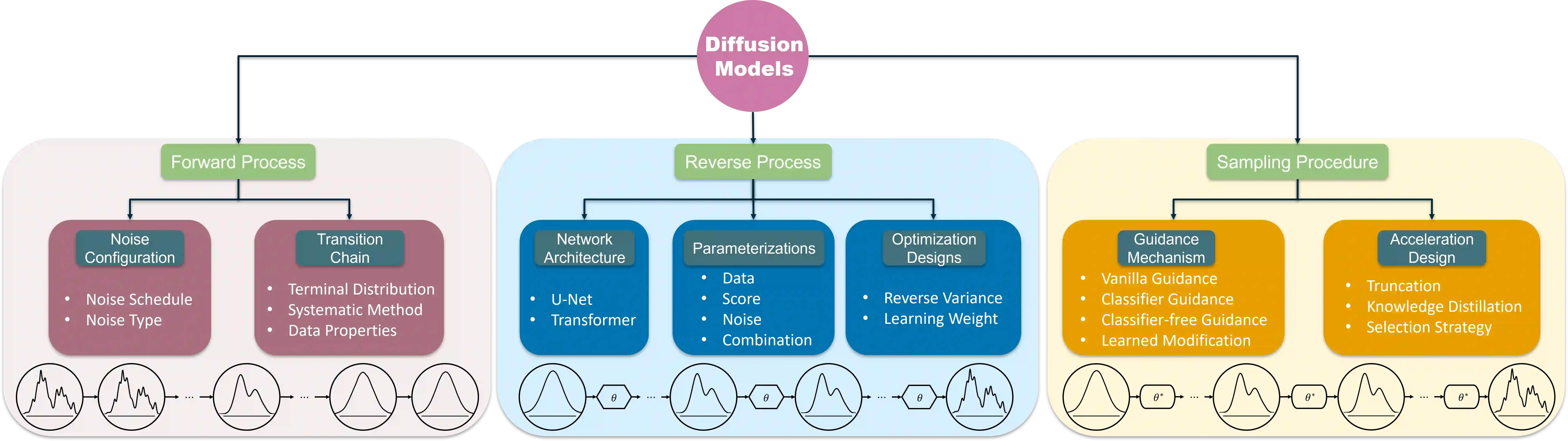
Diffusion models are generative models, which gradually add and remove noise to learn the underlying distribution of training data for data generation. The components of diffusion models have gained significant attention with many design choices proposed. Existing reviews have primarily focused on higher-level solutions, thereby covering less on the design fundamentals of components. This study seeks to address this gap by providing a comprehensive and coherent review on component-wise design choices in diffusion models. Specifically, we organize this review according to their three key components, namely the forward process, the reverse process, and the sampling procedure. This allows us to provide a fine-grained perspective of diffusion models, benefiting future studies in the analysis of individual components, the applicability of design choices, and the implementation of diffusion models.
翻译:扩散模型是一类生成模型,通过逐步添加和移除噪声来学习训练数据的潜在分布,从而实现数据生成。近年来,扩散模型各组件的设计选择备受关注,相关方案层出不穷。现有综述主要关注高层次解决方案,对组件的设计基础探讨较少。本研究旨在弥补这一不足,对扩散模型中基于组件的设计选择进行全面且连贯的综述。具体而言,我们根据扩散模型的三个关键组件——前向过程、反向过程和采样过程——来组织本次综述。这使我们能够提供细粒度的扩散模型视角,有助于未来在组件分析、设计选择的适用性以及扩散模型的实现等方面的研究。








相关内容





 微信扫码咨询专知VIP会员