

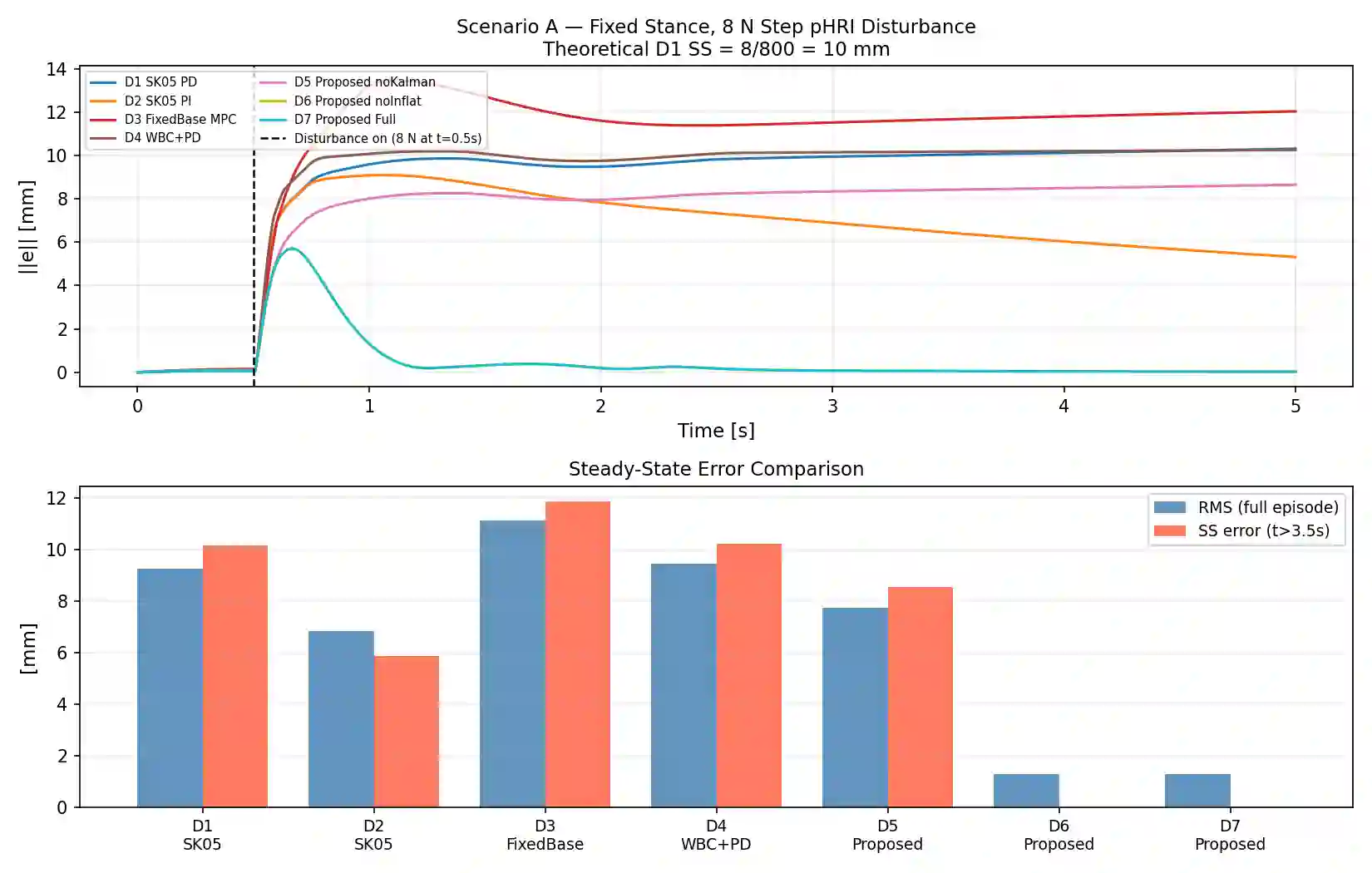
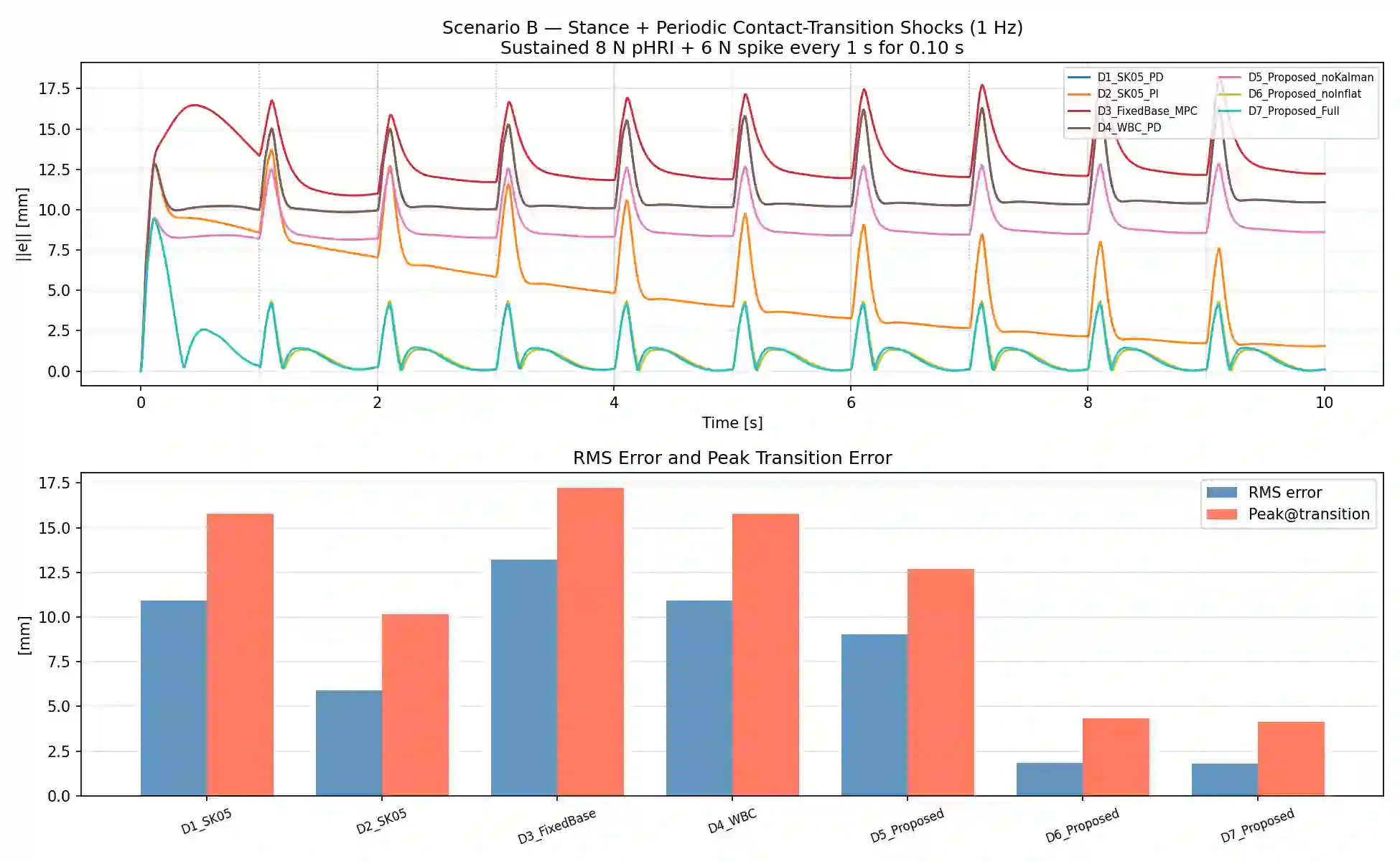
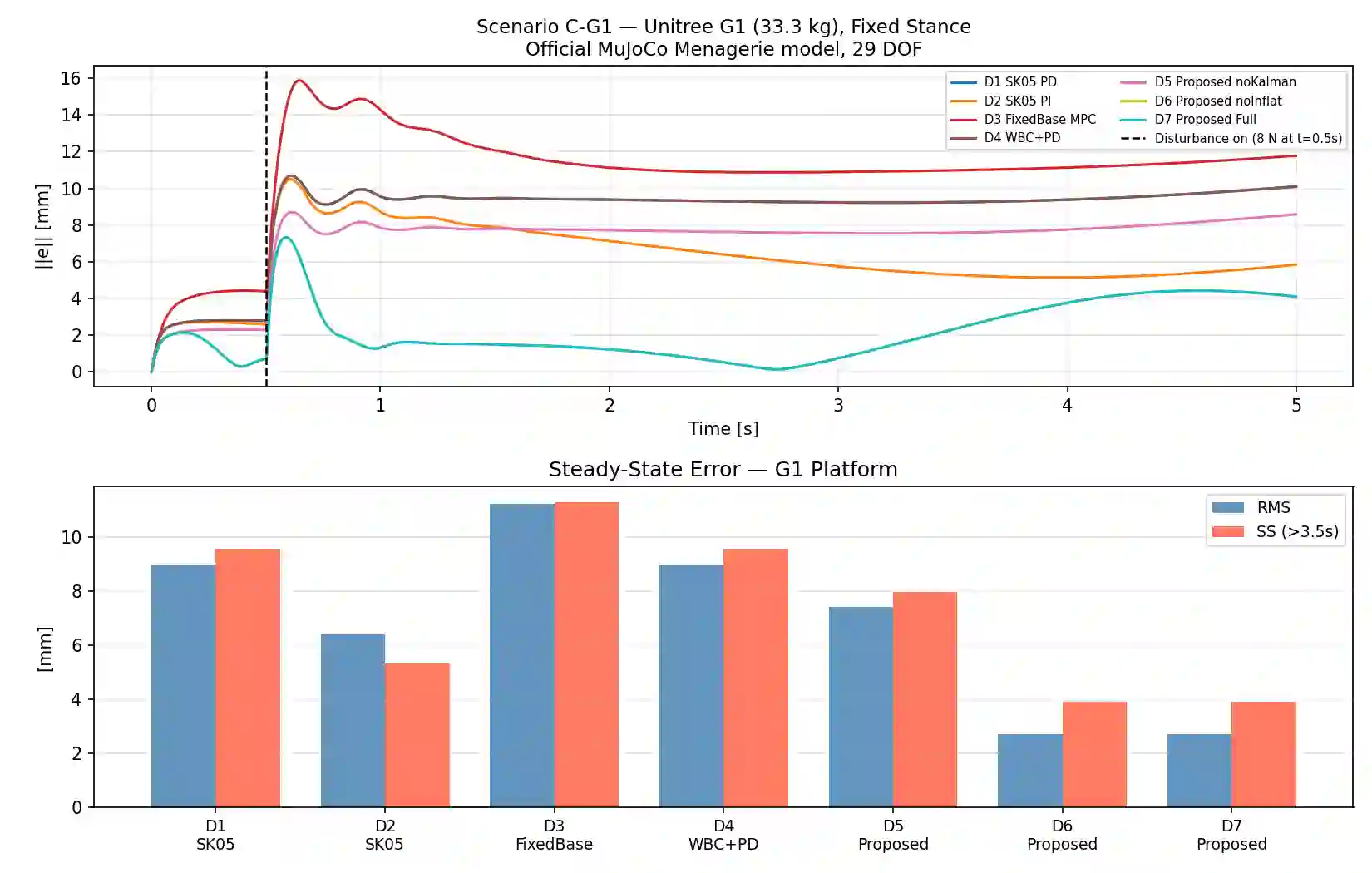
Floating-base robots must balance under rigid contact constraints while interacting safely with humans. Existing whole-body control~(WBC) frameworks allocate the full joint space to locomotion or rely on fixed-gain impedance feedback that accumulates steady-state error under sustained physical human--robot interaction~(pHRI) forces. This paper extends the authors' fixed-base two-layer Impedance MPC to floating-base platforms through a three-level architecture: a centroidal MPC plans contact forces over a 500\,ms horizon; a priority-driven WBC layer resolves balance into joint torques through contact-consistent null-space projection; and the residual null space is governed by a receding-horizon quadratic program~(QP) that predicts and rejects pHRI disturbances using a Kalman-augmented state. A contact-consistent feedback linearization reduces the arm end-effector plant to a double integrator with a \emph{constant} state matrix within each contact mode, enabling offline precomputation of the QP cost and ${\geq}1$\,kHz operation. A covariance-inflation protocol preserves the disturbance estimate across contact-mode switches, guaranteeing zero steady-state error under bounded constant pHRI loads, and an Impedance Equivalence Theorem shows the infinite-horizon limit recovers a classical task-space impedance law whose effective mass, damping, and stiffness adapt to posture and contact configuration. Simulations on a 17-DOF biped and the Unitree G1 humanoid validate the design.
翻译:浮基机器人需在刚性接触约束下保持平衡,同时与人类进行安全交互。现有全身控制框架将全部关节空间用于运动控制,或依赖固定增益阻抗反馈,在持续人机物理交互力作用下会产生稳态误差。本文通过三层架构将作者先前提出的固定基座双层阻抗MPC扩展至浮基平台:质心MPC在500毫秒时域内规划接触力;优先级驱动全身控制层通过接触一致零空间投影将平衡解算为关节力矩;剩余零空间则由递推二次规划管理,该QP利用卡尔曼增强状态预测并抑制人机物理交互扰动。基于接触一致的反馈线性化将机械臂末端执行器模型降阶为双积分器,各接触模式下状态矩阵保持恒定,从而支持QP代价函数的离线预计算与≥1千赫兹运行。通过协方差膨胀协议在接触模式切换时维持扰动估计,确保在有限恒定人机物理交互载荷下实现零稳态误差;同时阻抗等价定理证明无限时域极限可恢复经典任务空间阻抗规律,其等效质量、阻尼和刚度随姿态与接触构型自适应调整。在17自由度双足机器人与Unitree G1人形机器人上的仿真验证了该方案的有效性。




相关内容


 微信扫码咨询专知VIP会员