

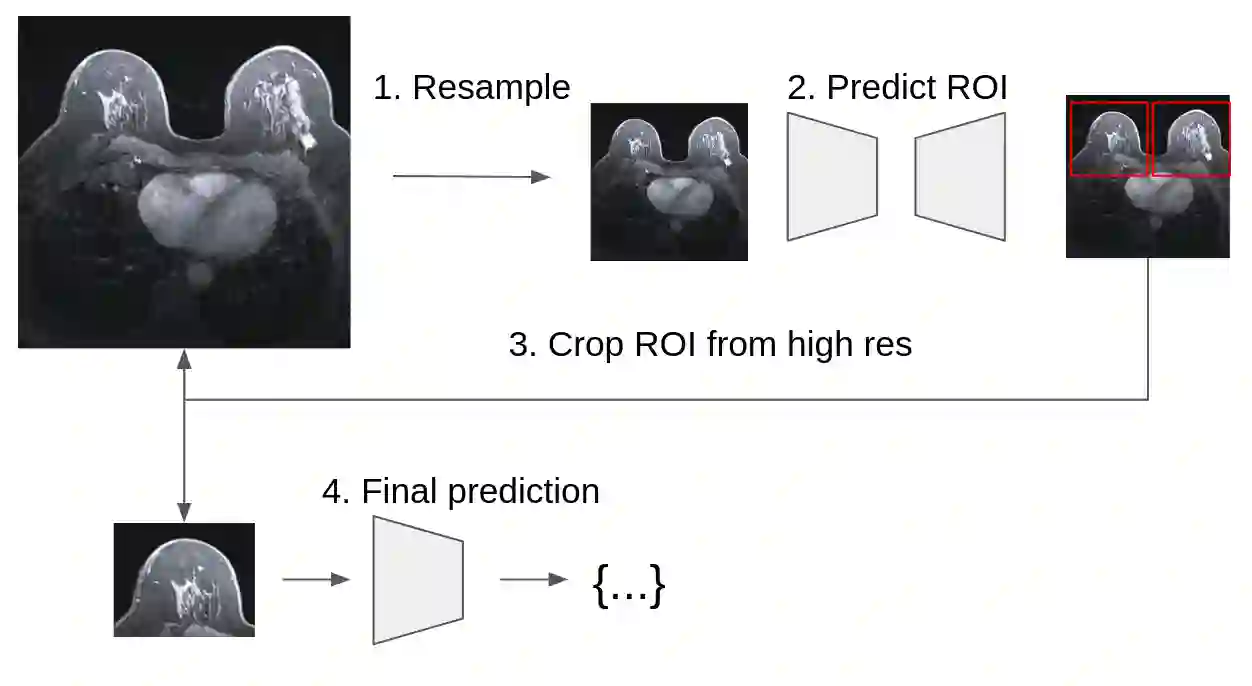
The ODELIA Breast MRI Challenge 2025 addresses a critical issue in breast cancer screening: improving early detection through more efficient and accurate interpretation of breast MRI scans. Even though methods for general-purpose whole-body lesion segmentation as well as multi-time-point analysis exist, breast cancer detection remains highly challenging, largely due to the limited availability of high-quality segmentation labels. Therefore, developing robust classification-based approaches is crucial for the future of early breast cancer detection, particularly in applications such as large-scale screening. In this write-up, we provide a comprehensive overview of our approach to the challenge. We begin by detailing the underlying concept and foundational assumptions that guided our work. We then describe the iterative development process, highlighting the key stages of experimentation, evaluation, and refinement that shaped the evolution of our solution. Finally, we present the reasoning and evidence that informed the design choices behind our final submission, with a focus on performance, robustness, and clinical relevance. We release our full implementation publicly at https://github.com/MIC-DKFZ/MeisenMeister
翻译:ODELIA 2025 乳腺磁共振成像挑战赛聚焦于乳腺癌筛查中的一个关键问题:通过更高效、更准确地解读乳腺磁共振成像扫描来提升早期检测水平。尽管目前存在用于通用全身病灶分割以及多时间点分析的方法,但乳腺癌检测仍然极具挑战性,这主要归因于高质量分割标签的有限可用性。因此,开发基于分类的稳健方法对于乳腺癌早期检测的未来至关重要,尤其是在大规模筛查等应用中。本文中,我们对参与该挑战赛的方法进行了全面概述。我们首先详细阐述了指导我们工作的基本概念和基础假设。随后,我们描述了迭代开发过程,重点介绍了实验、评估与优化等关键阶段,这些阶段塑造了我们解决方案的演进路径。最后,我们阐述了支撑最终提交方案设计选择的推理与证据,重点关注性能、鲁棒性及临床相关性。我们的完整实现已公开发布于 https://github.com/MIC-DKFZ/MeisenMeister。




相关内容



 微信扫码咨询专知VIP会员