

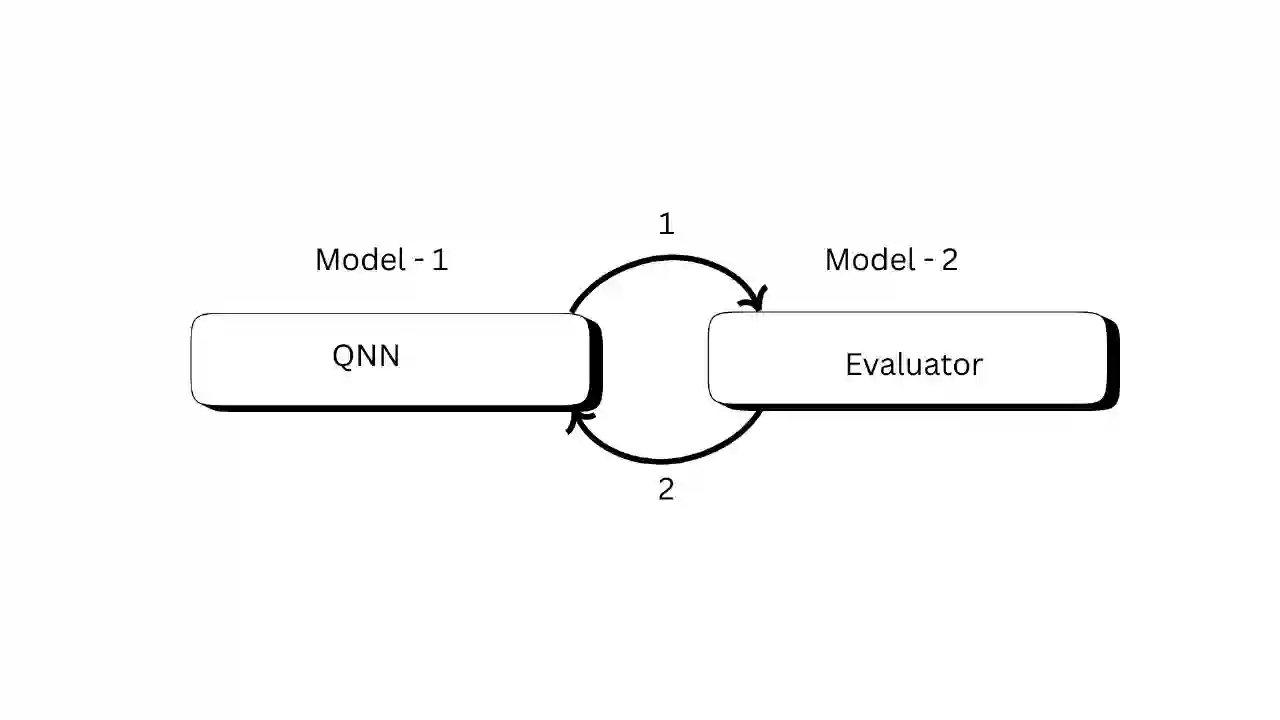
Current quantum machine learning approaches often face challenges balancing predictive accuracy, robustness, and interpretability. To address this, we propose a novel quantum adversarial framework that integrates a hybrid quantum neural network (QNN) with classical deep learning layers, guided by an evaluator model with LIME-based interpretability, and extended through quantum GAN and self-supervised variants. In the proposed model, an adversarial evaluator concurrently guides the QNN by computing feedback loss, thereby optimizing both prediction accuracy and model explainability. Empirical evaluations show that the Vanilla model achieves RMSE = 0.27, MSE = 0.071, MAE = 0.21, and R^2 = 0.59, delivering the most consistent performance across regression metrics compared to adversarial counterparts. These results demonstrate the potential of combining quantum-inspired methods with classical architectures to develop lightweight, high-performance, and interpretable predictive models, advancing the applicability of QML beyond current limitations.
翻译:当前的量子机器学习方法常在预测准确性、鲁棒性和可解释性之间面临平衡挑战。为此,我们提出了一种新型量子对抗框架,该框架将混合量子神经网络(QNN)与经典深度学习层相结合,并辅以基于LIME的可解释性评估模型指导,同时通过量子生成对抗网络(GAN)和自监督变体进行扩展。在所提模型中,对抗性评估器通过计算反馈损失同时指导QNN,从而优化预测准确性和模型可解释性。实证评估表明,基础模型实现了RMSE = 0.27、MSE = 0.071、MAE = 0.21和R^2 = 0.59,相较于对抗性变体,在回归指标上展现出最一致的性能。这些结果证明了将量子启发方法与经典架构相结合以开发轻量级、高性能且可解释的预测模型的潜力,推动了量子机器学习超越当前局限的适用性。




相关内容





 微信扫码咨询专知VIP会员