

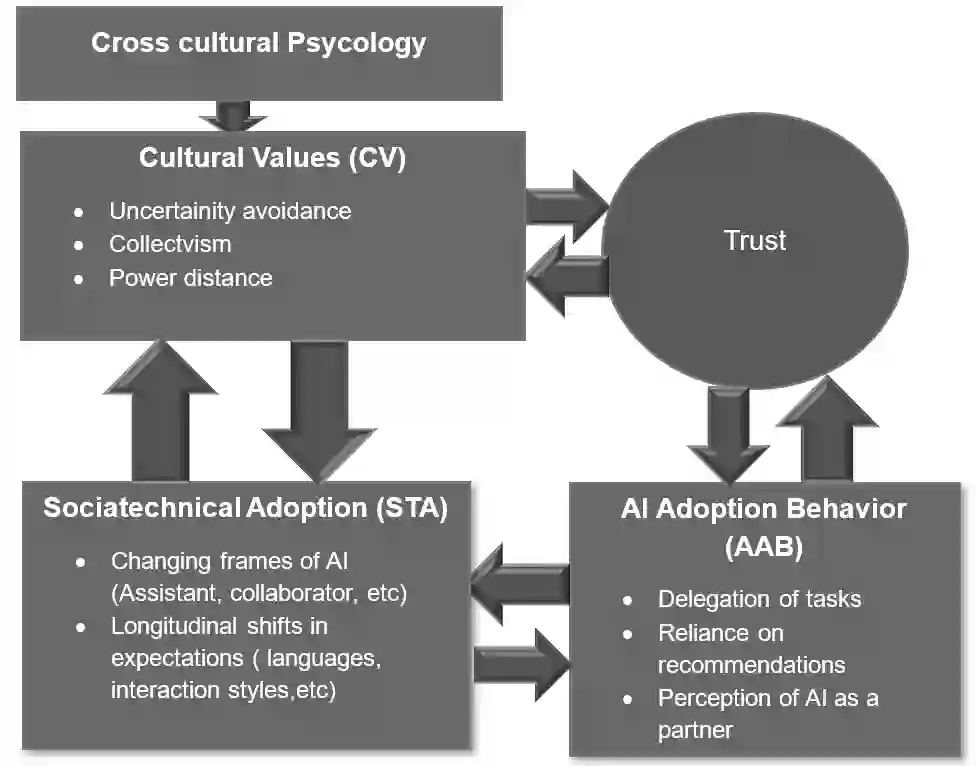
The swift diffusion of artificial intelligence (AI) raises critical questions about how cultural contexts shape adoption patterns and their consequences for human daily life. This study investigates the cultural dimensions of AI adoption and their influence on cognitive strategies across nine national contexts in Europe, Africa, Asia, and South America. Drawing on survey data from a diverse pilot sample (n = 21) and guided by cross-cultural psychology, digital ethics, and sociotechnical systems theory, we examine how demographic variables (age, gender, professional role) and cultural orientations (language, values, and institutional exposure) mediate perceptions of trust, ethical acceptability, and reliance on AI. Results reveal two key findings: First, cultural factors, particularly language and age, significantly affect AI adoption and perceptions of reliability with older participants reporting higher engagement with AI for educational purposes. Second, ethical judgment about AI use varied across domains, with professional contexts normalizing its role as a pragmatic collaborator while academic settings emphasized risks of plagiarism. These findings extend prior research on culture and technology adoption by demonstrating that AI use is neither universal nor neutral but culturally contingent, domain-specific, and ethically situated. The study highlights implications for AI use in education, professional practice, and global technology policy, pointing at actions that enable usage of AI in a way that is both culturally adaptive and ethically robust.
翻译:人工智能(AI)的快速扩散引发了一个关键问题:文化背景如何塑造其采纳模式,并对人类日常生活产生何种影响。本研究探讨了AI采纳的文化维度及其对欧洲、非洲、亚洲和南美洲九个不同国家背景下认知策略的影响。基于一项多样化试点样本(n = 21)的问卷调查数据,并借鉴跨文化心理学、数字伦理和社会技术系统理论,我们考察了人口统计学变量(年龄、性别、职业角色)和文化取向(语言、价值观及制度接触)如何中介对AI的信任感、伦理可接受性及依赖程度的认知。研究结果揭示了两项关键发现:首先,文化因素,特别是语言和年龄,显著影响AI的采纳及其可靠性感知,其中年长参与者报告了在教育目的上更高的AI使用参与度。其次,关于AI使用的伦理判断在不同领域存在差异,职业环境倾向于将其视为实用的合作者而加以常态化,而学术环境则更强调其可能带来的抄袭风险。这些发现拓展了先前关于文化与技术采纳的研究,表明AI的使用既非普适也非中立,而是具有文化依赖性、领域特定性及伦理情境性。本研究强调了AI在教育、专业实践及全球技术政策中的应用意义,并指出了以文化适应性强且伦理稳健的方式推动AI使用的可行路径。




相关内容





 微信扫码咨询专知VIP会员