

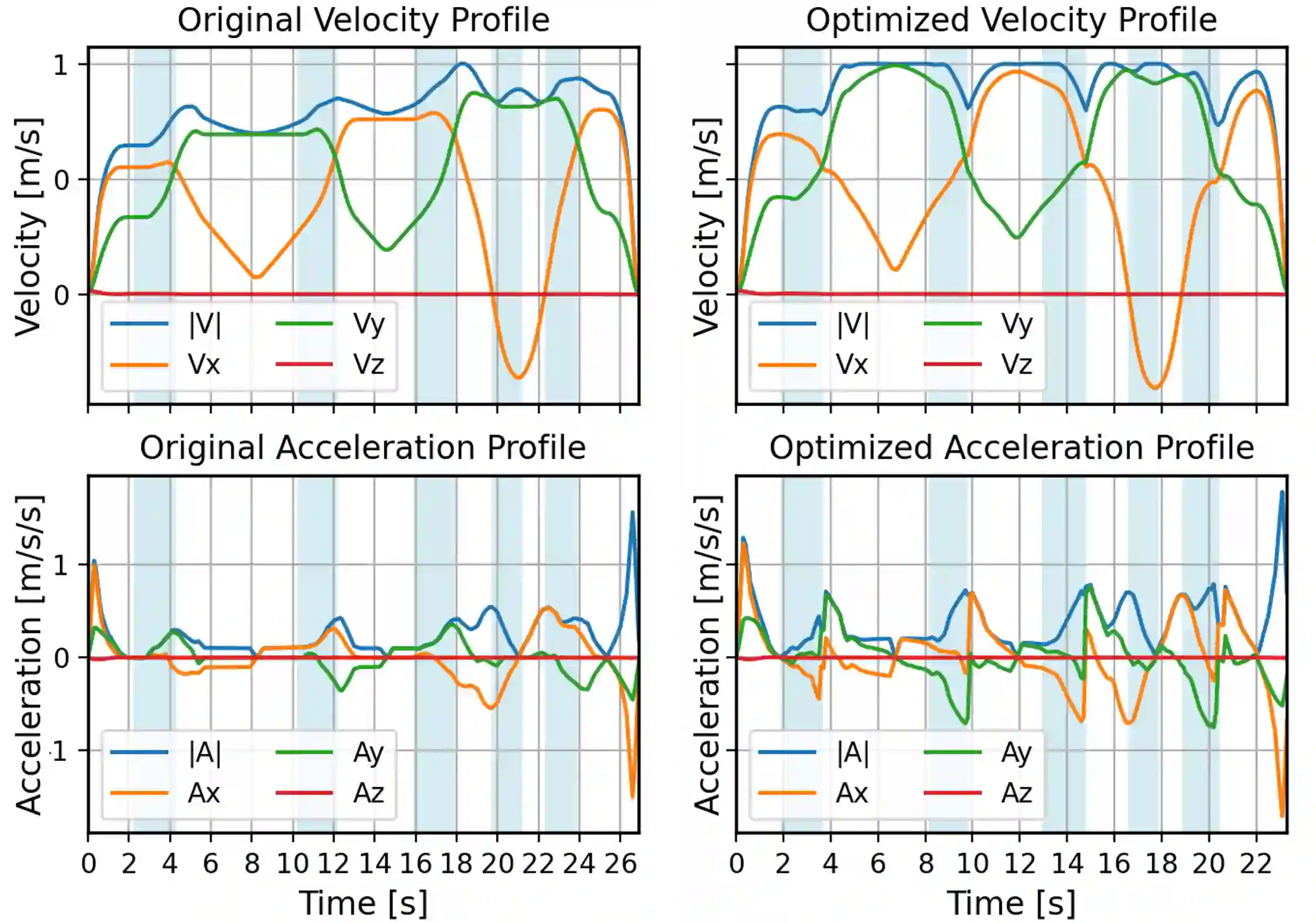
Autonomous navigation requires robots to generate trajectories for collision avoidance efficiently. Although plenty of previous works have proven successful in generating smooth and spatially collision-free trajectories, their solutions often suffer from suboptimal time efficiency and potential unsafety, particularly when accounting for uncertainties in robot perception and control. To address this issue, this paper presents the Robust Optimal Time Allocation (ROTA) framework. This framework is designed to optimize the time progress of the trajectories temporally, serving as a post-processing tool to enhance trajectory time efficiency and safety under uncertainties. In this study, we begin by formulating a non-convex optimization problem aimed at minimizing trajectory execution time while incorporating constraints on collision probability as the robot approaches obstacles. Subsequently, we introduce the concept of the trajectory braking zone and adopt the chance-constrained formulation for robust collision avoidance in the braking zones. Finally, the non-convex optimization problem is reformulated into a second-order cone programming problem to achieve real-time performance. Through simulations and physical flight experiments, we demonstrate that the proposed approach effectively reduces trajectory execution time while enabling robust collision avoidance in complex environments.
翻译:自主导航要求机器人高效生成避碰轨迹。尽管现有大量研究已能成功生成平滑且空间无碰撞的轨迹,但其解决方案往往存在时间效率次优及潜在安全问题,特别是在考虑机器人感知与控制的不确定性时尤为突出。针对这一难题,本文提出鲁棒最优时间分配(ROTA)框架。该框架旨在从时间维度优化轨迹进度,作为后处理工具提升不确定条件下轨迹的时间效率与安全性。本研究首先构建了一个非凸优化问题,以最小化轨迹执行时间为目标,同时引入机器人接近障碍物时的碰撞概率约束。随后,本文提出轨迹制动区概念,并在制动区内采用机会约束规划实现鲁棒碰撞规避。最终将非凸优化问题转化为二阶锥规划问题以实现实时性能。通过仿真实验与实物飞行验证,本方法在复杂环境中既能有效缩短轨迹执行时间,又能实现鲁棒的碰撞规避能力。




相关内容



 微信扫码咨询专知VIP会员