

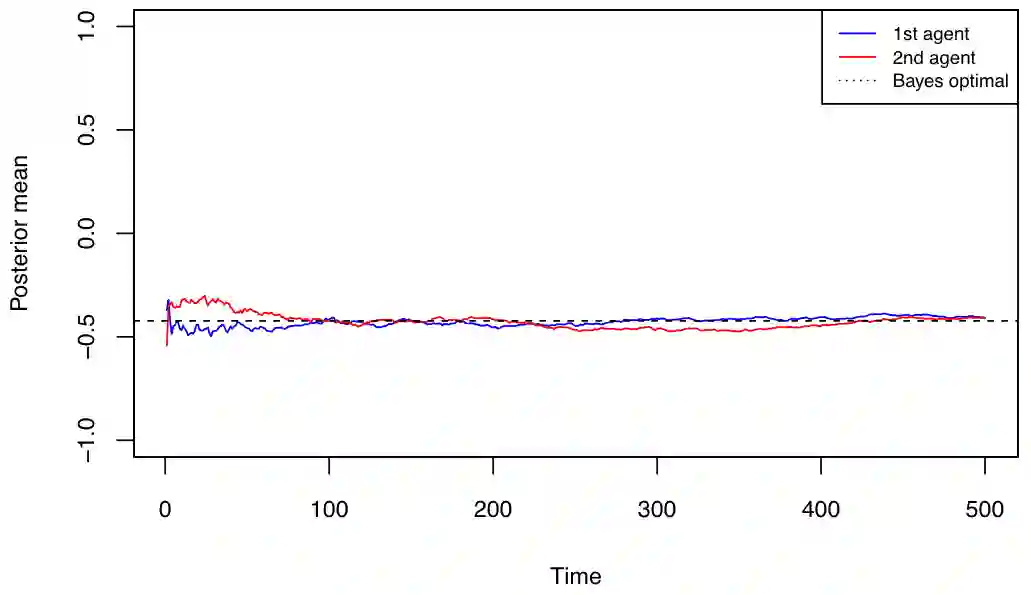
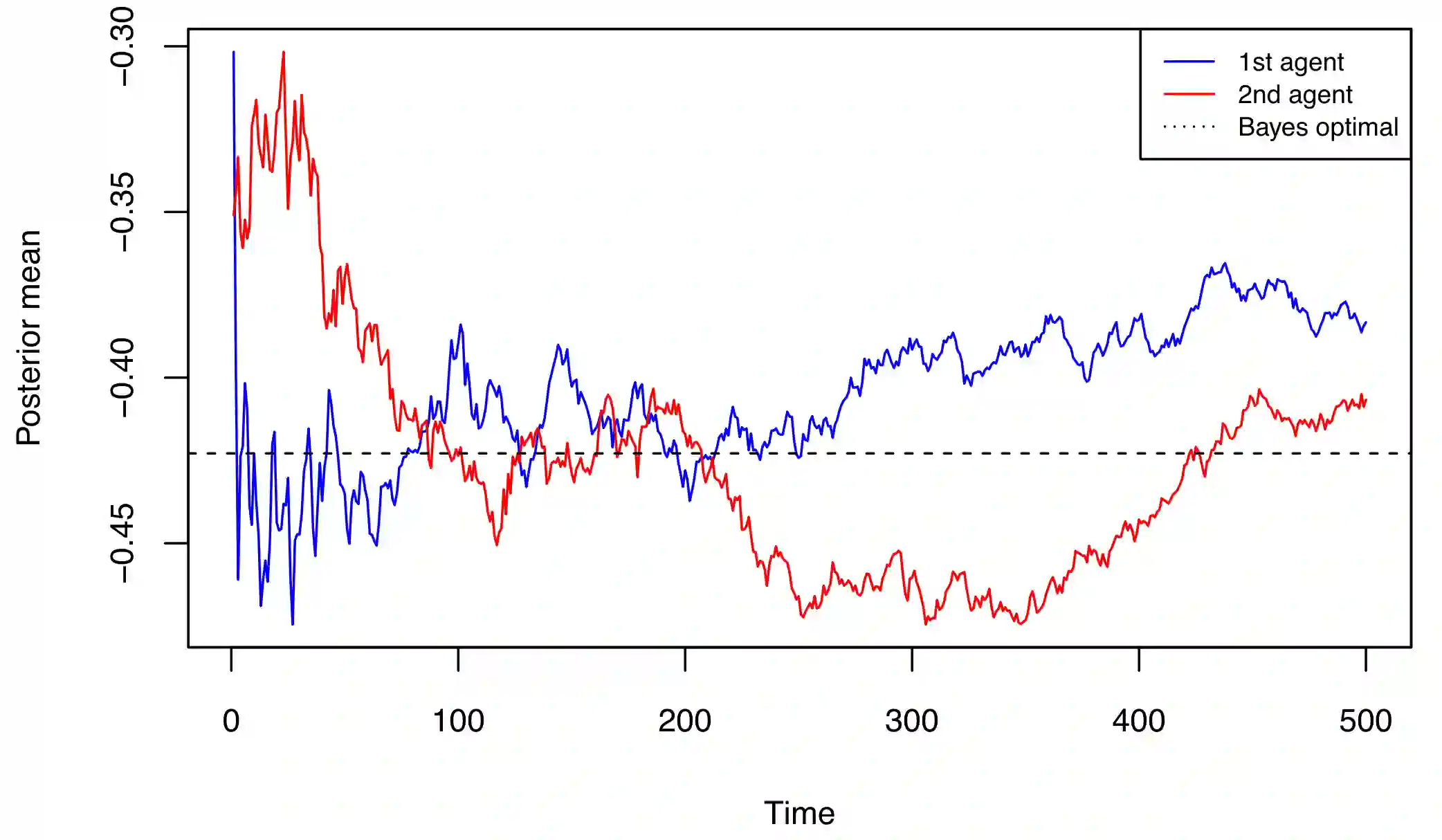
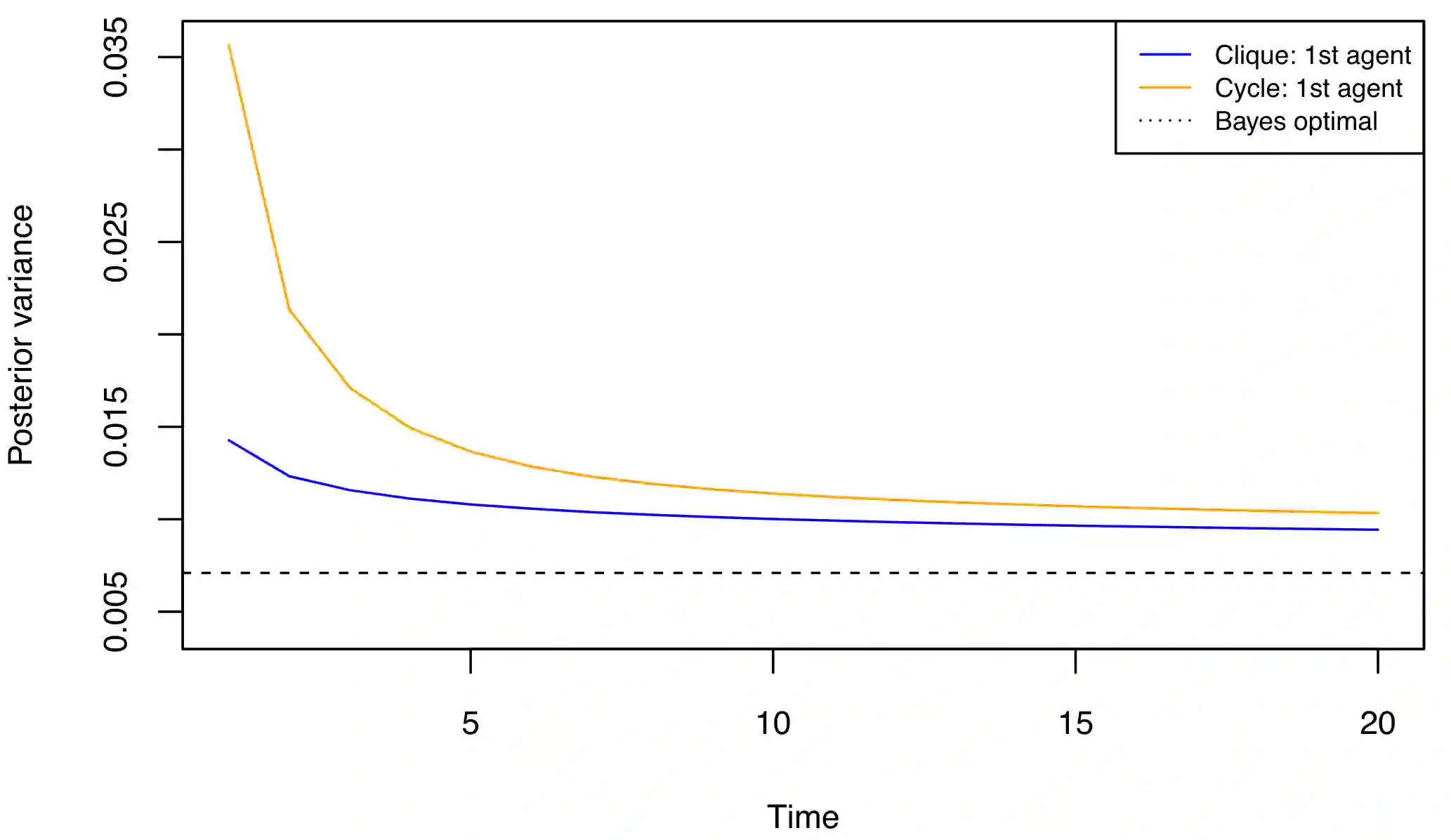
Bayesian models of group learning are studied in Economics since the 1970s. and more recently in computational linguistics. The models from Economics postulate that agents maximize utility in their communication and actions. The Economics models do not explain the ``probability matching" phenomena that are observed in many experimental studies. To address these observations, Bayesian models that do not formally fit into the economic utility maximization framework were introduced. In these models individuals sample from their posteriors in communication. In this work we study the asymptotic behavior of such models on connected networks with repeated communication. Perhaps surprisingly, despite the fact that individual agents are not utility maximizers in the classical sense, we establish that the individuals ultimately agree and furthermore show that the limiting posterior is Bayes optimal. We explore the interpretation of our results in terms of Large Language Models (LLMs). In the positive direction our results can be interpreted as stating that interaction between different LLMs can lead to optimal learning. However, we provide an example showing how misspecification may lead LLM agents to be overconfident in their estimates.
翻译:自20世纪70年代以来,经济学界就开始研究群体学习的贝叶斯模型,近年来计算语言学领域也对此展开探讨。经济学模型假定智能体在沟通和行动中追求效用最大化,但这类模型无法解释许多实验研究中观察到的"概率匹配"现象。为解释这些现象,研究者引入了形式上不符合经济学效用最大化框架的贝叶斯模型——在这些模型中,个体在沟通过程中会从其后验分布中抽样。本研究分析此类模型在具有重复沟通的连通网络中的渐近行为。令人意外的是,尽管单个智能体并非经典意义上的效用最大化者,我们仍证明了个体最终会达成一致,并进一步证明其极限后验分布具有贝叶斯最优性。我们探讨了该结果在大语言模型(LLMs)领域的解释意义。从积极方面看,该结果可解释为不同大语言模型之间的交互能够实现最优学习;但我们也通过示例表明,模型设定错误可能导致大语言模型智能体对其估计结果产生过度自信。




相关内容



 微信扫码咨询专知VIP会员