

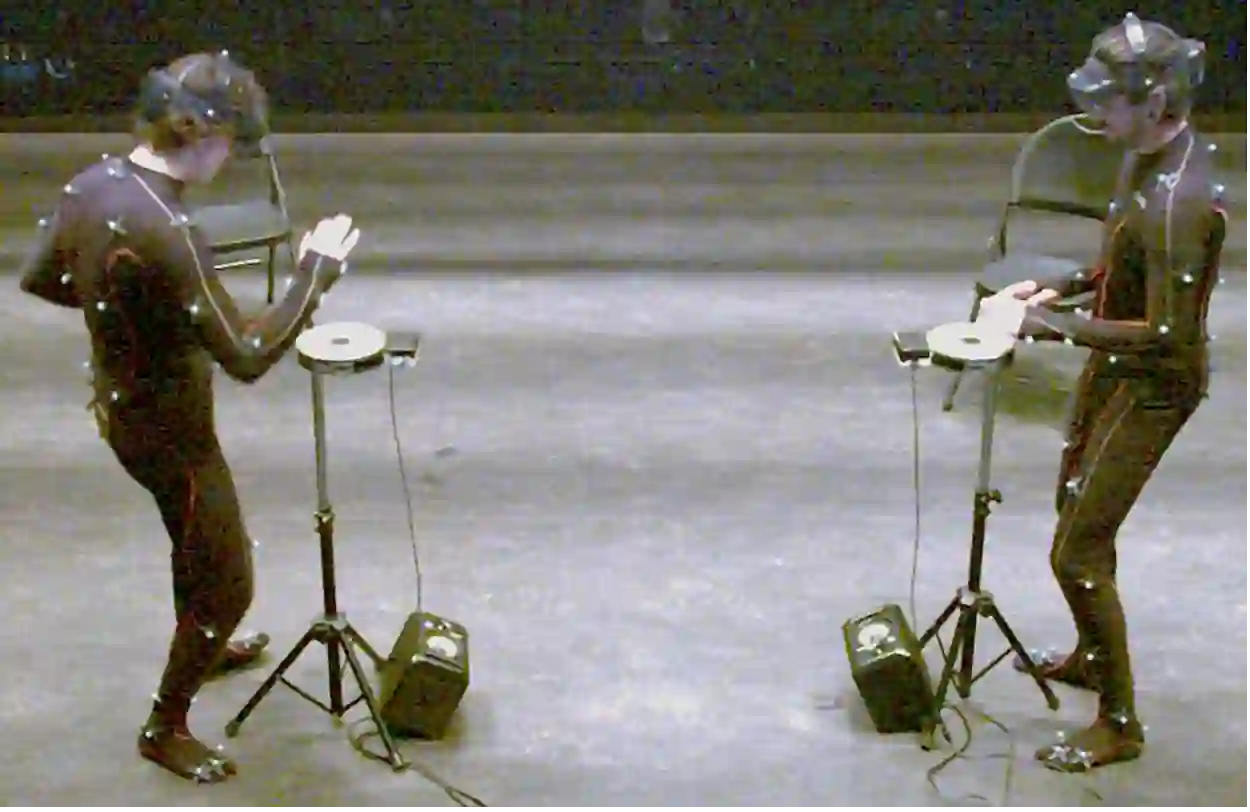
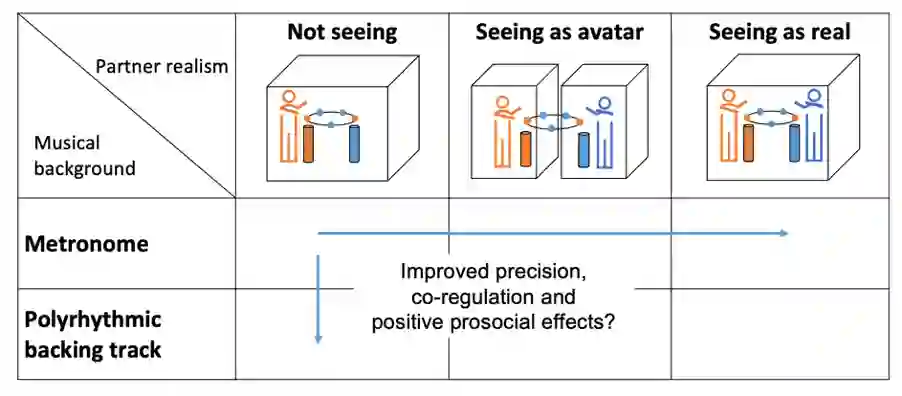
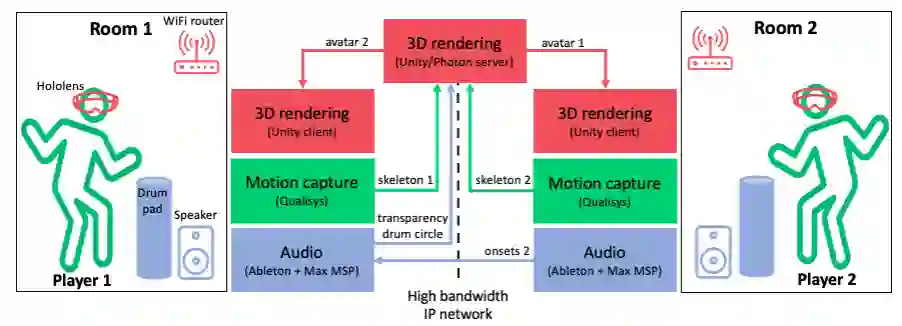
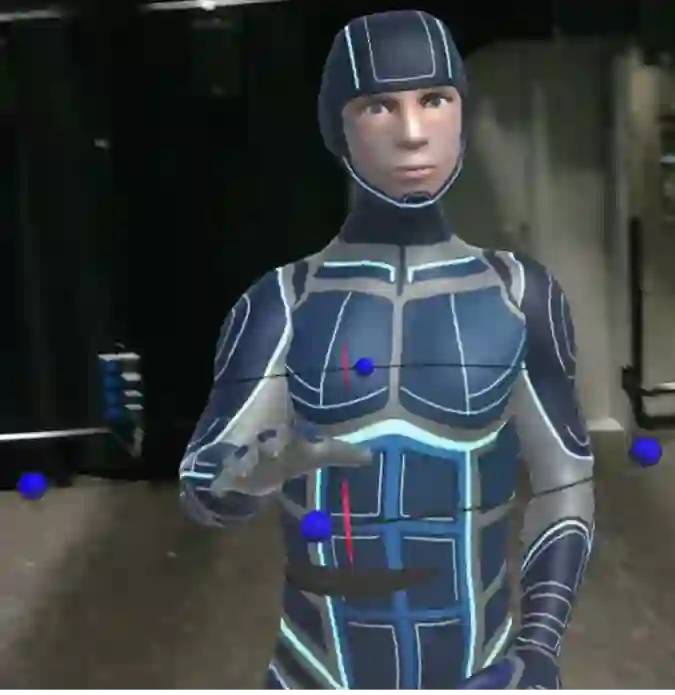
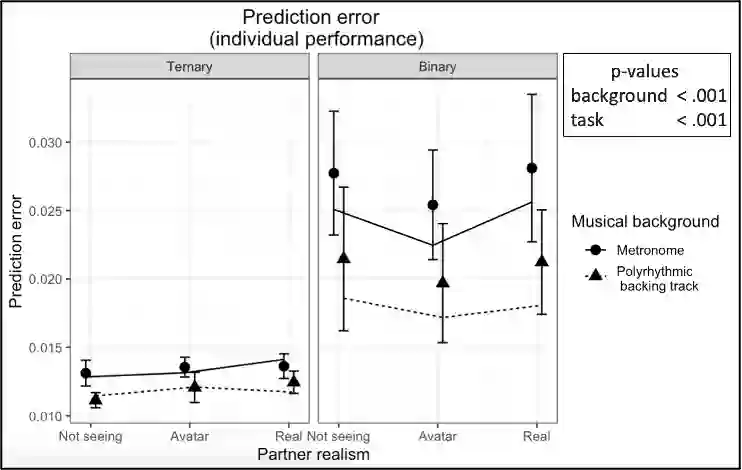
Emerging technologies in the domain of extended reality offer rich, new possibilities for the study and practice of joint music performance. Apart from the technological challenges, bringing music players together in extended reality raises important questions on their performance and embodied coordination. In this study, we designed an extended reality platform to assess a remote, bidirectional polyrhythmic interaction between two players, mediated in real time by their three-dimensional embodied avatars and a shared, virtual drum circle. We leveraged a multi-layered analysis framework to assess their performance quality, embodied co-regulation and first-person interaction experience, using statistical techniques for time-series analysis and mixed-effect regression and focusing on contrasts of visual coupling (not seeing / seeing as avatars / seeing as real) and auditory context (metronome / music). Results reveal that an auditory context with music improved the performance output as measured by a prediction error, increased movement energy and levels of experienced agency. Visual coupling impacted experiential qualities and induced prosocial effects with increased levels of partner realism resulting in increased levels of shared agency and self-other merging. Embodied co-regulation between players was impacted by auditory context, visual coupling, and task complexity, suggesting prediction-based compensatory mechanisms to deal with the novelty, difficulty, and expressivity in the musical interaction. This study contributes to the understanding of music performance in extended reality by using a methodological approach to demonstrate how co-regulation between players is impacted by visual coupling and auditory context and provides a basis and future directions for further action-oriented research.
翻译:扩展现实领域的新兴技术为联合音乐表演的研究与实践提供了丰富的新可能性。除技术挑战外,将音乐演奏者聚集于扩展现实环境中还引发了关于其表演表现与具身协调的重要问题。本研究设计了一个扩展现实平台,用以评估两名演奏者之间远程、双向的多节奏交互,该交互通过双方的三维具身虚拟化身及共享虚拟鼓圈实现实时中介。我们采用多层次分析框架,运用时间序列分析与混合效应回归的统计技术,聚焦视觉耦合(不可见/以虚拟化身形式可见/以真实形象可见)与听觉情境(节拍器/音乐)的对比,评估其表演质量、具身协同调节及第一人称交互体验。结果表明:包含音乐的听觉情境通过预测误差的测量改善了表演输出,提升了动作能量与能动感体验水平;视觉耦合影响了体验质量并诱导出亲社会效应——随着伙伴真实感提升,共享能动感与自我-他人融合程度显著增强。演奏者间的具身协同调节受听觉情境、视觉耦合及任务复杂性的共同影响,提示存在基于预测的补偿机制以应对音乐交互中的新颖性、难度与表现力需求。本研究通过方法论途径实证了视觉耦合与听觉情境对演奏者间协同调节的影响机制,为扩展现实中的音乐表演理解作出贡献,并为后续面向行动的研究提供了基础与未来方向。




相关内容



 微信扫码咨询专知VIP会员