

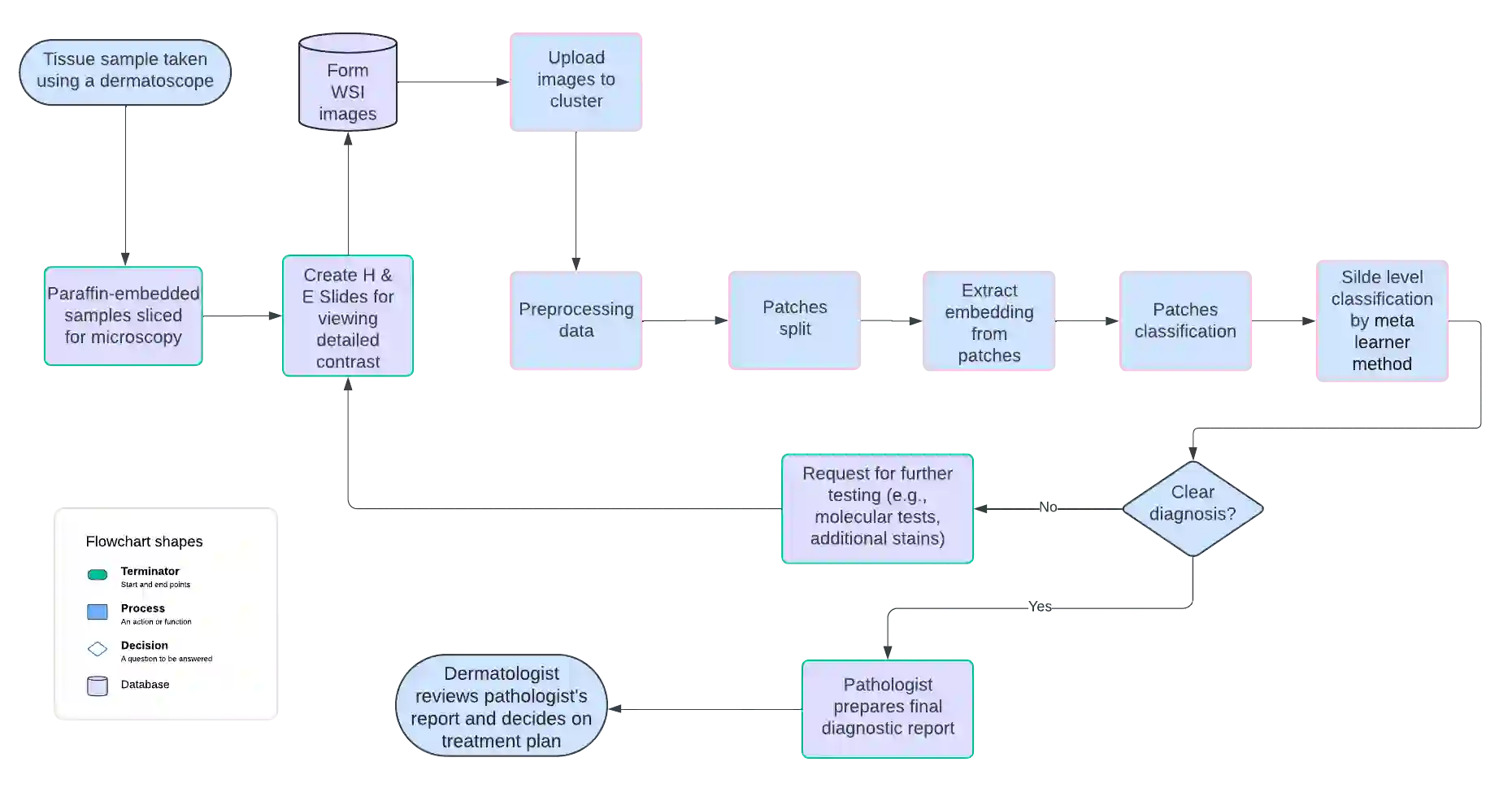
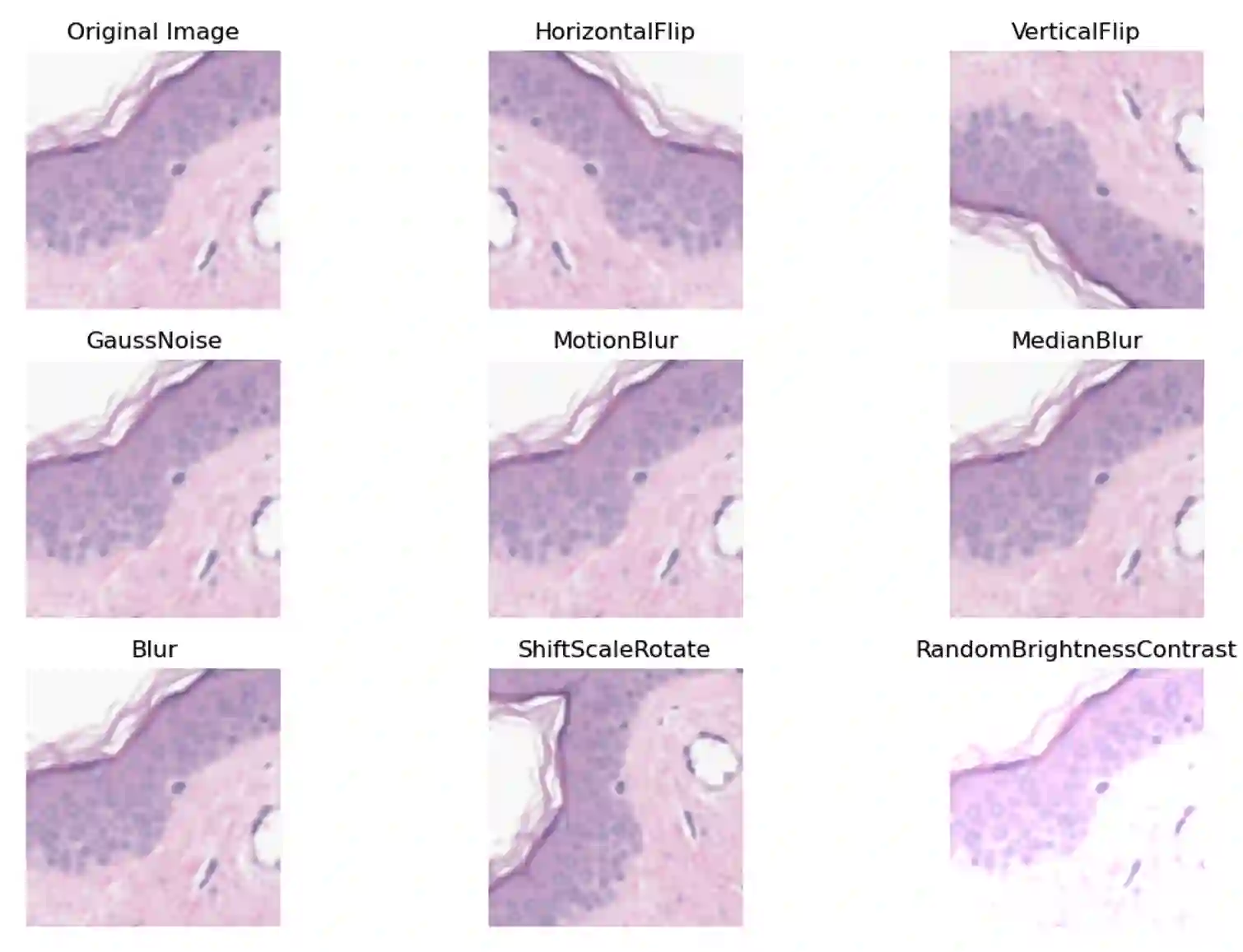
The rapid generation of whole-slide images (WSIs) in dermatopathology necessitates automated methods for efficient processing and accurate classification. This study evaluates the performance of two foundation models, UNI and Virchow2, as feature extractors for classifying WSIs into three diagnostic categories: melanocytic, basaloid, and squamous lesions. Patch-level embeddings were aggregated into slide-level features using a mean-aggregation strategy and subsequently used to train multiple machine learning classifiers, including logistic regression, gradient-boosted trees, and random forest models. Performance was assessed using precision, recall, true positive rate, false positive rate, and the area under the receiver operating characteristic curve (AUROC) on the test set. Results demonstrate that patch-level features extracted using Virchow2 outperformed those extracted via UNI across most slide-level classifiers, with logistic regression achieving the highest accuracy (90%) for Virchow2, though the difference was not statistically significant. The study also explored data augmentation techniques and image normalization to enhance model robustness and generalizability. The mean-aggregation approach provided reliable slide-level feature representations. All experimental results and metrics were tracked and visualized using WandB.ai, facilitating reproducibility and interpretability. This research highlights the potential of foundation models for automated WSI classification, providing a scalable and effective approach for dermatopathological diagnosis while paving the way for future advancements in slide-level representation learning.
翻译:皮肤病理学中全切片图像(WSI)的快速生成需要自动化方法以实现高效处理和精准分类。本研究评估了两种基础模型(UNI和Virchow2)作为特征提取器,将WSI分类为三种诊断类别(黑素细胞性病变、基底细胞样病变和鳞状病变)的性能。通过均值聚合策略将切片级嵌入特征聚合成玻片级特征,随后用于训练多种机器学习分类器,包括逻辑回归、梯度提升树和随机森林模型。在测试集上使用精确率、召回率、真阳性率、假阳性率及受试者工作特征曲线下面积(AUROC)评估性能。结果表明,在大多数玻片级分类器中,使用Virchow2提取的切片级特征优于通过UNI提取的特征,其中逻辑回归在Virchow2上达到最高准确率(90%),但差异无统计学显著性。本研究还探索了数据增强技术和图像归一化方法以提升模型的鲁棒性和泛化能力。均值聚合策略提供了可靠的玻片级特征表示。所有实验结果和指标均通过WandB.ai进行跟踪和可视化,确保了结果的可复现性和可解释性。本研究凸显了基础模型在自动化WSI分类中的潜力,为皮肤病理学诊断提供了可扩展且高效的解决方案,同时为玻片级表征学习的未来发展奠定了基础。




相关内容




 微信扫码咨询专知VIP会员