

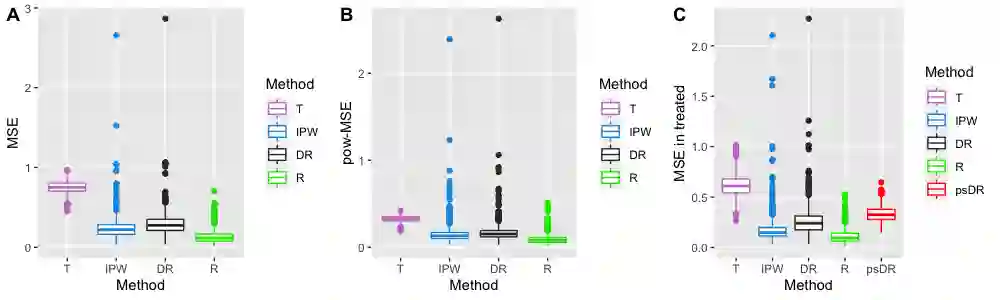
Motivated by applications in personalized medicine and individualized policy making, there is a growing interest in techniques for quantifying treatment effect heterogeneity in terms of the conditional average treatment effect (CATE). Some of the most prominent methods for CATE estimation developed in recent years are T-Learner, DR-Learner and R-Learner. The latter two were designed to improve on the former by being Neyman-orthogonal. However, the relations between them remain unclear, and likewise does the literature remain vague on whether these learners converge to a useful quantity or (functional) estimand when the underlying optimization procedure is restricted to a class of functions that does not include the CATE. In this article, we provide insight into these questions by discussing DR-learner and R-learner as special cases of a general class of Neyman-orthogonal learners for the CATE, for which we moreover derive oracle bounds. Our results shed light on how one may construct Neyman-orthogonal learners with desirable properties, on when DR-learner may be preferred over R-learner (and vice versa), and on novel learners that may sometimes be preferable to either of these. Theoretical findings are confirmed using results from simulation studies on synthetic data, as well as an application in critical care medicine.
翻译:受个性化医疗和个性化政策制定应用的推动,近年来对通过条件平均治疗效应(CATE)量化治疗效应异质性的技术兴趣日益增长。近年来发展的一些最突出的CATE估计方法包括T-Learner、DR-Learner和R-Learner。后两种方法通过设计具备Neyman正交性以改进前者。然而,它们之间的关系仍不明确,当优化过程被限制在不包含CATE的函数类时,这些学习器是否收敛到有用量或(泛函)估计目标在文献中同样模糊。本文通过将DR-Learner和R-Learner作为CATE的Neyman正交学习器广义类的特例进行讨论,并为其推导出oracle界,从而为这些问题提供了见解。我们的结果揭示了如何构造具有理想性质的Neyman正交学习器,阐明了何时DR-Learner优于R-Learner(反之亦然),以及在某些情况下可能更优的新型学习器。理论发现通过合成数据的模拟研究结果以及危重症医学应用得到了验证。




相关内容


 微信扫码咨询专知VIP会员