

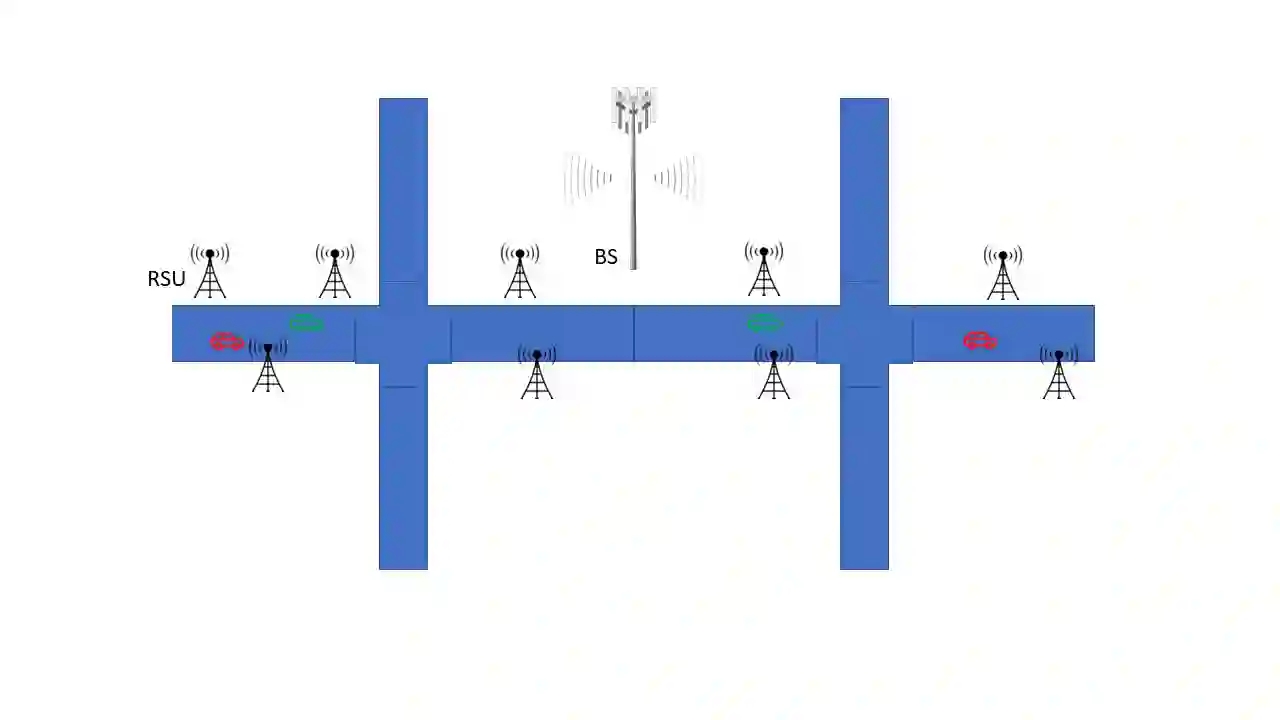
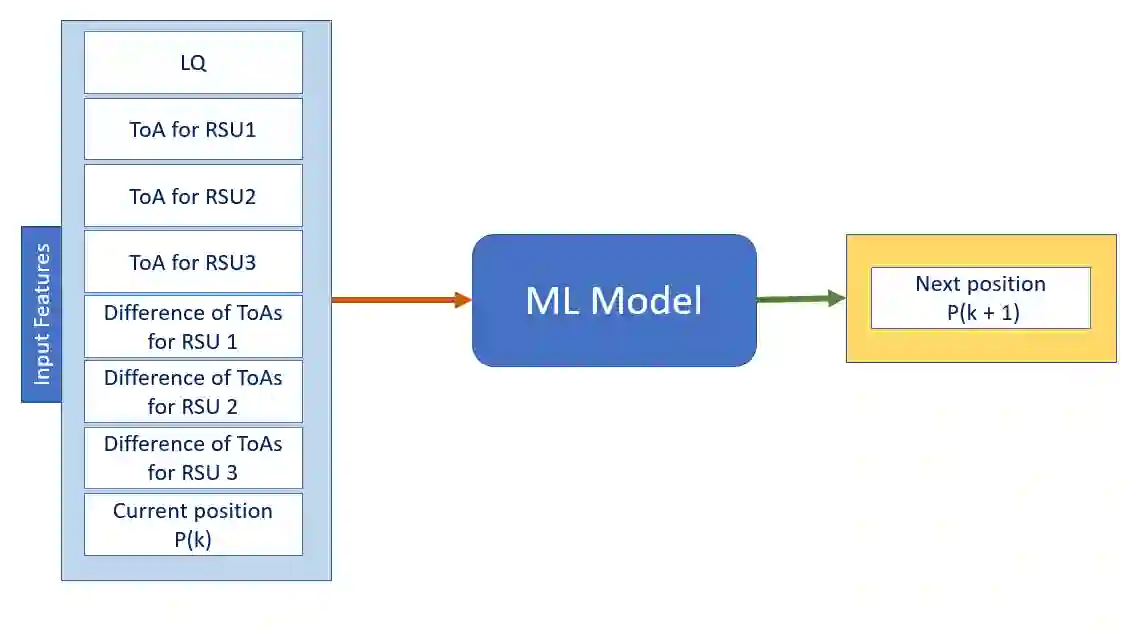
Vehicular communication networks are rapidly emerging as vehicles become smarter. However, these networks are increasingly susceptible to various attacks. The situation is exacerbated by the rise in automated vehicles complicates, emphasizing the need for security and authentication measures to ensure safe and effective traffic management. In this paper, we propose a novel hybrid physical layer security (PLS)-machine learning (ML) authentication scheme by exploiting the position of the transmitter vehicle as a device fingerprint. We use a time-of-arrival (ToA) based localization mechanism where the ToA is estimated at roadside units (RSUs), and the coordinates of the transmitter vehicle are extracted at the base station (BS).Furthermore, to track the mobility of the moving legitimate vehicle, we use ML model trained on several system parameters. We try two ML models for this purpose, i.e., support vector regression and decision tree. To evaluate our scheme, we conduct binary hypothesis testing on the estimated positions with the help of the ground truths provided by the ML model, which classifies the transmitter node as legitimate or malicious. Moreover, we consider the probability of false alarm and the probability of missed detection as performance metrics resulting from the binary hypothesis testing, and mean absolute error (MAE), mean square error (MSE), and coefficient of determination $\text{R}^2$ to further evaluate the ML models. We also compare our scheme with a baseline scheme that exploits the angle of arrival at RSUs for authentication. We observe that our proposed position-based mechanism outperforms the baseline scheme significantly in terms of missed detections.
翻译:随着车辆智能化程度不断提高,车联网通信网络正快速发展。然而,这些网络日益容易受到各类攻击的威胁。自动化车辆的兴起使情况进一步复杂化,凸显了保障交通安全高效运行所需的安全与认证措施的重要性。本文提出一种新颖的混合物理层安全(PLS)与机器学习(ML)身份认证方案,利用发送车辆的位置作为设备指纹。我们采用基于到达时间(ToA)的定位机制:由路边单元(RSU)估计ToA,并在基站(BS)提取发送车辆的坐标。此外,为追踪合法运动车辆的移动性,我们使用基于多个系统参数训练的ML模型。为此我们尝试了两种ML模型:支持向量回归和决策树。为评估方案性能,我们借助ML模型提供的真实位置信息对估计位置进行二元假设检验,从而将发送节点分类为合法或恶意节点。同时,以虚警概率和漏检概率作为二元假设检验的性能指标,并采用平均绝对误差(MAE)、均方误差(MSE)和决定系数$\text{R}^2$进一步评估ML模型。我们还将所提方案与基于RSU到达角(AoA)的基线认证方案进行对比,结果表明本文提出的基于位置的方案在漏检率方面显著优于基线方案。




相关内容



 微信扫码咨询专知VIP会员