

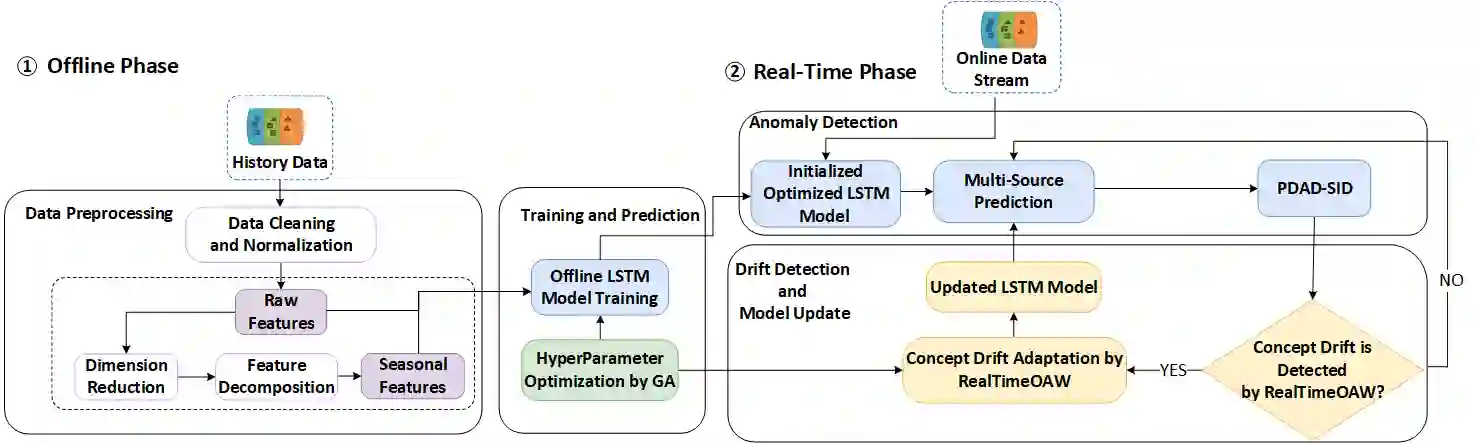
To ensure reliability and service availability, next-generation networks are expected to rely on automated anomaly detection systems powered by advanced machine learning methods with the capability of handling multi-dimensional data. Such multi-dimensional, heterogeneous data occurs mostly in today's industrial Internet of Things (IIoT), where real-time detection of anomalies is critical to prevent impending failures and resolve them in a timely manner. However, existing anomaly detection methods often fall short of effectively coping with the complexity and dynamism of multi-dimensional data streams in IIoT. In this paper, we propose an adaptive method for detecting anomalies in IIoT streaming data utilizing a multi-source prediction model and concept drift adaptation. The proposed anomaly detection algorithm merges a prediction model into a novel drift adaptation method resulting in accurate and efficient anomaly detection that exhibits improved scalability. Our trace-driven evaluations indicate that the proposed method outperforms the state-of-the-art anomaly detection methods by achieving up to an 89.71% accuracy (in terms of Area under the Curve (AUC)) while meeting the given efficiency and scalability requirements.
翻译:为确保可靠性与服务可用性,下一代网络预计将依赖由先进机器学习方法驱动的自动化异常检测系统,这些方法需具备处理多维数据的能力。此类多维异构数据主要出现在当今的工业物联网(IIoT)中,其中异常情况的实时检测对于预防即将发生的故障并及时解决至关重要。然而,现有的异常检测方法往往难以有效应对IIoT中多维数据流的复杂性与动态性。本文提出一种利用多源预测模型与概念漂移自适应的IIoT流数据异常检测方法。所提出的异常检测算法将预测模型与一种新颖的漂移自适应方法相结合,实现了准确高效的异常检测,并展现出更优的可扩展性。基于真实数据驱动的评估表明,该方法在满足既定效率与可扩展性要求的同时,以高达89.71%的准确率(基于曲线下面积(AUC)指标)优于当前最先进的异常检测方法。





相关内容



 微信扫码咨询专知VIP会员