

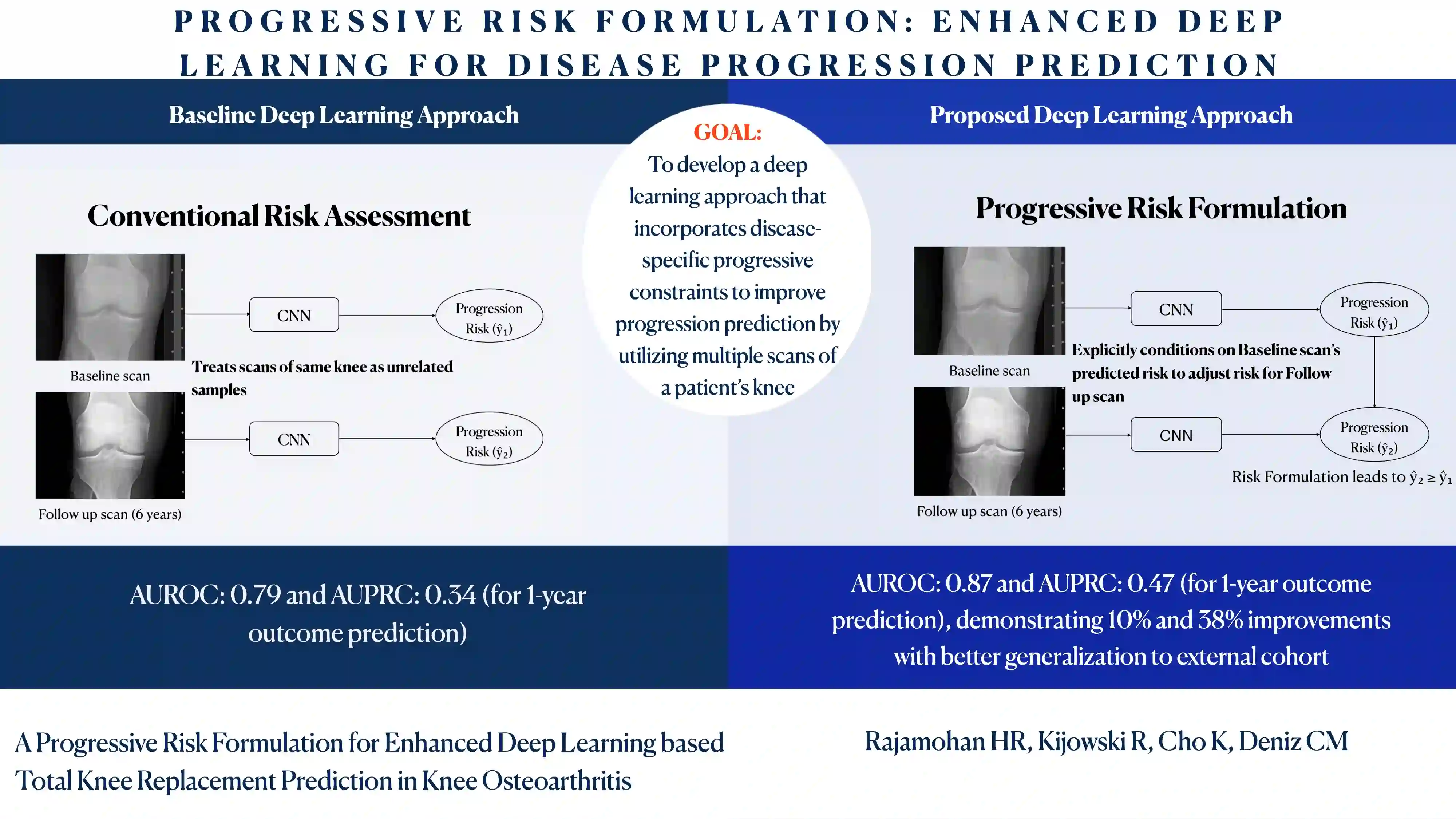
We developed deep learning models for predicting Total Knee Replacement (TKR) need within various time horizons in knee osteoarthritis patients, with a novel capability: the models can perform TKR prediction using a single scan, and furthermore when a previous scan is available, they leverage a progressive risk formulation to improve their predictions. Unlike conventional approaches that treat each scan of a patient independently, our method incorporates a constraint based on disease's progressive nature, ensuring that predicted TKR risk either increases or remains stable over time when multiple scans of a knee are available. This was achieved by enforcing a progressive risk formulation constraint during training with patients who have more than one available scan in the studies. Knee radiographs and MRIs from the Osteoarthritis Initiative (OAI) and Multicenter Osteoarthritis Study (MOST) were used in this work and deep learning models were trained to predict TKR within 1, 2, and 4-year time periods. The proposed approach, utilizing a dual-model risk constraint architecture, demonstrated superior performance compared to baseline - conventional models trained with standard binary cross entropy loss. It achieved an AUROC of 0.87 and AUPRC of 0.47 for 1-year TKR prediction on the OAI radiograph test set, considerably improving over the baseline AUROC of 0.79 and AUPRC of 0.34. For the MOST radiograph test set, the proposed approach achieved an AUROC of 0.77 and AUPRC of 0.25 for 1-year predictions, outperforming the baseline AUROC of 0.71 and AUPRC of 0.19. Similar trends were observed in the MRI testsets
翻译:我们开发了深度学习模型,用于预测膝骨关节炎患者在多个时间范围内进行全膝关节置换(TKR)的需求,该模型具备一项新颖功能:能够使用单次扫描进行TKR预测,并且在可获得既往扫描时,利用渐进风险公式来改进其预测。与将患者每次扫描独立处理的传统方法不同,我们的方法结合了基于疾病渐进性质的约束,确保在可获得膝关节多次扫描时,预测的TKR风险随时间推移要么增加,要么保持稳定。这是通过在训练中对研究中拥有超过一次可用扫描的患者施加渐进风险公式约束来实现的。本研究使用了来自骨关节炎倡议(OAI)和多中心骨关节炎研究(MOST)的膝关节X光片和MRI图像,并训练深度学习模型以预测1年、2年和4年内的TKR。所提出的方法采用双模型风险约束架构,与基线(使用标准二元交叉熵损失训练的传统模型)相比,表现出更优的性能。在OAI X光片测试集上,其1年TKR预测的AUROC达到0.87,AUPRC达到0.47,较基线AUROC 0.79和AUPRC 0.34有显著提升。在MOST X光片测试集上,该方法1年预测的AUROC为0.77,AUPRC为0.25,优于基线AUROC 0.71和AUPRC 0.19。在MRI测试集中也观察到了类似的趋势。




相关内容




 微信扫码咨询专知VIP会员