

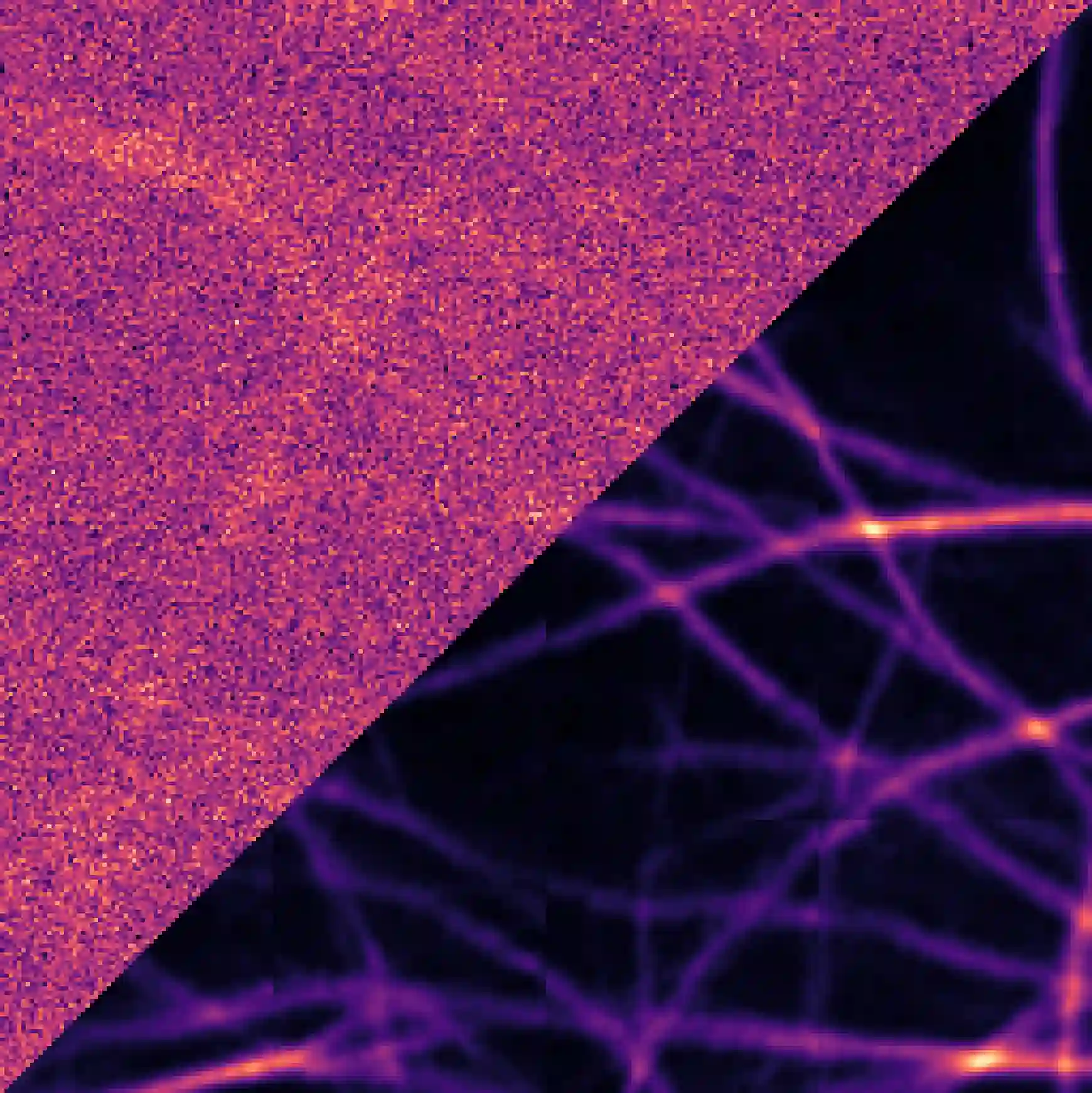
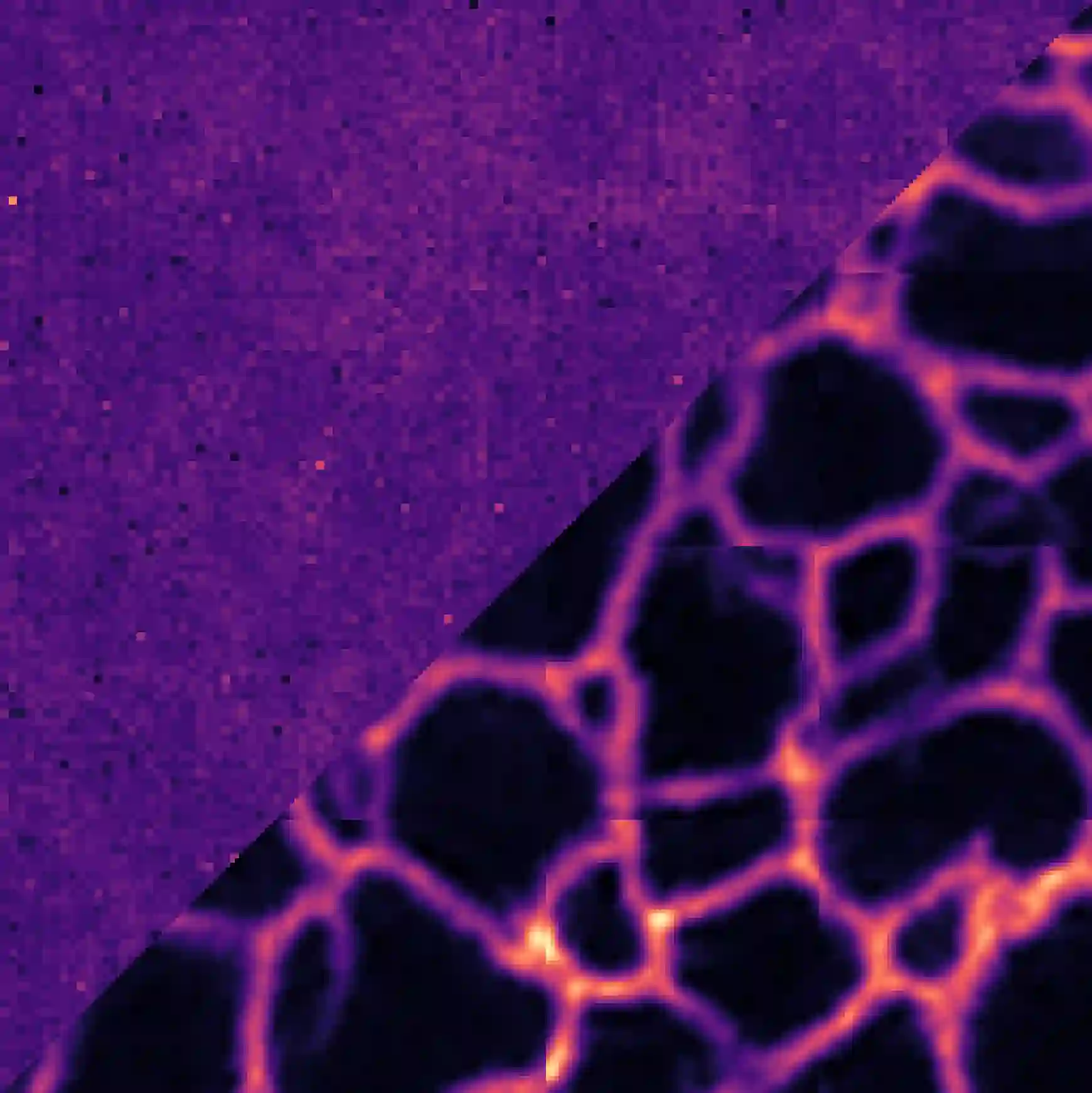
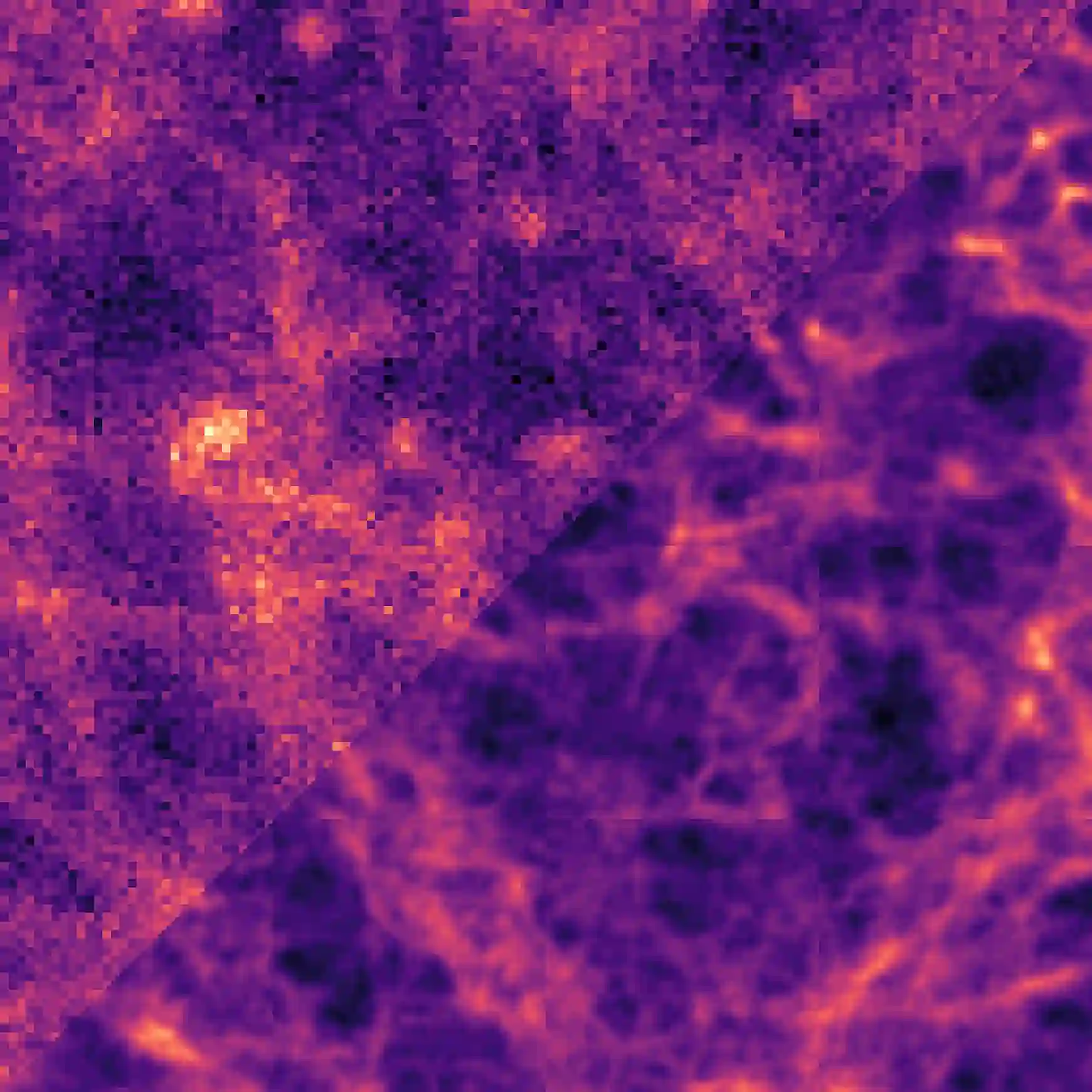
Computational Super-Resolution (CSR) in fluorescence microscopy has, despite being an ill-posed problem, a long history. At its very core, CSR is about finding a prior that can be used to extrapolate frequencies in a micrograph that have never been imaged by the image-generating microscope. It stands to reason that, with the advent of better data-driven machine learning techniques, stronger prior can be learned and hence CSR can lead to better results. Here, we present ResMatching, a novel CSR method that uses guided conditional flow matching to learn such improved data-priors. We evaluate ResMatching on 4 diverse biological structures from the BioSR dataset and compare its results against 7 baselines. ResMatching consistently achieves competitive results, demonstrating in all cases the best trade-off between data fidelity and perceptual realism. We observe that CSR using ResMatching is particularly effective in cases where a strong prior is hard to learn, e.g. when the given low-resolution images contain a lot of noise. Additionally, we show that ResMatching can be used to sample from an implicitly learned posterior distribution and that this distribution is calibrated for all tested use-cases, enabling our method to deliver a pixel-wise data-uncertainty term that can guide future users to reject uncertain predictions.
翻译:荧光显微镜中的计算超分辨率(CSR)尽管是一个不适定问题,却拥有悠久的研究历史。其核心在于寻找一种先验,用于外推显微图像中从未被成像系统捕获的频率成分。随着数据驱动的机器学习技术的进步,可以学习到更强的先验,从而有望提升CSR的性能。本文提出ResMatching,一种基于引导条件流匹配的新型CSR方法,通过学习改进的数据先验实现超分辨率重建。我们在BioSR数据集的4种不同生物结构上评估ResMatching,并与7种基线方法进行比较。ResMatching在所有案例中均取得具有竞争力的结果,展现出数据保真度与感知真实性之间的最佳平衡。我们观察到,在难以学习强先验的场景下(例如低分辨率图像含有大量噪声时),ResMatching尤其有效。此外,我们证明ResMatching能够从隐式学习的后验分布中采样,且该分布在所有测试用例中均经过校准,使方法能够提供像素级的数据不确定性度量,从而指导用户识别并剔除不可靠的预测结果。




相关内容



 微信扫码咨询专知VIP会员