

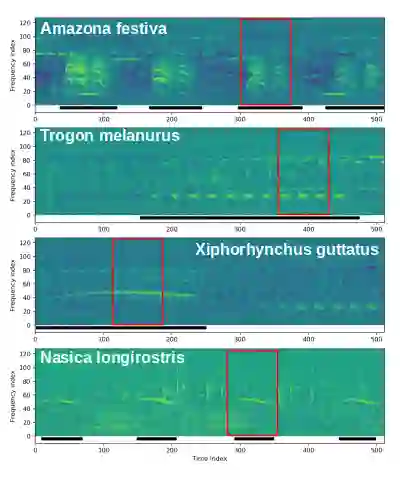
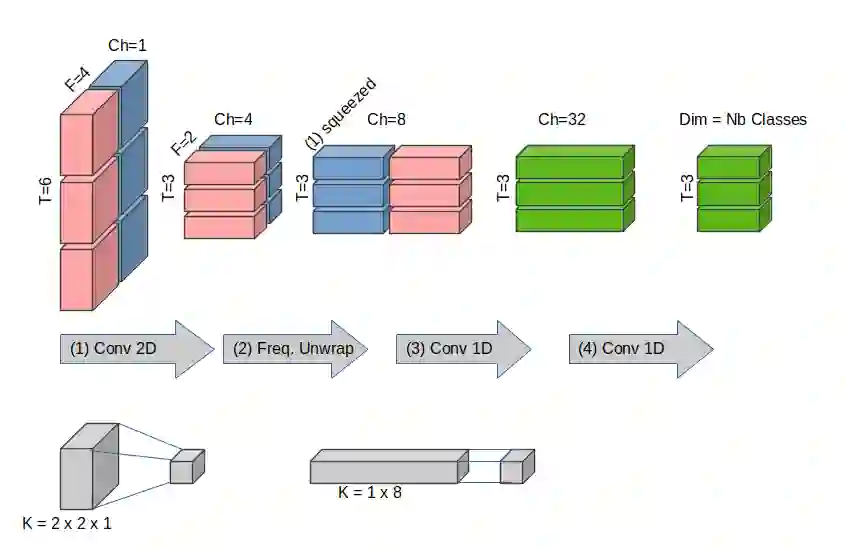
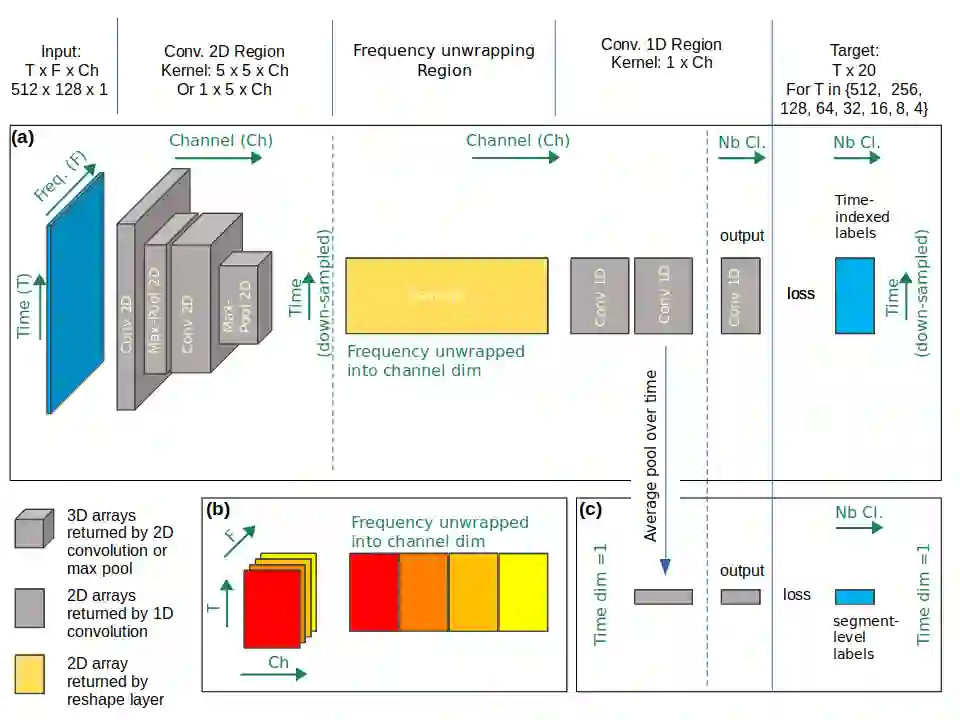
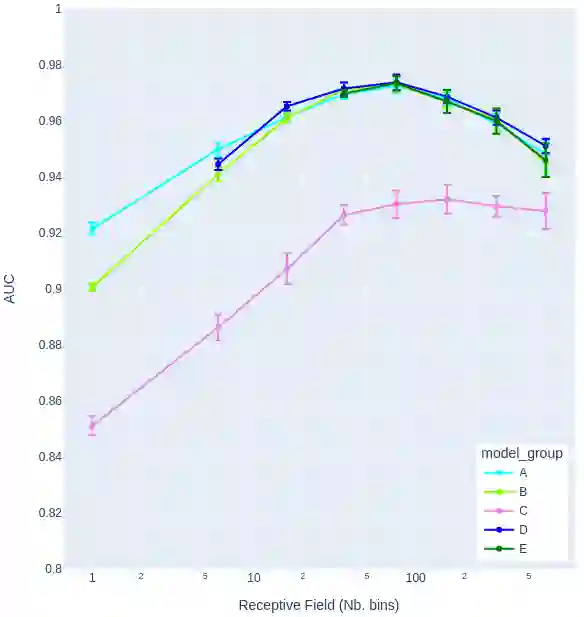
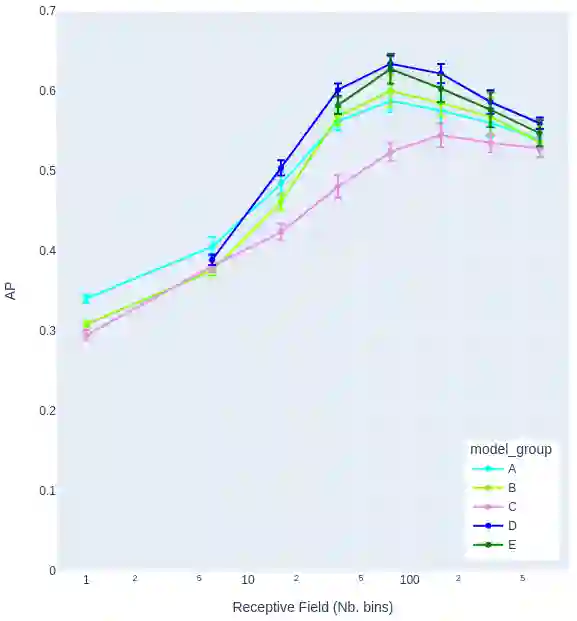
Automated classification of animal sounds is a prerequisite for large-scale monitoring of biodiversity. Convolutional Neural Networks (CNNs) are among the most promising algorithms but they are slow, often achieve poor classification in the field and typically require large training data sets. Our objective was to design CNNs that are fast at inference time and achieve good classification performance while learning from moderate-sized data. Recordings from a rainforest ecosystem were used. Start and end-point of sounds from 20 bird species were manually annotated. Spectrograms from 10 second segments were used as CNN input. We designed simple CNNs with a frequency unwrapping layer (SIMP-FU models) such that any output unit was connected to all spectrogram frequencies but only to a sub-region of time, the Receptive Field (RF). Our models allowed experimentation with different RF durations. Models either used the time-indexed labels that encode start and end-point of sounds or simpler segment-level labels. Models learning from time-indexed labels performed considerably better than their segment-level counterparts. Best classification performances was achieved for models with intermediate RF duration of 1.5 seconds. The best SIMP-FU models achieved AUCs over 0.95 in 18 of 20 classes on the test set. On compact low-cost hardware the best SIMP-FU models evaluated up to seven times faster than real-time data acquisition. RF duration was a major driver of classification performance. The optimum of 1.5 s was in the same range as the duration of the sounds. Our models achieved good classification performance while learning from moderate-sized training data. This is explained by the usage of time-indexed labels during training and adequately sized RF. Results confirm the feasibility of deploying small CNNs with good classification performance on compact low-cost devices.
翻译:自动分类动物声音是实现大规模生物多样性监测的前提。卷积神经网络(CNN)是最有前景的算法之一,但其运行速度慢,在实地环境中常表现欠佳,且通常需要大规模训练数据集。我们的目标是设计在推理阶段快速、能从中等规模数据中学习并实现良好分类性能的CNN。研究采用雨林生态系统的录音数据,人工标注了20种鸟类声音的起止点。将10秒片段的声谱图作为CNN输入。我们设计了带有频率解缠绕层的简单CNN(SIMP-FU模型),使每个输出单元连接所有声谱图频率,但仅连接时间子区域(感受野RF)。我们的模型支持不同RF持续时间的实验,使用了两种标签:编码声音起止点的时间索引标签,或更简单的片段级标签。基于时间索引标签训练的模型性能显著优于片段级标签模型。当RF持续时间为1.5秒时,模型达到最佳分类性能。在测试集中,最佳SIMP-FU模型在20个类别中有18个类别的AUC超过0.95。在紧凑低成本的硬件上,最佳SIMP-FU模型的推理速度比实时数据采集快七倍。RF持续时间是分类性能的主要驱动因素,最优值1.5秒与声音持续时间范围一致。我们的模型能从中等规模训练数据中学习并实现良好分类性能,这归因于训练过程中使用了时间索引标签和适当大小的RF。结果证实了在紧凑低成本设备上部署具有良好分类性能的小型CNN的可行性。




相关内容




 微信扫码咨询专知VIP会员