

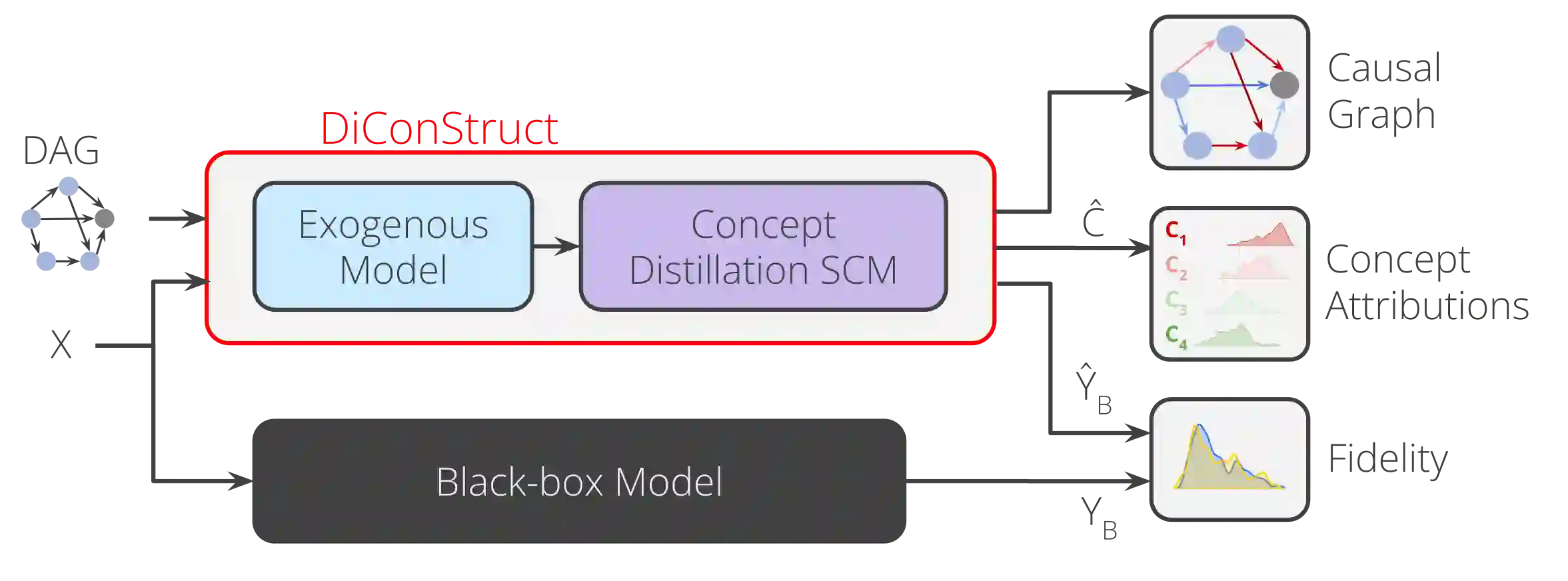
Model interpretability plays a central role in human-AI decision-making systems. Ideally, explanations should be expressed using human-interpretable semantic concepts. Moreover, the causal relations between these concepts should be captured by the explainer to allow for reasoning about the explanations. Lastly, explanation methods should be efficient and not compromise the performance of the predictive task. Despite the rapid advances in AI explainability in recent years, as far as we know to date, no method fulfills these three properties. Indeed, mainstream methods for local concept explainability do not produce causal explanations and incur a trade-off between explainability and prediction performance. We present DiConStruct, an explanation method that is both concept-based and causal, with the goal of creating more interpretable local explanations in the form of structural causal models and concept attributions. Our explainer works as a distillation model to any black-box machine learning model by approximating its predictions while producing the respective explanations. Because of this, DiConStruct generates explanations efficiently while not impacting the black-box prediction task. We validate our method on an image dataset and a tabular dataset, showing that DiConStruct approximates the black-box models with higher fidelity than other concept explainability baselines, while providing explanations that include the causal relations between the concepts.
翻译:模型可解释性在人机决策系统中扮演着核心角色。理想情况下,解释应使用人类可理解的语义概念进行表述。此外,解释器需要捕获这些概念间的因果关系,以便对解释进行逻辑推理。最后,解释方法应具备高效性,且不损害预测任务的性能。尽管近年来AI可解释性研究取得快速进展,但据我们所知,目前尚无方法同时满足这三项特性。事实上,主流局部概念可解释性方法既无法生成因果解释,又在可解释性与预测性能之间存在权衡。本文提出DiConStruct——一种兼具概念基础与因果特性的解释方法,旨在以结构因果模型与概念归因的形式生成更具可解释性的局部解释。我们的解释器通过近似黑盒模型的预测并生成相应解释,作为任何黑盒机器学习模型的蒸馏模型。因此,DiConStruct能在不影响黑盒预测任务的前提下高效生成解释。我们在图像数据集与表格数据集上验证了该方法,结果表明DiConStruct在近似黑盒模型时具有比其他概念可解释性基线更高的保真度,同时能提供包含概念间因果关系的解释。







相关内容




 微信扫码咨询专知VIP会员