

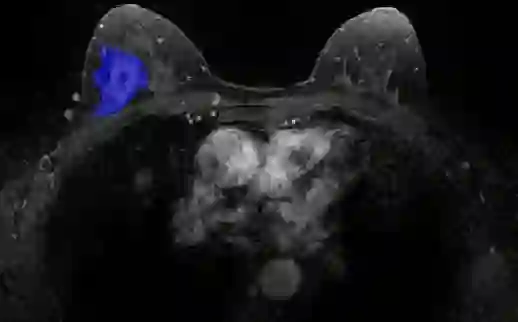
Most papers caution against using predictive models for disease stratification based on unselected radiomic features, as these features are affected by contouring variability. Instead, they advocate for the use of the Intraclass Correlation Coefficient (ICC) as a measure of stability for feature selection. However, the direct effect of segmentation variability on the predictive models is rarely studied. This study investigates the impact of segmentation variability on feature stability and predictive performance in radiomics-based prediction of Triple-Negative Breast Cancer (TNBC) subtype using Magnetic Resonance Imaging. A total of 244 images from the Duke dataset were used, with segmentation variability introduced through modifications of manual segmentations. For each mask, explainable radiomic features were selected using the Shapley Additive exPlanations method and used to train logistic regression models. Feature stability across segmentations was assessed via ICC, Pearson's correlation, and reliability scores quantifying the relationship between feature stability and segmentation variability. Results indicate that segmentation accuracy does not significantly impact predictive performance. While incorporating peritumoral information may reduce feature reproducibility, it does not diminish feature predictive capability. Moreover, feature selection in predictive models is not inherently tied to feature stability with respect to segmentation, suggesting that an overreliance on ICC or reliability scores for feature selection might exclude valuable predictive features.
翻译:大多数研究警告不要使用基于未经筛选的影像组学特征的预测模型进行疾病分层,因为这些特征受勾画变异性的影响。相反,它们主张使用组内相关系数作为特征选择稳定性的度量指标。然而,分割变异性对预测模型的直接影响却鲜有研究。本研究探讨了在基于磁共振成像的影像组学预测三阴性乳腺癌亚型中,分割变异性对特征稳定性和预测性能的影响。研究使用了杜克数据集的244幅图像,并通过修改手动分割引入了分割变异性。对于每个掩模,使用Shapley Additive exPlanations方法选择可解释的影像组学特征,并用于训练逻辑回归模型。通过组内相关系数、皮尔逊相关性和可靠性评分评估了不同分割间特征的稳定性,量化了特征稳定性与分割变异性之间的关系。结果表明,分割准确性对预测性能没有显著影响。虽然纳入瘤周信息可能降低特征的可重复性,但不会削弱特征的预测能力。此外,预测模型中的特征选择并不固有地与分割相关的特征稳定性相关联,这表明过度依赖组内相关系数或可靠性评分进行特征选择可能会排除有价值的预测特征。




相关内容





 微信扫码咨询专知VIP会员