

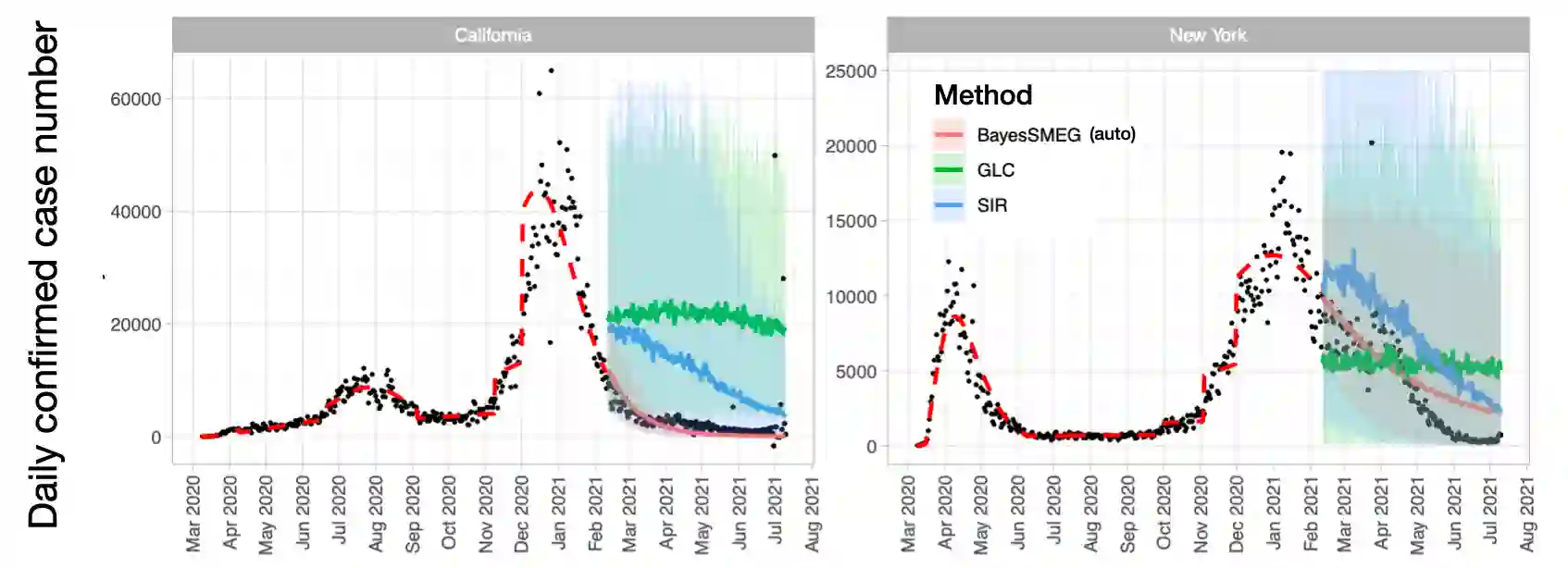
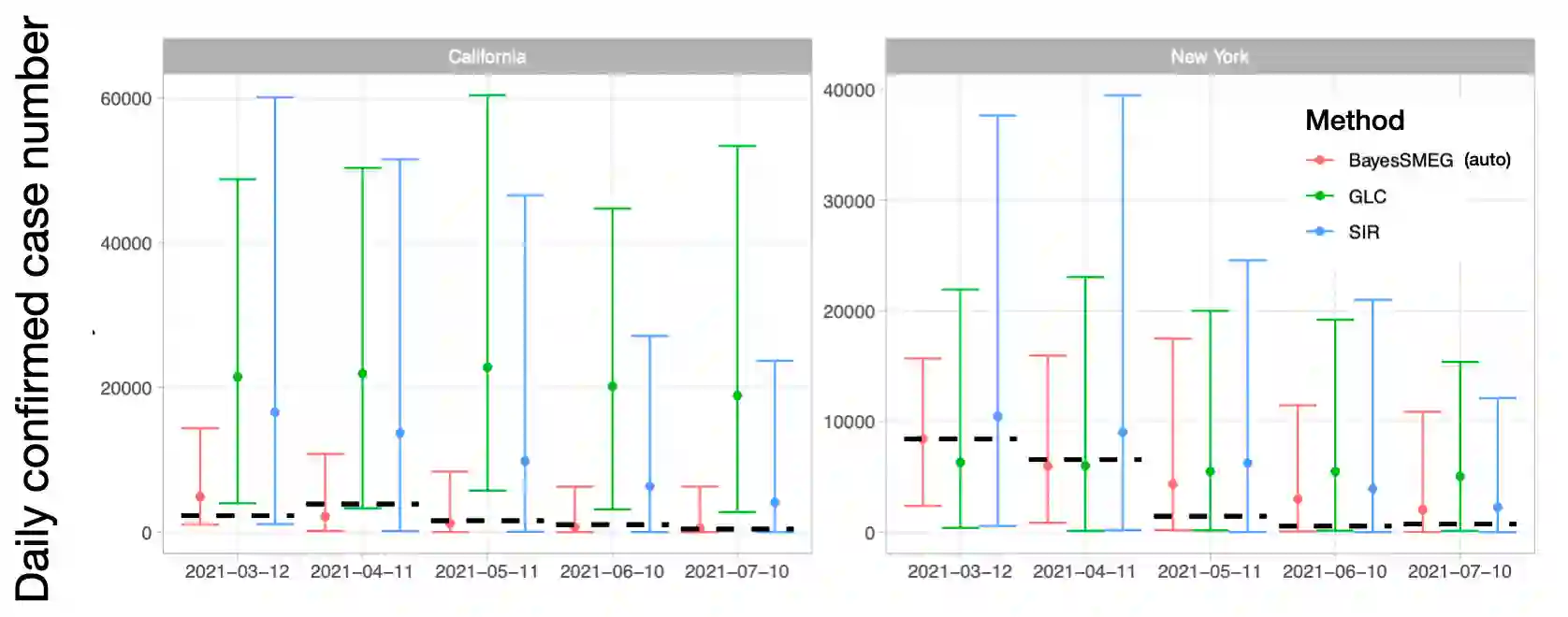
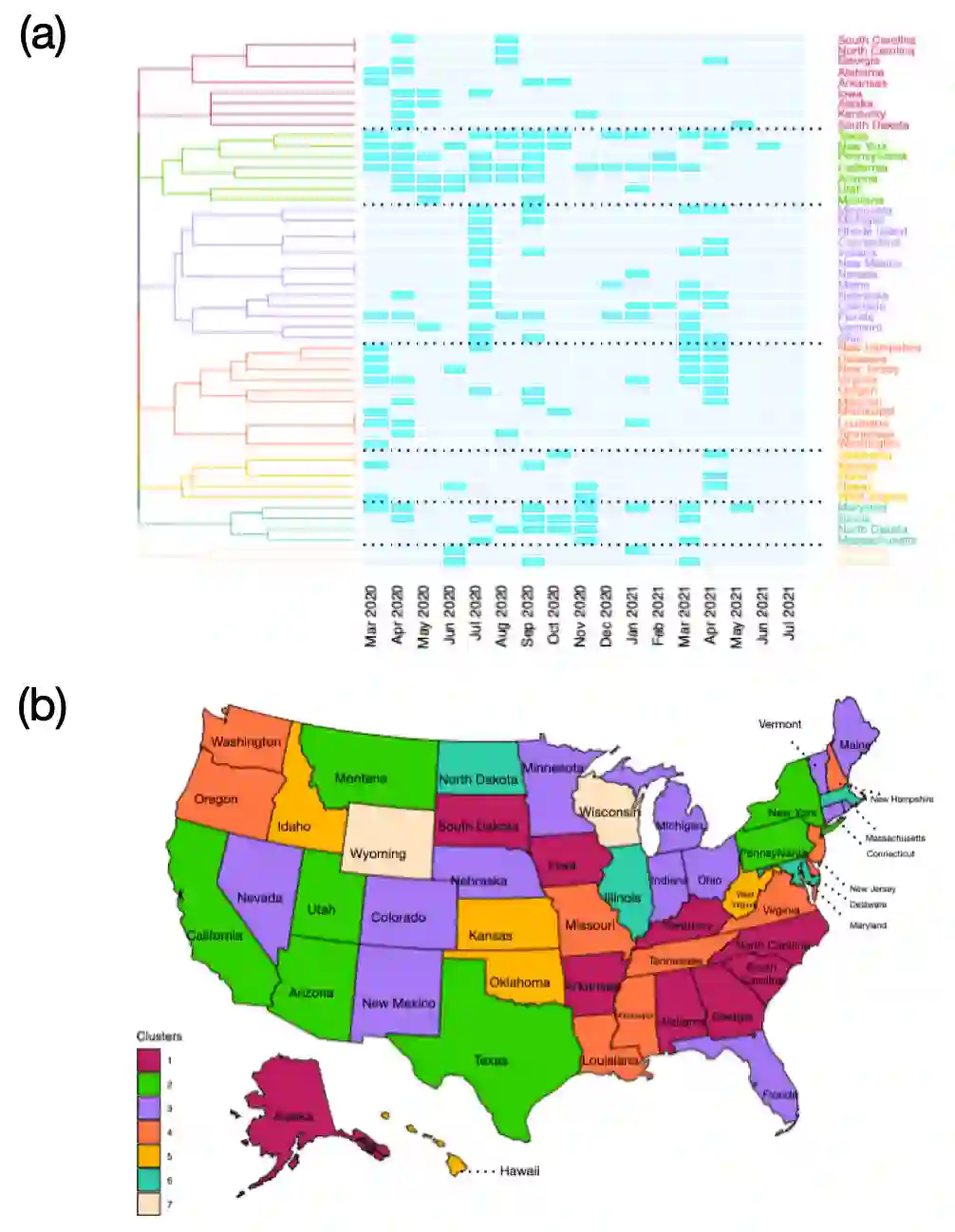
Tracking the spread of infectious disease during a pandemic has posed a great challenge to the governments and health sectors on a global scale. To facilitate informed public health decision-making, the concerned parties usually rely on short-term daily and weekly projections generated via predictive modeling. Several deterministic and stochastic epidemiological models, including growth and compartmental models, have been proposed in the literature. These models assume that an epidemic would last over a short duration and the observed cases/deaths would attain a single peak. However, some infectious diseases, such as COVID-19, extend over a longer duration than expected. Moreover, time-varying disease transmission rates due to government interventions have made the observed data multi-modal. To address these challenges, this work proposes stochastic epidemiological models under a unified Bayesian framework augmented by a change-point detection mechanism to account for multiple peaks. The Bayesian framework allows us to incorporate prior knowledge, such as dates of influential policy changes, to predict the change-point locations precisely. We develop a trans-dimensional reversible jump Markov chain Monte Carlo algorithm to sample the posterior distributions of epidemiological parameters while estimating the number of change points and the resulting parameters. The proposed method is evaluated and compared to alternative methods in terms of change-point detection, parameter estimation, and long-term forecasting accuracy on both simulated and COVID-19 data of several major states in the United States.
翻译:在疫情大流行期间追踪传染病的传播给全球各国政府和卫生部门带来了巨大挑战。为促进基于信息的公共卫生决策,相关方通常依赖通过预测模型生成的短期日度和周度预测。文献中已提出多种确定性和随机性流行病学模型,包括增长模型和房室模型。这些模型假设疫情持续时间较短,且观测到的病例/死亡人数仅出现单峰。然而,某些传染病(如COVID-19)的持续时间远超预期。此外,政府干预导致的时间变化疾病传播率使观测数据呈现多峰特征。针对这些挑战,本研究在统一贝叶斯框架下提出随机流行病学模型,并引入变点检测机制以处理多峰现象。该贝叶斯框架允许整合先验知识(如重大政策变更日期),从而精确预测变点位置。我们开发了一种跨维可逆跳跃马尔可夫链蒙特卡罗算法,在估计变点数量及其参数的同时,对流行病学参数的后验分布进行采样。在模拟数据和美国多个主要州的COVID-19数据上,我们从变点检测、参数估计和长期预测精度三个维度对所提方法进行了评估,并与替代方法进行了比较。




相关内容




 微信扫码咨询专知VIP会员