

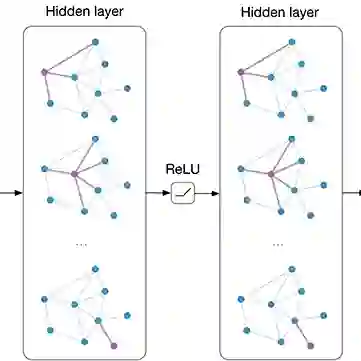
The proliferation of social media platforms such as Twitter, Instagram, and Weibo has significantly enhanced the dissemination of false information. This phenomenon grants both individuals and governmental entities the ability to shape public opinions, highlighting the need for deploying effective detection methods. In this paper, we propose GraMuFeN, a model designed to detect fake content by analyzing both the textual and image content of news. GraMuFeN comprises two primary components: a text encoder and an image encoder. For textual analysis, GraMuFeN treats each text as a graph and employs a Graph Convolutional Neural Network (GCN) as the text encoder. Additionally, the pre-trained ResNet-152, as a Convolutional Neural Network (CNN), has been utilized as the image encoder. By integrating the outputs from these two encoders and implementing a contrastive similarity loss function, GraMuFeN achieves remarkable results. Extensive evaluations conducted on two publicly available benchmark datasets for social media news indicate a 10 % increase in micro F1-Score, signifying improvement over existing state-of-the-art models. These findings underscore the effectiveness of combining GCN and CNN models for detecting fake news in multi-modal data, all while minimizing the additional computational burden imposed by model parameters.
翻译:社交媒体平台(如Twitter、Instagram和微博)的普及显著加速了虚假信息的传播。这一现象使得个人和政府实体均能影响公众舆论,凸显了部署有效检测方法的必要性。本文提出GraMuFeN模型,通过分析新闻的文本和图像内容来检测虚假信息。GraMuFeN包含两个主要组件:文本编码器和图像编码器。在文本分析中,GraMuFeN将每条新闻文本视为图结构,采用图卷积神经网络(GCN)作为文本编码器。同时,利用预训练的ResNet-152(一种卷积神经网络CNN)作为图像编码器。通过整合两个编码器的输出并引入对比相似性损失函数,GraMuFeN取得了显著效果。在两个公开的社交媒体新闻基准数据集上进行的大量评估表明,其微平均F1分数提升了10%,优于现有最先进模型。这些结果充分验证了结合GCN与CNN模型在多模态数据中检测假新闻的有效性,同时将模型参数带来的额外计算负担降至最低。




相关内容




 微信扫码咨询专知VIP会员