

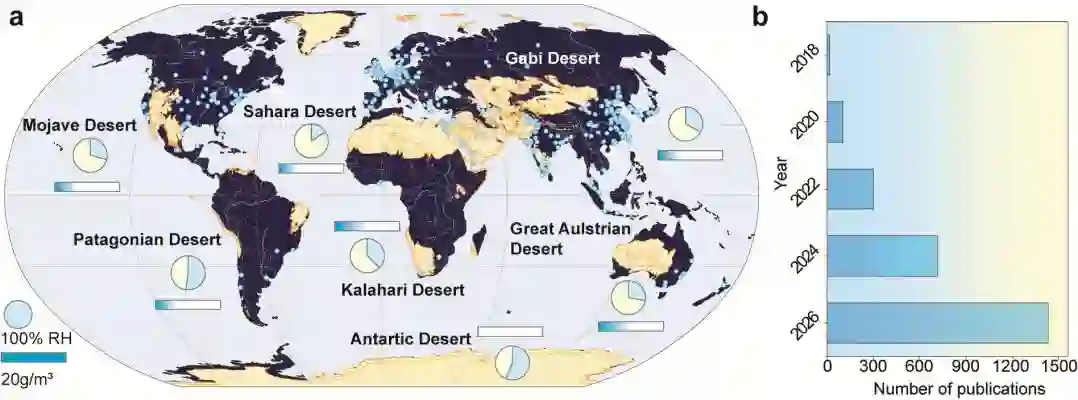
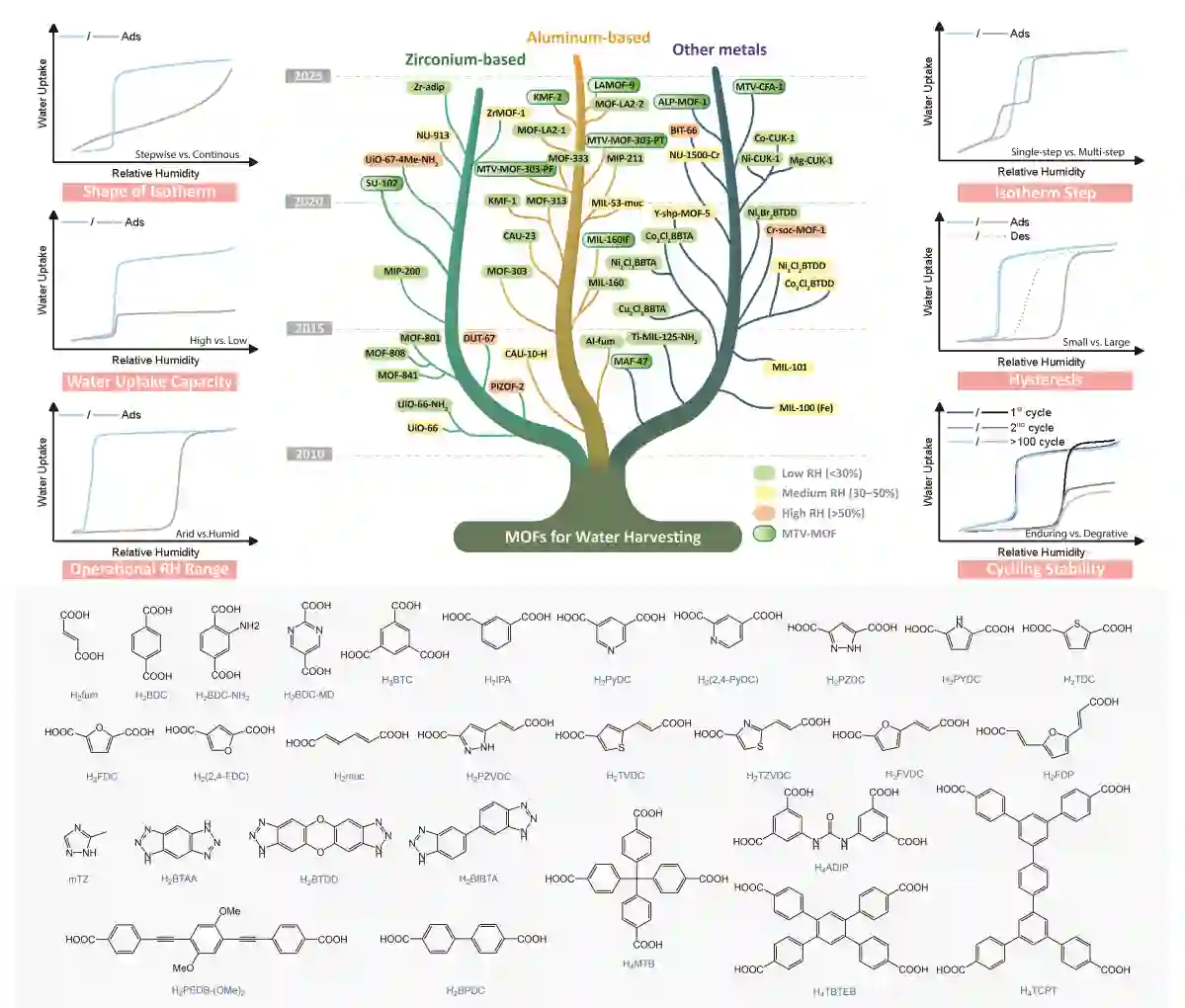
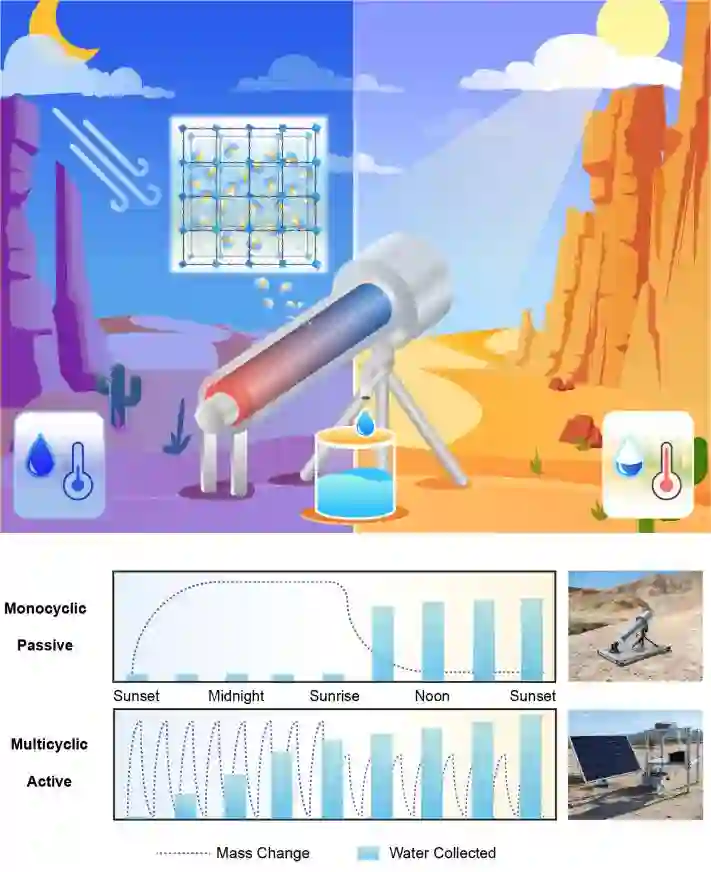
Metal-organic frameworks (MOFs) are excellent candidates for water harvesting due to their tunable pore environments, which can be precisely engineered to capture and release water in arid conditions. Integrating artificial intelligence (AI) into MOF discovery can further accelerate the design of high-performance sorbents by identifying structural features that enhance atmospheric water harvesting (AWH), stability, and cycling efficiency. In this Perspective, we examine key MOF design principles, including cooperative adsorption, operational relative humidity (RH), uptake capacity, hysteresis, and scalability. We highlight recent design advancements such as multivariate strategies and long-arm linker extension, and examine how these principles tune pore capacity and hydrophilicity, while preserving stability and crystallinity. Furthermore, we discuss how AI, large language models (LLMs), and data mining can accelerate the discovery process through predictive synthesis, inverse design, and elucidating synthesis-structure-property relationships for the next generation of MOF water harvesters.
翻译:金属有机框架(MOFs)因其可调控的孔道环境,在干旱条件下能精确设计以捕获和释放水分,从而成为水收集的理想候选材料。将人工智能(AI)整合到MOF发现过程中,可通过识别增强大气水收集(AWH)、稳定性及循环效率的结构特征,进一步加速高性能吸附剂的设计。在本展望中,我们审视了关键的MOF设计原则,包括协同吸附、操作相对湿度(RH)、吸附容量、滞后现象及可扩展性。我们重点介绍了近期设计进展,如多变量策略和长臂连接体延伸,并探讨了这些原则如何在保持稳定性与结晶性的同时调控孔道容量和亲水性。此外,我们讨论了AI、大语言模型(LLMs)及数据挖掘如何通过预测合成、逆向设计以及阐明合成-结构-性能关系,加速下一代MOF水收集器的发现过程。





相关内容



 微信扫码咨询专知VIP会员