

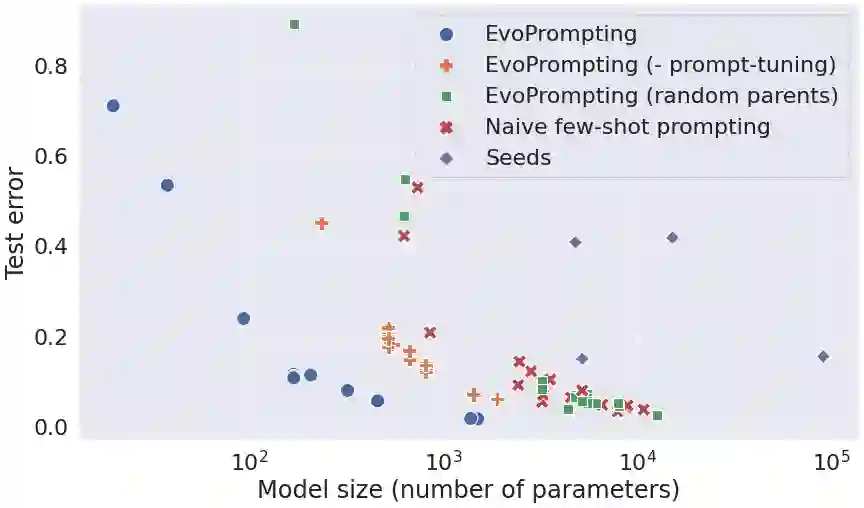
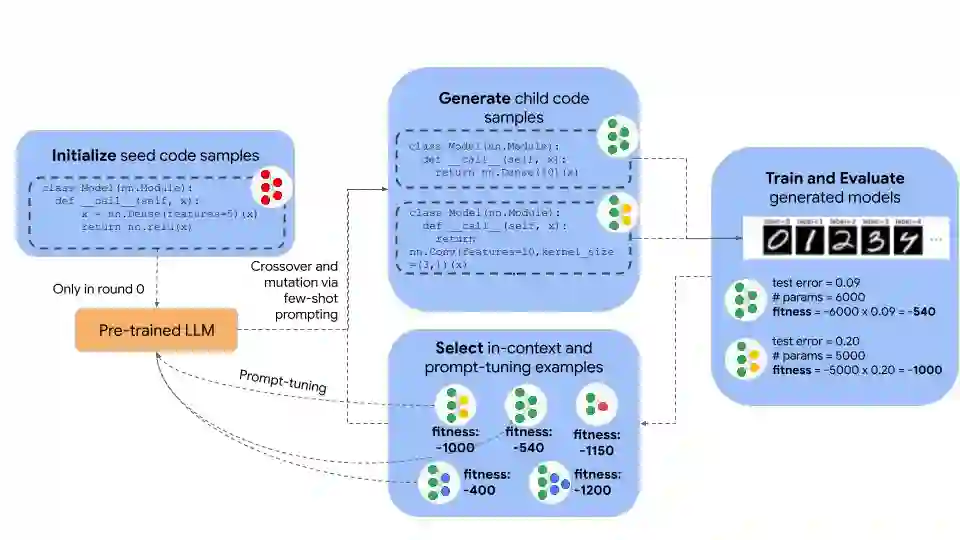
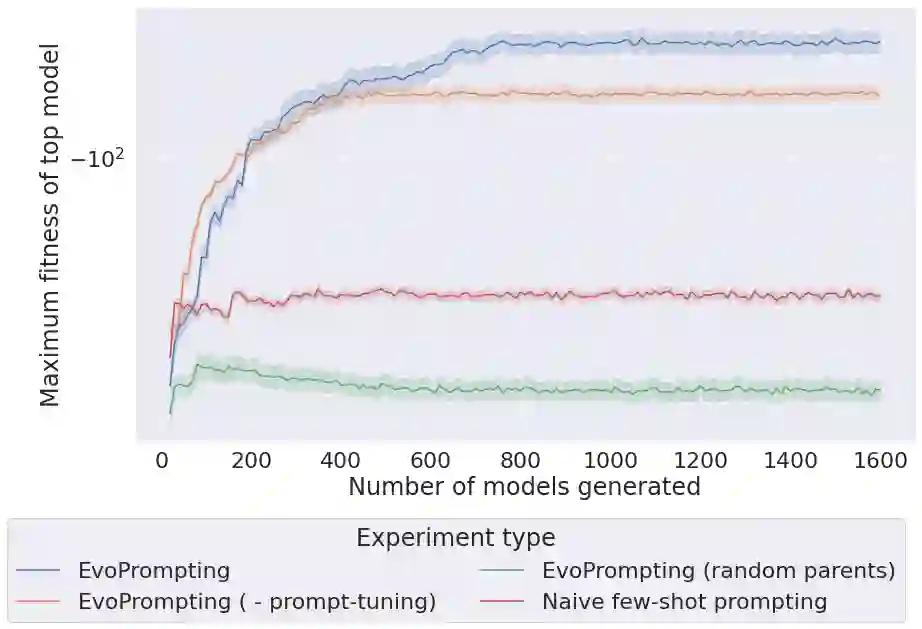
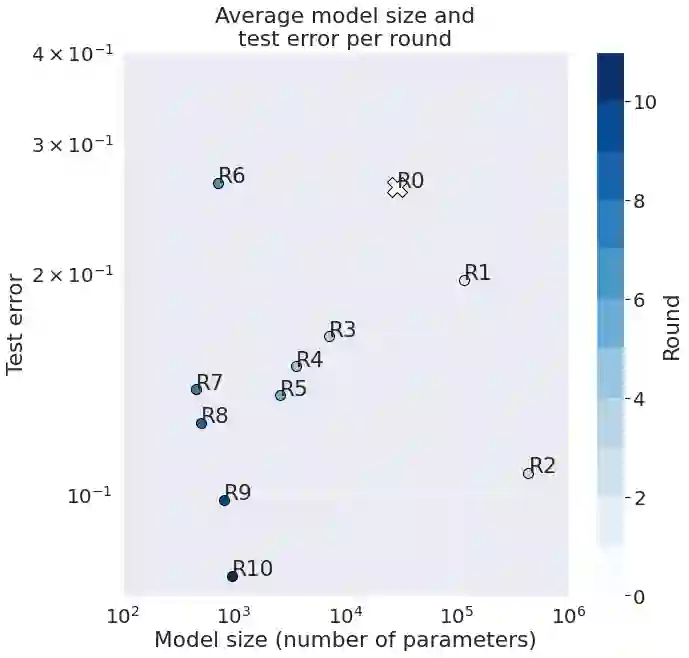
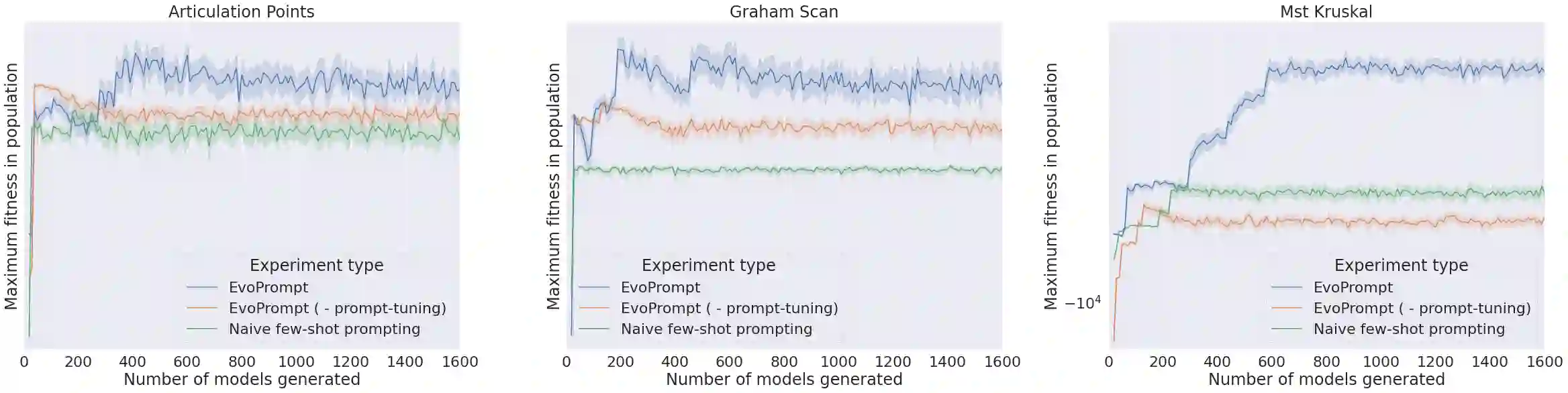
Given the recent impressive accomplishments of language models (LMs) for code generation, we explore the use of LMs as adaptive mutation and crossover operators for an evolutionary neural architecture search (NAS) algorithm. While NAS still proves too difficult a task for LMs to succeed at solely through prompting, we find that the combination of evolutionary prompt engineering with soft prompt-tuning, a method we term EvoPrompting, consistently finds diverse and high performing models. We first demonstrate that EvoPrompting is effective on the computationally efficient MNIST-1D dataset, where EvoPrompting produces convolutional architecture variants that outperform both those designed by human experts and naive few-shot prompting in terms of accuracy and model size. We then apply our method to searching for graph neural networks on the CLRS Algorithmic Reasoning Benchmark, where EvoPrompting is able to design novel architectures that outperform current state-of-the-art models on 21 out of 30 algorithmic reasoning tasks while maintaining similar model size. EvoPrompting is successful at designing accurate and efficient neural network architectures across a variety of machine learning tasks, while also being general enough for easy adaptation to other tasks beyond neural network design.
翻译:鉴于语言模型(LM)在代码生成领域近期取得的显著成就,我们探索将LM作为进化神经架构搜索(NAS)算法中的自适应变异与交叉算子。尽管仅通过提示方法让LM成功完成NAS任务仍具挑战性,但我们发现,将进化式提示工程与软提示调优相结合的方法(我们称之为EvoPrompting)能够持续发现多样且高性能的模型。我们首先在计算高效的MNIST-1D数据集上验证了EvoPrompting的有效性:与人类专家设计的架构和简单的少样本提示方法相比,EvoPrompting生成的卷积架构变体在准确率和模型规模方面均表现更优。随后,我们将该方法应用于CLRS算法推理基准上的图神经网络搜索任务,结果显示EvoPrompting能够设计出新颖的架构,在30个算法推理任务中的21个上超越当前最先进模型,同时保持相似的模型规模。EvoPrompting成功地为多种机器学习任务设计了准确且高效的神经网络架构,并且具备足够的通用性,可便捷地适配除神经网络设计之外的其他任务。




相关内容





 微信扫码咨询专知VIP会员