

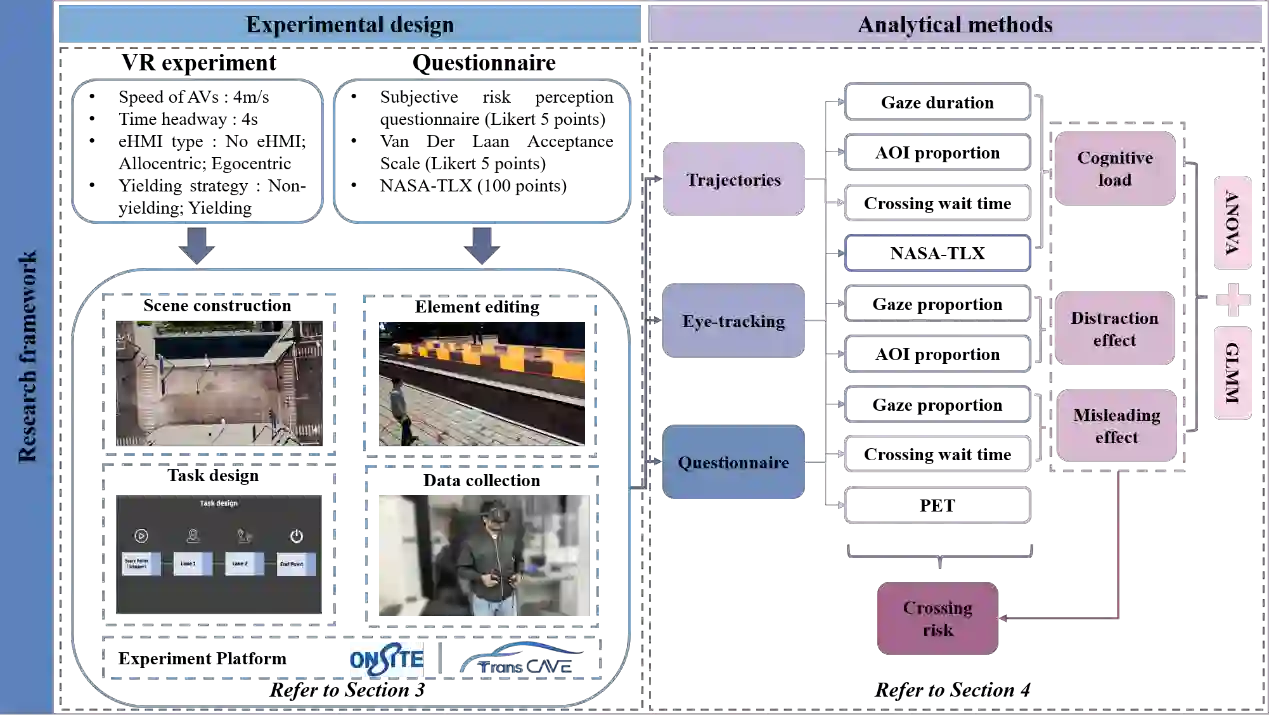
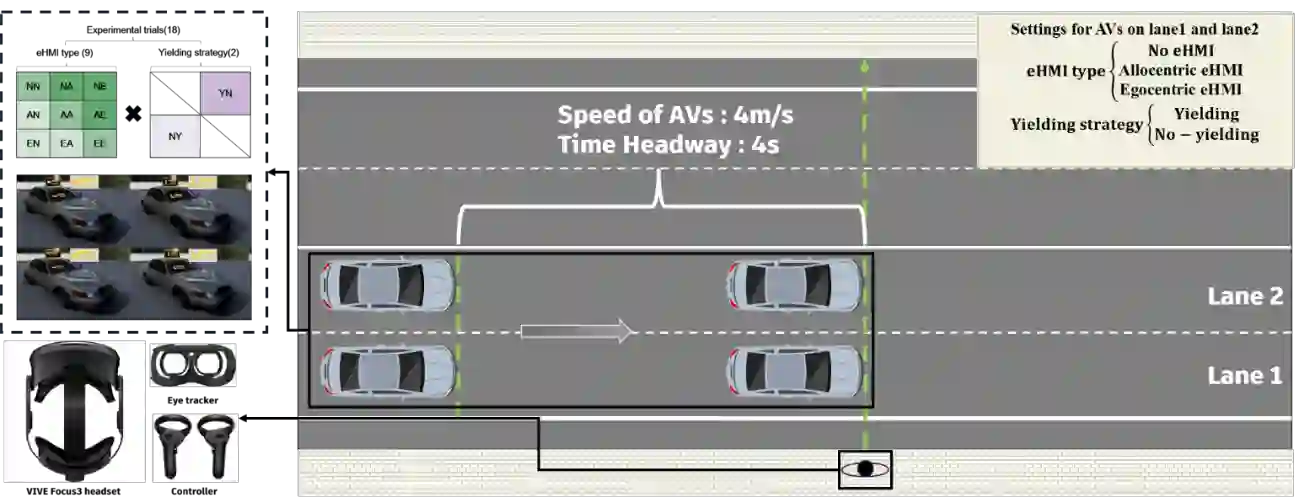
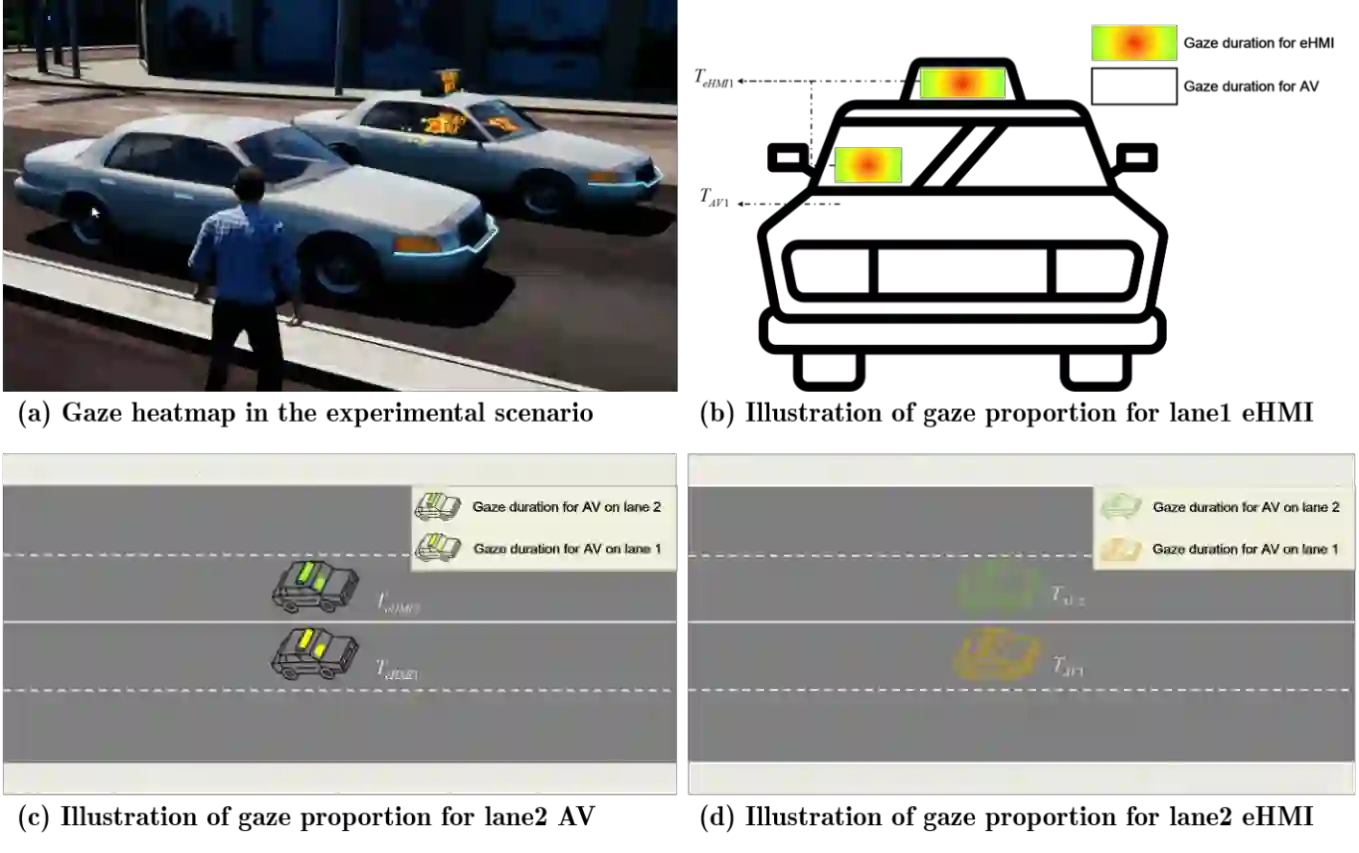
Appropriate communication is crucial for efficient and safe interactions between pedestrians and autonomous vehicles (AVs). External human-machine interfaces (eHMIs) on AVs, which can be categorized as allocentric or egocentric, are considered a promising solution. While the effectiveness of eHMIs has been extensively studied, in complex environments, such as unsignalized multi-lane streets, their potential to interfere with pedestrian crossing behavior remains underexplored. Hence, a virtual reality-based experiment was conducted to examine how different types of eHMIs displayed on AVs affect the crossing behavior of pedestrians in multi-lane streets environments, with a focus on the gaze patterns of pedestrians during crossing. The results revealed that the presence of eHMIs significantly influenced the cognitive load on pedestrians and increased the possibility of distraction, even misleading pedestrians in cases involving multiple AVs on multi-lane streets. Notably, allocentric eHMIs induced higher cognitive loads and greater distraction in pedestrians than egocentric eHMIs. This was primarily evidenced by longer gaze time and higher proportions of attention for the eHMI on the interacting vehicle, as well as a broader distribution of gaze toward vehicles in the non-interacting lane. However, misleading behavior was mainly triggered by eHMI signals from yielding vehicles in the non-interacting lane. Under such asymmetric signal configurations, egocentric eHMIs resulted in a higher misjudgment rate than allocentric eHMIs. These findings highlight the importance of enhancing eHMI designs to balance the clarity and consistency of the displayed information across different perspectives, especially in complex multi-lane traffic scenarios. This study provides valuable insights regarding the application and standardization of future eHMI systems for AVs.
翻译:适当的沟通对于行人与自动驾驶车辆(AVs)之间高效且安全的交互至关重要。自动驾驶车辆上的外部人机界面(eHMIs)——可分为非自我中心型(allocentric)与自我中心型(egocentric)——被视为一种有前景的解决方案。尽管eHMIs的有效性已得到广泛研究,但在复杂环境(如无信号灯的多车道街道)中,其可能干扰行人过街行为的潜力仍未得到充分探索。为此,本研究开展了一项基于虚拟现实的实验,旨在探究自动驾驶车辆上显示的不同类型eHMIs如何影响行人在多车道街道环境中的过街行为,并重点关注行人过街过程中的注视模式。结果表明,eHMIs的存在显著影响了行人的认知负荷,增加了分心的可能性,甚至在涉及多车道街道上多辆自动驾驶车辆的情况下误导了行人。值得注意的是,与非自我中心型eHMIs相比,自我中心型eHMIs引发了行人更高的认知负荷和更严重的分心。这主要体现在:对交互车辆上eHMI的注视时间更长、注意力比例更高,以及对非交互车道车辆的注视分布更广。然而,误导行为主要由非交互车道中礼让车辆的eHMI信号触发。在此类非对称信号配置下,自我中心型eHMIs导致的误判率高于非自我中心型eHMIs。这些发现凸显了改进eHMI设计以平衡不同视角下所显示信息的清晰度与一致性的重要性,尤其是在复杂的多车道交通场景中。本研究为未来自动驾驶车辆eHMI系统的应用与标准化提供了有价值的见解。





相关内容

 微信扫码咨询专知VIP会员