

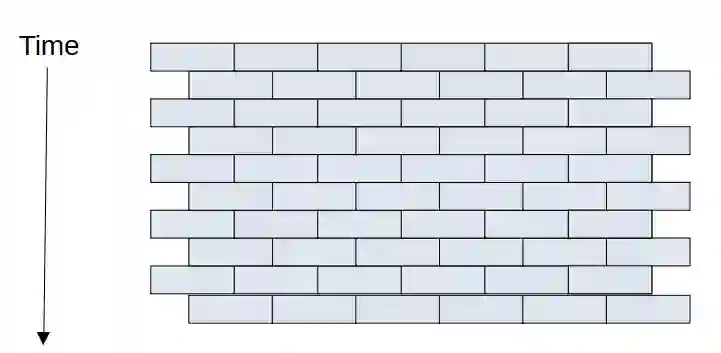
A major line of questions in quantum information and computing asks how quickly locally random circuits converge to resemble global randomness. In particular, approximate k-designs are random unitary ensembles that resemble random circuits up to their first k moments. It was recently shown that on n qudits, random circuits with slightly structured architectures converge to k-designs in depth O(log n), even on one-dimensional connectivity. It has however remained open whether the same shallow depth applies more generally among random circuit architectures and connectivities, or if the structure is truly necessary. We recall the study of exponential relative entropy decay, another topic with a long history in quantum information theory. We show that a constant number of layers of a parallel random circuit on a family of architectures including one-dimensional `brickwork' has O(1/logn) per-layer multiplicative entropy decay. We further show that on general connectivity graphs of bounded degree, randomly placed gates achieve O(1/nlogn)-decay (consistent with logn depth). Both of these results imply that random circuit ensembles with O(polylog(n)) depth achieve approximate k-designs in diamond norm. Hence our results address the question of whether extra structure is truly necessary for sublinear-depth convergence. Furthermore, the relative entropy recombination techniques might be of independent interest.
翻译:量子信息与计算领域的一个核心问题关注局部随机电路以多快速度收敛至全局随机性。特别地,近似k-设计是指其前k阶矩与随机电路相近的随机酉系综。近期研究表明,在n个qudit上,具有轻微结构化架构的随机电路可在O(log n)深度内收敛至k-设计,即使在一维连通性条件下亦然。然而,相同浅层深度是否普遍适用于随机电路架构与连通性,抑或结构化确属必要,此问题始终悬而未决。我们回顾了指数相对熵衰减这一在量子信息论中具有悠久历史的研究主题。我们证明:在包含一维"砖墙"架构的架构族上,恒定层数的并行随机电路具有每层O(1/logn)乘性熵衰减。进一步证明:在有限度的通用连通图上,随机放置的门电路可实现O(1/nlogn)衰减(与logn深度一致)。这两项结果均表明:具有O(polylog(n))深度的随机电路系综可在钻石范数下实现近似k-设计。因此,我们的研究结果回应了亚线性深度收敛是否必须依赖额外结构化的问题。此外,相对熵重组技术可能具有独立的研究价值。







相关内容




 微信扫码咨询专知VIP会员