

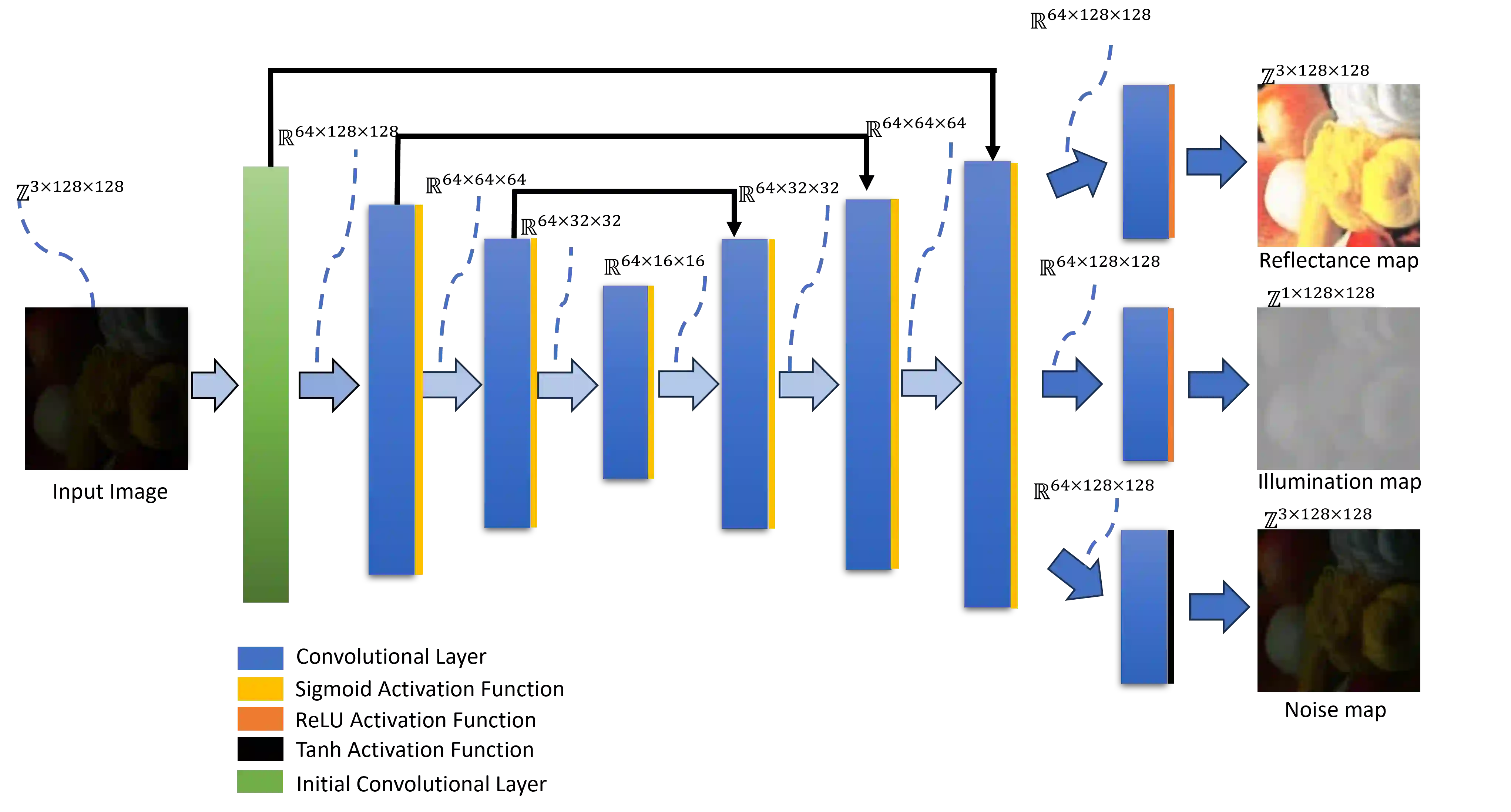
Low-light image denoising and enhancement are challenging, especially when traditional noise assumptions, such as Gaussian noise, do not hold in majority. In many real-world scenarios, such as low-light imaging, noise is signal-dependent and is better represented as Poisson noise. In this work, we address the problem of denoising images degraded by Poisson noise under extreme low-light conditions. We introduce a light-weight deep learning-based method that integrates Retinex based decomposition with Poisson denoising into a unified encoder-decoder network. The model simultaneously enhances illumination and suppresses noise by incorporating a Poisson denoising loss to address signal-dependent noise. Without prior requirement for reflectance and illumination, the network learns an effective decomposition process while ensuring consistent reflectance and smooth illumination without causing any form of color distortion. The experimental results demonstrate the effectiveness and practicality of the proposed low-light illumination enhancement method. Our method significantly improves visibility and brightness in low-light conditions, while preserving image structure and color constancy under ambient illumination.
翻译:低光照图像去噪与增强具有挑战性,尤其是在传统噪声假设(如高斯噪声)在多数情况下不成立时。在许多实际场景(如低光照成像)中,噪声具有信号依赖性,更适合用泊松噪声建模。本研究针对极端低光照条件下受泊松噪声退化的图像去噪问题,提出一种轻量级深度学习方法,将基于Retinex的分解与泊松去噪集成到统一的编码器-解码器网络中。该模型通过引入泊松去噪损失函数处理信号相关噪声,同步实现光照增强与噪声抑制。无需反射率与光照的先验信息,网络能够学习有效的分解过程,在确保反射率一致性与光照平滑性的同时避免任何形式的色彩失真。实验结果表明,所提出的低光照增强方法具有显著的有效性与实用性。该方法在低光照条件下显著提升图像可见度与亮度,同时保持环境光照下的图像结构与色彩恒常性。





相关内容





 微信扫码咨询专知VIP会员