

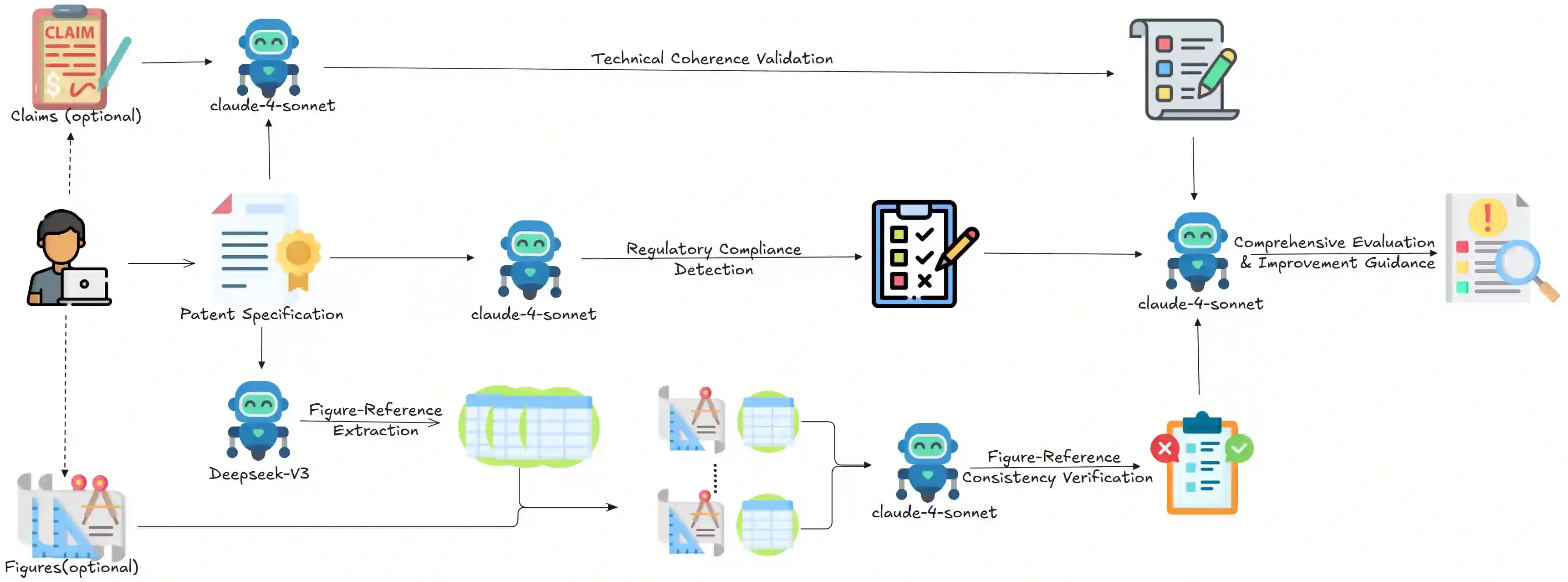
Although AI drafting tools have gained prominence in patent writing, the systematic evaluation of AI-generated patent content quality represents a significant research gap. To address this gap, We propose to evaluate patents using regulatory compliance, technical coherence, and figure-reference consistency detection modules, and then generate improvement suggestions via an integration module. The framework is validated on a comprehensive dataset comprising 80 human-authored and 80 AI-generated patents from two patent drafting tools. Evaluation is performed on 10,841 total sentences, 8,924 non-template sentences, and 554 patent figures for the three detection modules respectively, achieving balanced accuracies of 99.74%, 82.12%, and 91.2% against expert annotations. Additional analysis was conducted to examine defect distributions across patent sections, technical domains, and authoring sources. Section-based analysis indicates that figure-text consistency and technical detail precision require particular attention. Mechanical Engineering and Construction show more claim-specification inconsistencies due to complex technical documentation requirements. AI-generated patents show a significant gap compared to human-authored ones. While human-authored patents primarily contain surface-level errors like typos, AI-generated patents exhibit more structural defects in figure-text alignment and cross-references.
翻译:尽管AI辅助起草工具在专利撰写中日益重要,但对AI生成专利内容质量的系统性评估仍存在显著的研究空白。为填补这一空白,我们提出通过法规遵从性、技术连贯性及图文一致性检测模块对专利进行评估,并借助集成模块生成改进建议。该框架在一个包含来自两种专利起草工具的80份人工撰写和80份AI生成专利的综合数据集上得到验证。针对三个检测模块,分别对总计10,841个句子、8,924个非模板句子及554个专利附图进行评估,相较于专家标注,平衡准确率分别达到99.74%、82.12%和91.2%。进一步分析考察了缺陷在专利章节、技术领域及撰写来源中的分布情况。基于章节的分析表明,图文一致性和技术细节精确性需特别关注。机械工程与建筑领域因复杂的技术文档要求,表现出更多的权利要求书与说明书不一致问题。AI生成专利与人工撰写专利相比存在显著差距:人工撰写专利主要包含拼写错误等表层缺陷,而AI生成专利则在图文对齐和交叉引用方面表现出更多结构性缺陷。




相关内容




 微信扫码咨询专知VIP会员