

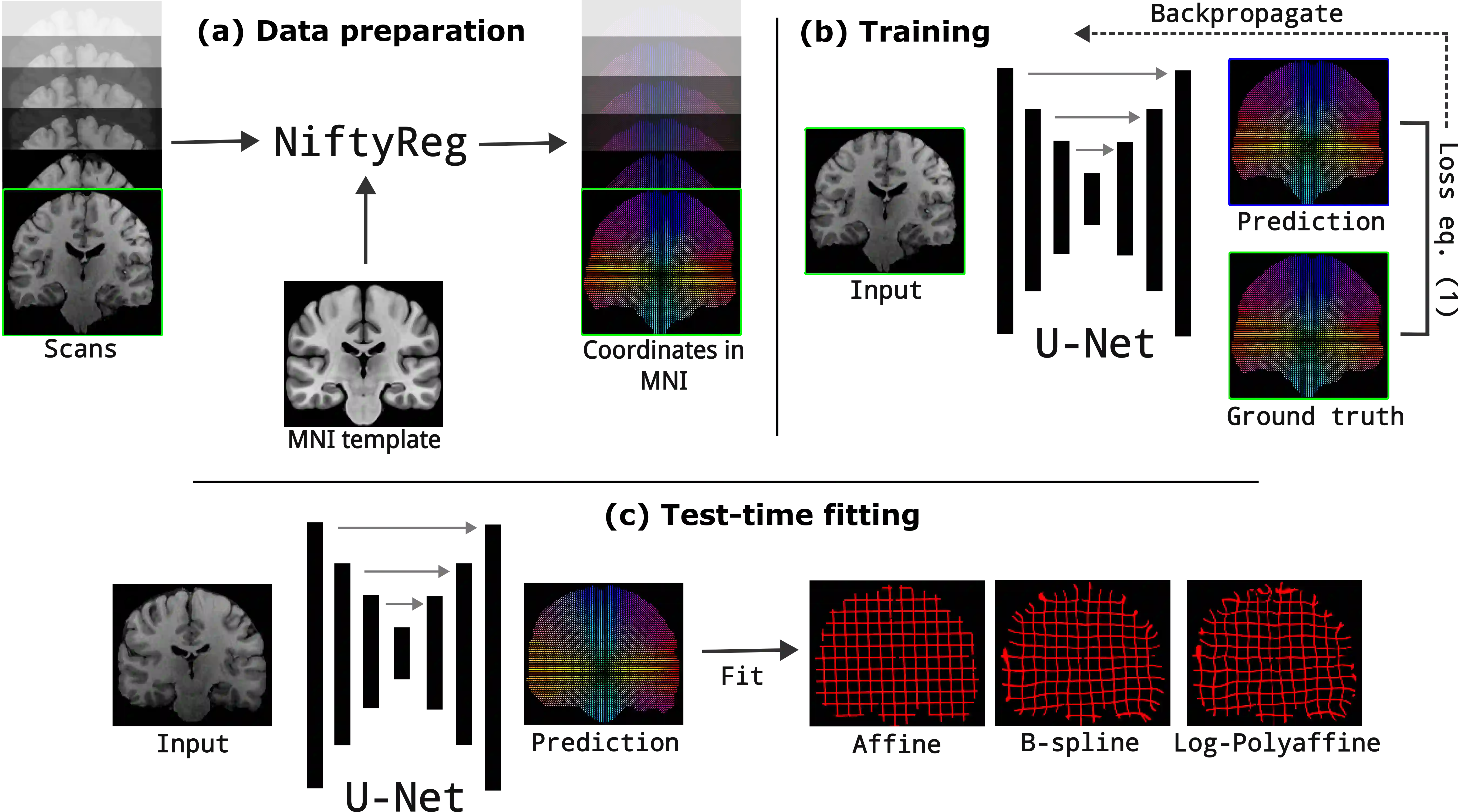
In human neuroimaging studies, atlas registration enables mapping MRI scans to a common coordinate frame, which is necessary to aggregate data from multiple subjects. Machine learning registration methods have achieved excellent speed and accuracy but lack interpretability. More recently, keypoint-based methods have been proposed to tackle this issue, but their accuracy is still subpar, particularly when fitting nonlinear transforms. Here we propose Registration by Regression (RbR), a novel atlas registration framework that is highly robust and flexible, conceptually simple, and can be trained with cheaply obtained data. RbR predicts the (x,y,z) atlas coordinates for every voxel of the input scan (i.e., every voxel is a keypoint), and then uses closed-form expressions to quickly fit transforms using a wide array of possible deformation models, including affine and nonlinear (e.g., Bspline, Demons, invertible diffeomorphic models, etc.). Robustness is provided by the large number of voxels informing the registration and can be further increased by robust estimators like RANSAC. Experiments on independent public datasets show that RbR yields more accurate registration than competing keypoint approaches, while providing full control of the deformation model.
翻译:在人类神经影像学研究中,图谱配准能够将MRI扫描映射到共同坐标框架,这对于聚合多个被试的数据至关重要。机器学习配准方法在速度和准确性上表现优异,但缺乏可解释性。近年来,基于关键点的方法被提出以解决该问题,但其准确性仍不尽如人意,尤其在拟合非线性变换时。本文提出基于回归的配准(RbR)——一种新型图谱配准框架,该框架高度鲁棒且灵活、概念简洁,并可通过低成本获取的数据进行训练。RbR为输入扫描中每个体素预测图谱坐标(即每个体素作为关键点),随后利用闭式表达式快速拟合变换,支持包括仿射和非线性(如B样条、Demons、可逆微分同胚模型等)在内的多种变形模型。大量体素参与配准提供了鲁棒性,且可通过RANSAC等鲁棒估计器进一步增强。在独立公共数据集上的实验表明,RbR在保证变形模型完全可控的前提下,比现有基于关键点的方法取得了更准确的配准结果。




相关内容





 微信扫码咨询专知VIP会员