

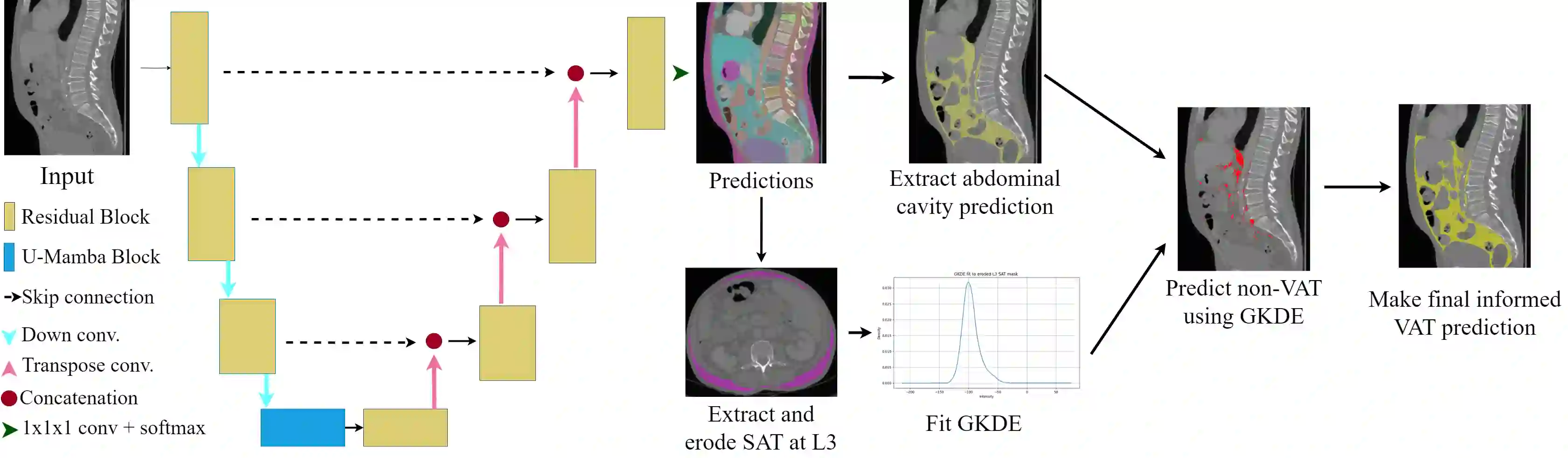
Purpose: The distribution of visceral adipose tissue (VAT) in cystectomy patients is indicative of the incidence of post-operative complications. Existing VAT segmentation methods for computed tomography (CT) employing intensity thresholding have limitations relating to inter-observer variability. Moreover, the difficulty in creating ground-truth masks limits the development of deep learning (DL) models for this task. This paper introduces a novel method for VAT prediction in pre-cystectomy CT, which is fully automated and does not require ground-truth VAT masks for training, overcoming aforementioned limitations. Methods: We introduce the Kernel density Enhanced VAT Segmentator ( KEVS), combining a DL semantic segmentation model, for multi-body feature prediction, with Gaussian kernel density estimation analysis of predicted subcutaneous adipose tissue to achieve accurate scan-specific predictions of VAT in the abdominal cavity. Uniquely for a DL pipeline, KEVS does not require ground-truth VAT masks. Results: We verify the ability of KEVS to accurately segment abdominal organs in unseen CT data and compare KEVS VAT segmentation predictions to existing state-of-the-art (SOTA) approaches in a dataset of 20 pre-cystectomy CT scans, collected from University College London Hospital (UCLH-Cyst), with expert ground-truth annotations. KEVS presents a 4.80% and 6.02% improvement in Dice Coefficient over the second best DL and thresholding-based VAT segmentation techniques respectively when evaluated on UCLH-Cyst. Conclusion: This research introduces KEVS; an automated, SOTA method for the prediction of VAT in pre-cystectomy CT which eliminates inter-observer variability and is trained entirely on open-source CT datasets which do not contain ground-truth VAT masks.
翻译:目的:膀胱切除术患者内脏脂肪组织(VAT)的分布情况可预示术后并发症的发生率。现有基于CT强度阈值的VAT分割方法存在观察者间变异性的局限。此外,真实标注掩膜的制作困难限制了针对此任务的深度学习模型发展。本文提出一种膀胱切除术前CT中VAT预测的新方法,该方法完全自动化且训练时无需真实标注的VAT掩膜,从而克服了上述局限。方法:我们提出核密度增强VAT分割器(KEVS),该方法结合用于多体部特征预测的深度学习语义分割模型,以及对预测皮下脂肪组织进行高斯核密度估计分析,从而实现腹腔内VAT的精准扫描特异性预测。KEVS作为深度学习流程具有独特优势:无需真实标注的VAT掩膜。结果:我们在未见CT数据中验证了KEVS准确分割腹部器官的能力,并在来自伦敦大学学院医院的20例膀胱切除术前CT扫描数据集(UCLH-Cyst)中,将KEVS的VAT分割预测与现有最先进方法进行比较,该数据集包含专家标注的真实值。在UCLH-Cyst数据集上的评估显示,KEVS的Dice系数相较于次优的深度学习方法和基于阈值的VAT分割技术分别提升4.80%和6.02%。结论:本研究提出的KEVS是一种自动化、最先进的膀胱切除术前CT中VAT预测方法,该方法消除了观察者间变异性,并完全在未包含真实标注VAT掩膜的开源CT数据集上完成训练。






相关内容


 微信扫码咨询专知VIP会员