

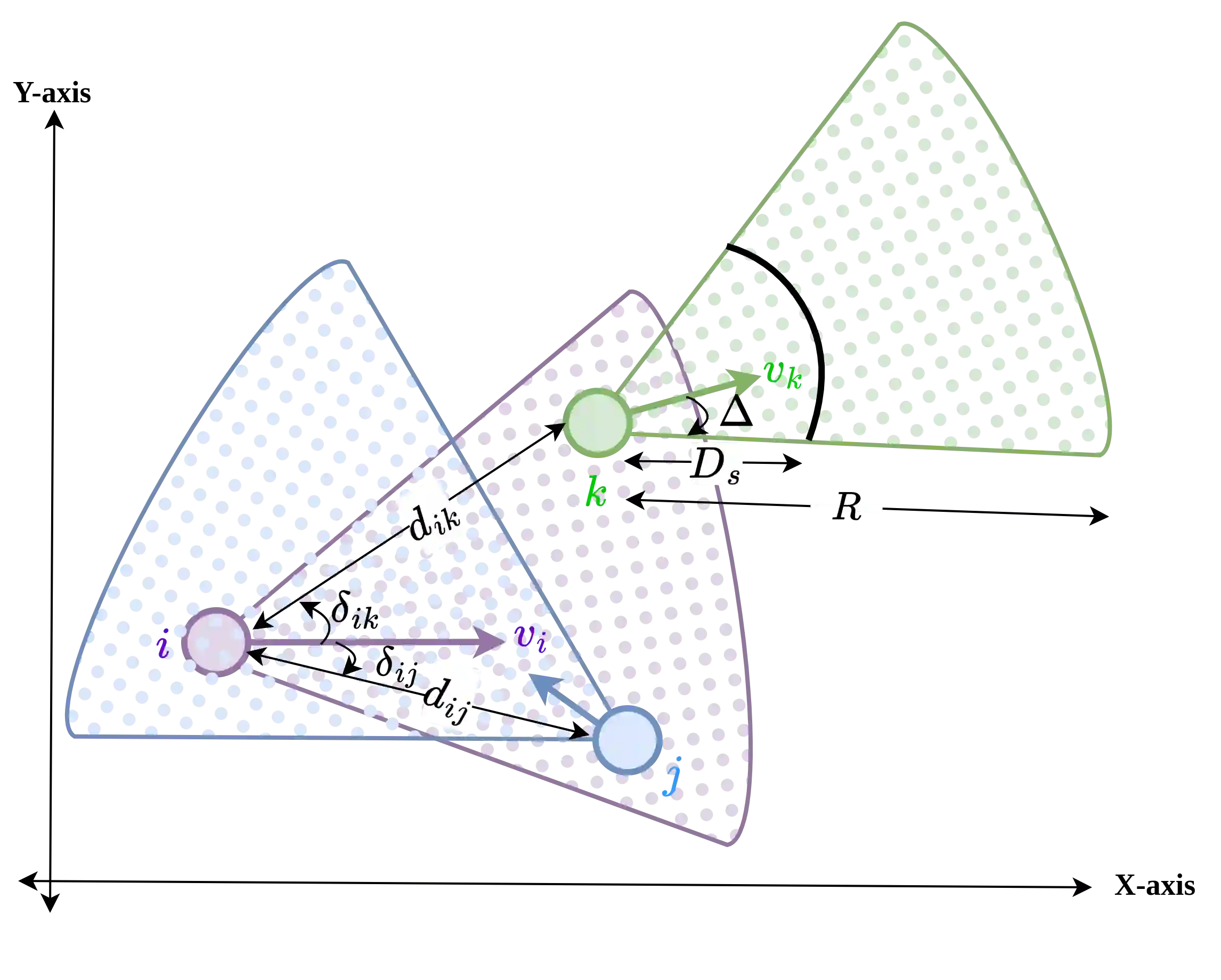
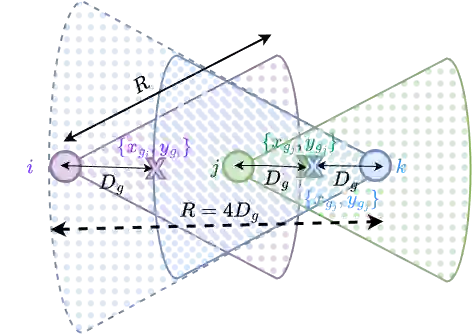
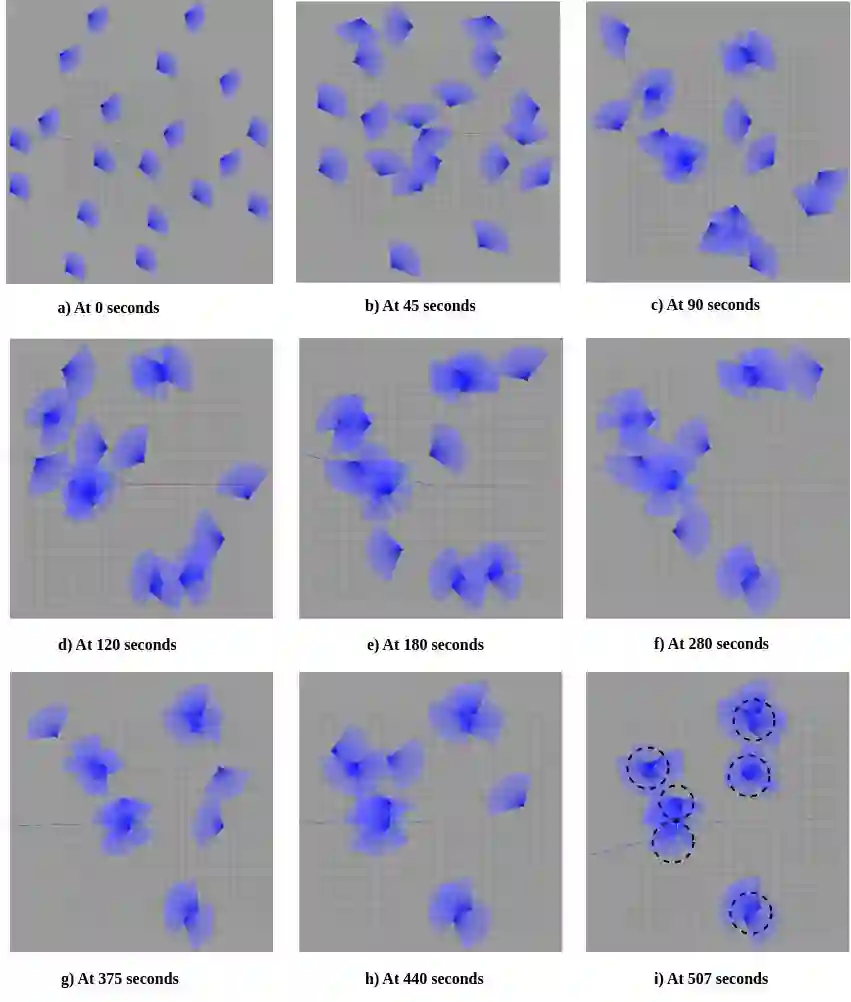
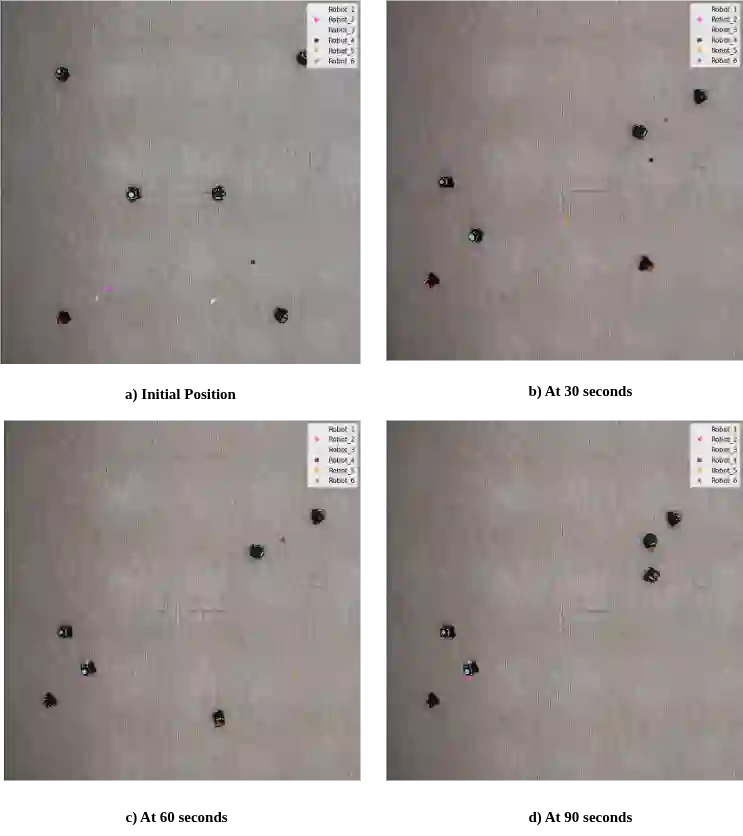
In this work, we investigate swarm self-clustering, where robots autonomously organize into spatially coherent groups using only local sensing and decision-making, without external commands, global positioning, or inter-robot communication. Each robot forms and maintains clusters by responding to relative distances from nearby neighbors detected through onboard range sensors with limited fields of view. The method is suited for GPS-denied and communication-constrained environments and requires no prior knowledge of cluster size, number, or membership. A mechanism enables robots to alternate between consensus-based and random goal assignment based on local neighborhood size, ensuring robustness, scalability, and untraceable clustering independent of initial conditions. Extensive simulations and real-robot experiments demonstrate empirical convergence, adaptability to dynamic additions, and improved performance over local-only baselines across standard cluster quality metrics.
翻译:本文研究群体自聚类问题,其中机器人仅通过局部感知与自主决策,在无外部指令、全局定位或机器人间通信的条件下,自主组织成空间连贯的集群。每个机器人通过机载有限视场测距传感器探测邻近机器人的相对距离,据此形成并维持集群。该方法适用于全球定位系统拒止与通信受限环境,且无需预先获知集群规模、数量或成员构成。通过基于局部邻域规模在共识驱动与随机目标分配间切换的机制,确保了方法的鲁棒性、可扩展性以及与初始条件无关的不可追踪聚类特性。大量仿真与真实机器人实验验证了该方法在经验收敛性、动态增删适应性方面的表现,并在标准聚类质量指标上优于纯局部基线方法。





相关内容


 微信扫码咨询专知VIP会员