

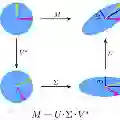
With the widespread application of deep learning across various domains, concerns about its security have grown significantly. Among these, backdoor attacks pose a serious security threat to deep neural networks (DNNs). In recent years, backdoor attacks on neural networks have become increasingly sophisticated, aiming to compromise the security and trustworthiness of models by implanting hidden, unauthorized functionalities or triggers, leading to misleading predictions or behaviors. To make triggers less perceptible and imperceptible, various invisible backdoor attacks have been proposed. However, most of them only consider invisibility in the spatial domain, making it easy for recent defense methods to detect the generated toxic images.To address these challenges, this paper proposes an invisible backdoor attack called DEBA. DEBA leverages the mathematical properties of Singular Value Decomposition (SVD) to embed imperceptible backdoors into models during the training phase, thereby causing them to exhibit predefined malicious behavior under specific trigger conditions. Specifically, we first perform SVD on images, and then replace the minor features of trigger images with those of clean images, using them as triggers to ensure the effectiveness of the attack. As minor features are scattered throughout the entire image, the major features of clean images are preserved, making poisoned images visually indistinguishable from clean ones. Extensive experimental evaluations demonstrate that DEBA is highly effective, maintaining high perceptual quality and a high attack success rate for poisoned images. Furthermore, we assess the performance of DEBA under existing defense measures, showing that it is robust and capable of significantly evading and resisting the effects of these defense measures.
翻译:暂无翻译




相关内容



 微信扫码咨询专知VIP会员