

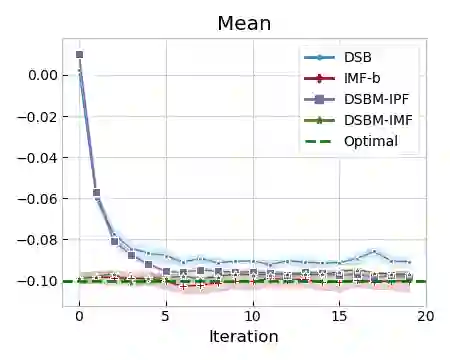
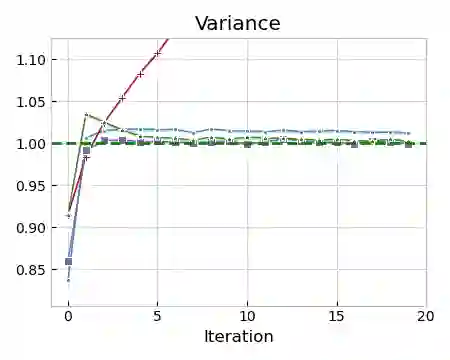
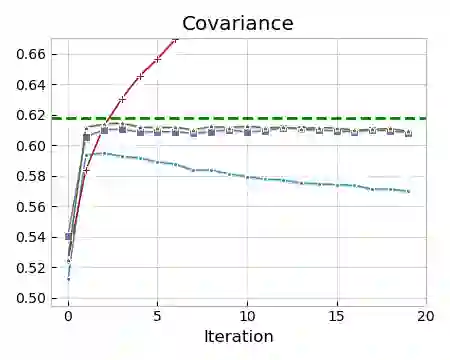
Solving transport problems, i.e. finding a map transporting one given distribution to another, has numerous applications in machine learning. Novel mass transport methods motivated by generative modeling have recently been proposed, e.g. Denoising Diffusion Models (DDMs) and Flow Matching Models (FMMs) implement such a transport through a Stochastic Differential Equation (SDE) or an Ordinary Differential Equation (ODE). However, while it is desirable in many applications to approximate the deterministic dynamic Optimal Transport (OT) map which admits attractive properties, DDMs and FMMs are not guaranteed to provide transports close to the OT map. In contrast, Schr\"odinger bridges (SBs) compute stochastic dynamic mappings which recover entropy-regularized versions of OT. Unfortunately, existing numerical methods approximating SBs either scale poorly with dimension or accumulate errors across iterations. In this work, we introduce Iterative Markovian Fitting, a new methodology for solving SB problems, and Diffusion Schr\"odinger Bridge Matching (DSBM), a novel numerical algorithm for computing IMF iterates. DSBM significantly improves over previous SB numerics and recovers as special/limiting cases various recent transport methods. We demonstrate the performance of DSBM on a variety of problems.
翻译:解决传输问题,即寻找将给定分布映射到另一分布的映射,在机器学习中有着广泛应用。受生成建模启发,近期提出了新的质量传输方法,例如去噪扩散模型(DDM)和流匹配模型(FMM)通过随机微分方程(SDE)或常微分方程(ODE)实现此类传输。然而,尽管在许多应用中需要近似具有优良特性的确定性动态最优传输(OT)映射,DDM和FMM并不能保证提供接近OT映射的传输。相比之下,薛定谔桥(SB)计算的随机动态映射恢复了熵正则化版本的OT。遗憾的是,现有近似SB的数值方法要么维度扩展性差,要么在迭代过程中累积误差。本研究提出了迭代马尔可夫拟合(IMF)这一解决SB问题的新方法论,以及扩散薛定谔桥匹配(DSBM)这一计算IMF迭代的新型数值算法。DSBM显著改进了先前的SB数值方法,并可恢复各种近期传输方法作为其特例/极限情况。我们通过多个问题验证了DSBM的性能。






相关内容


 微信扫码咨询专知VIP会员