

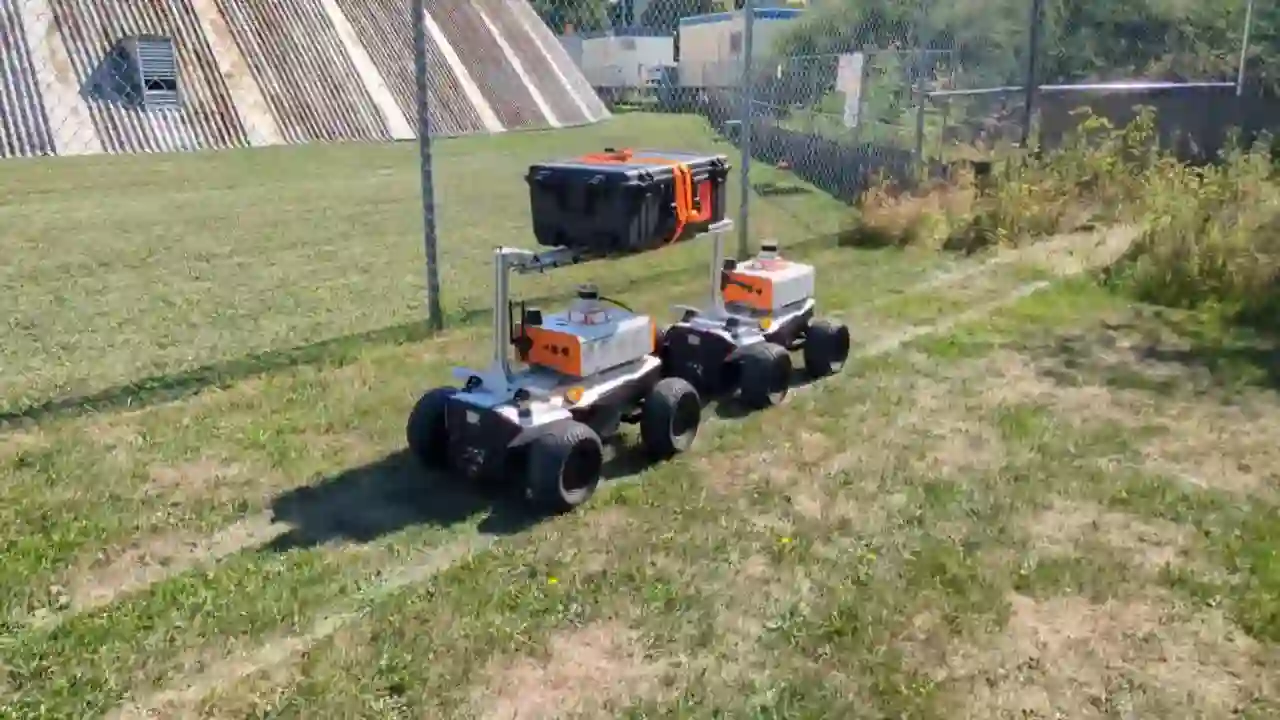
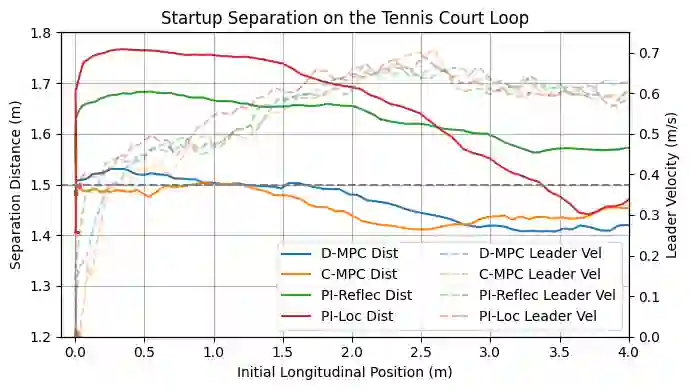
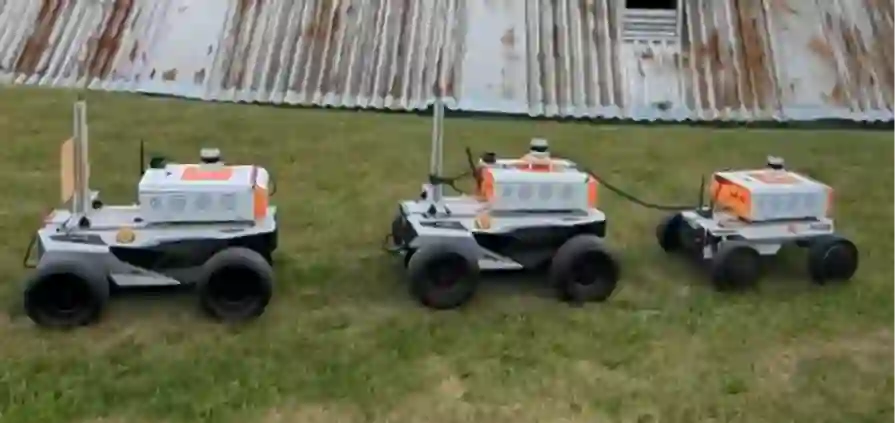
For autonomous cargo transportation, teams of mobile robots can provide more operational flexibility than a single large robot. In these scenarios, precision in both inter-vehicle distance and path tracking is key. With this motivation, we develop a distributed model-predictive controller (MPC) for multi-vehicle cargo operations that builds on the precise path-tracking of lidar teach and repeat. To carry cargo, a following vehicle must maintain a Euclidean distance offset from a lead vehicle regardless of the path curvature. Our approach uses a shared map to localize the robots relative to each other without GNSS or direct observations. We compare our approach to a centralized MPC and a baseline approach that directly measures the inter-vehicle distance. The distributed MPC shows equivalent nominal performance to the more complex centralized MPC. Using a direct measurement of the relative distance between the leader and follower shows improved tracking performance in close-range scenarios but struggles with long-range offsets. The operational flexibility provided by distributing the computation makes it well suited for real deployments. We evaluate four types of convoyed path trackers with over 10 km of driving in a coupled convoy. With convoys of two and three rovers, the proposed distributed MPC method works in real-time to allow map-based convoying to maintain maximum spacing within 20 cm of the target in various conditions.
翻译:在自主货物运输任务中,移动机器人团队相较于单一大型机器人可提供更高的操作灵活性。在此类场景中,车辆间距离与路径跟踪的精确度至关重要。基于此,我们开发了一种用于多车货物运输的分布式模型预测控制器(MPC),该控制器建立在激光雷达示教回放技术所实现的精确路径跟踪基础之上。为运输货物,跟随车辆必须与引导车辆保持固定的欧几里得距离偏移,且不受路径曲率影响。我们的方法通过共享地图实现机器人间的相对定位,无需依赖全球导航卫星系统(GNSS)或直接观测。我们将所提方法与集中式MPC以及直接测量车辆间距的基线方法进行了对比。分布式MPC在标称性能上与更复杂的集中式MPC表现相当。采用直接测量主从车辆相对距离的方法在近距离场景中展现出更优的跟踪性能,但在长距离偏移场景中存在困难。分布式计算带来的操作灵活性使其非常适合实际部署。我们在超过10公里的耦合车队行驶中评估了四种类型的编队路径跟踪器。在双车及三车编队中,所提出的分布式MPC方法能够实时运行,使基于地图的编队系统在各种条件下将最大间距维持在目标值20厘米范围内。




相关内容


 微信扫码咨询专知VIP会员