

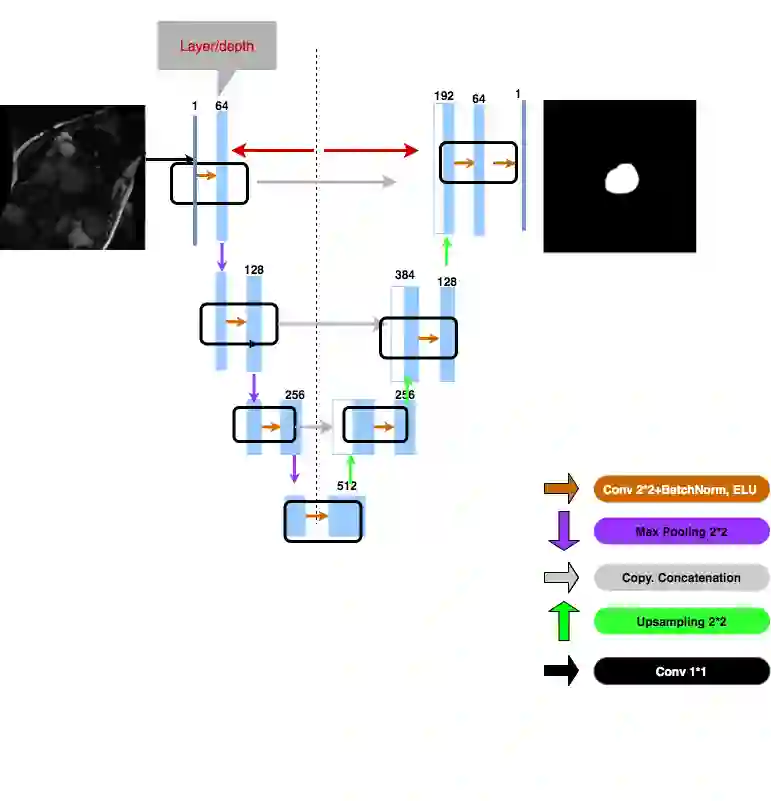
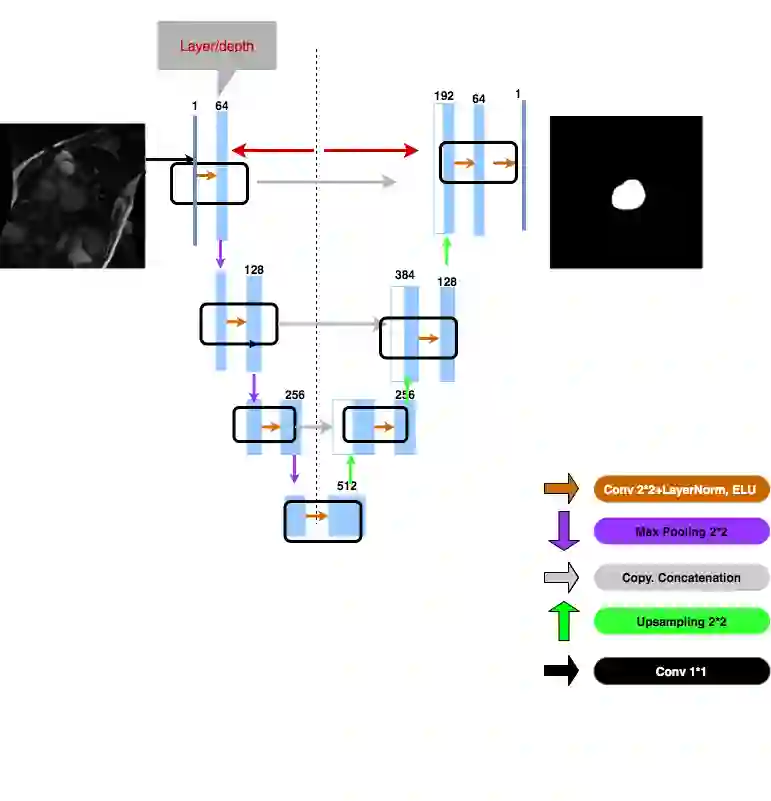
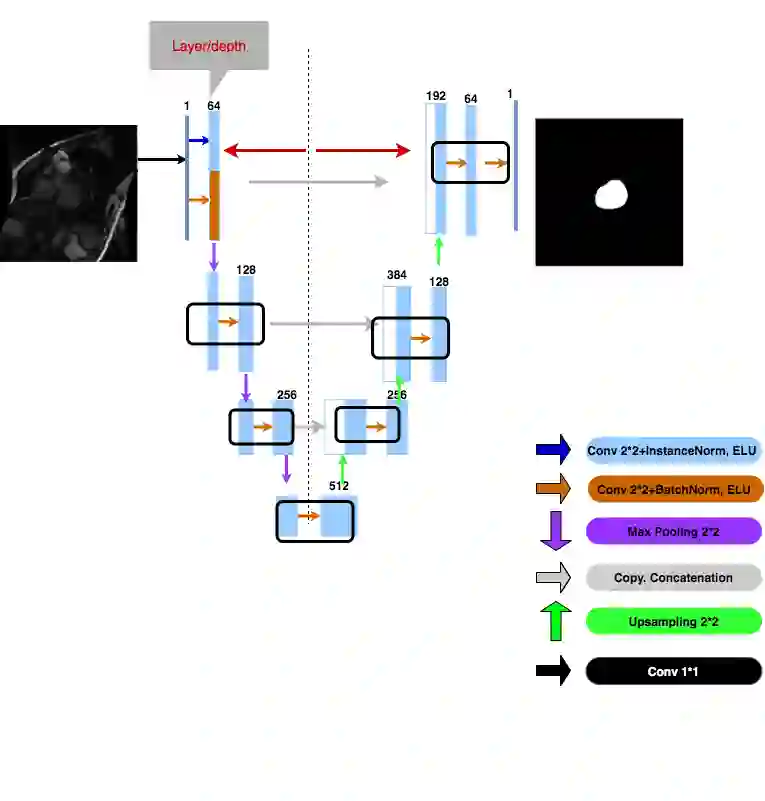
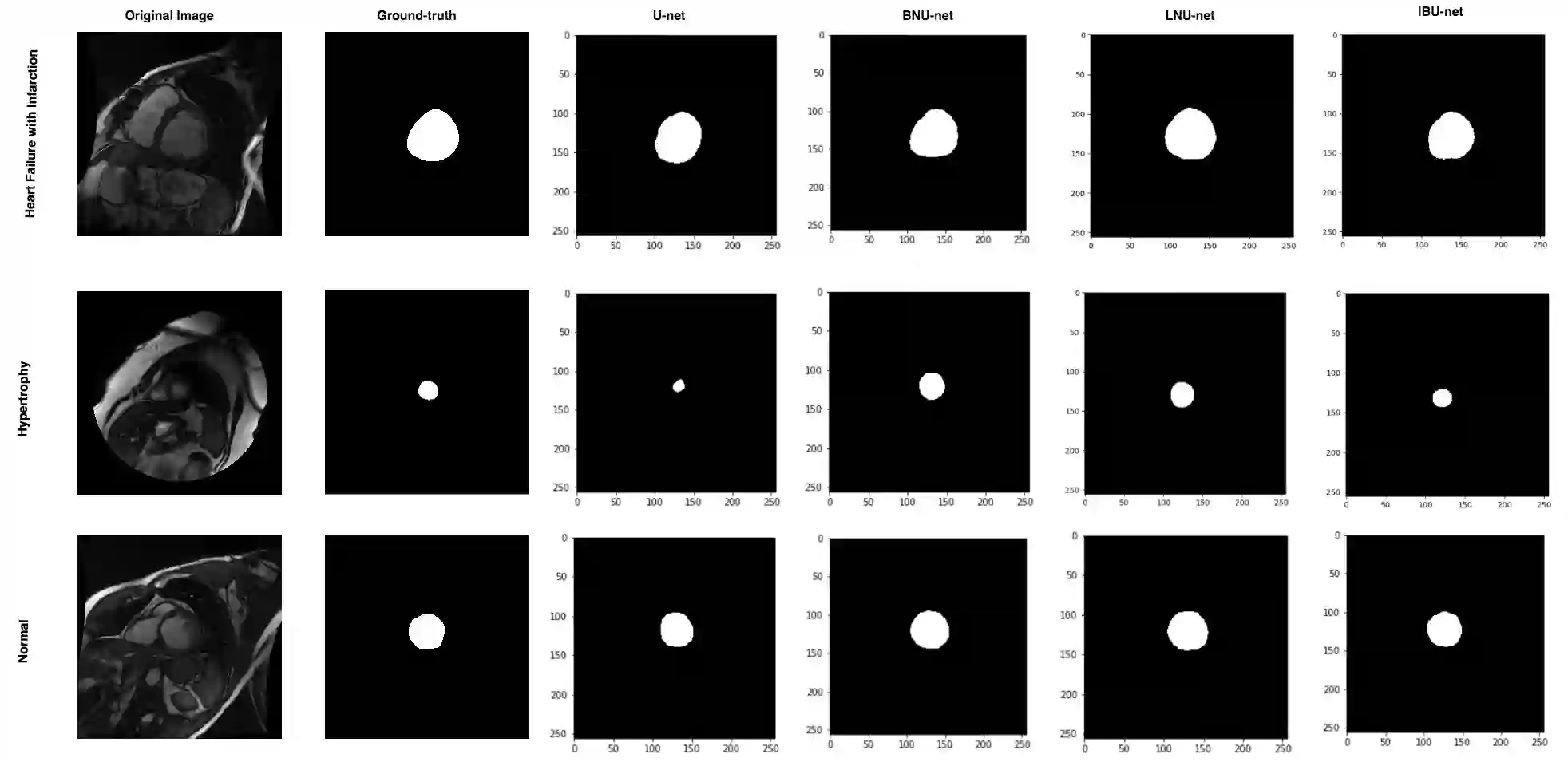
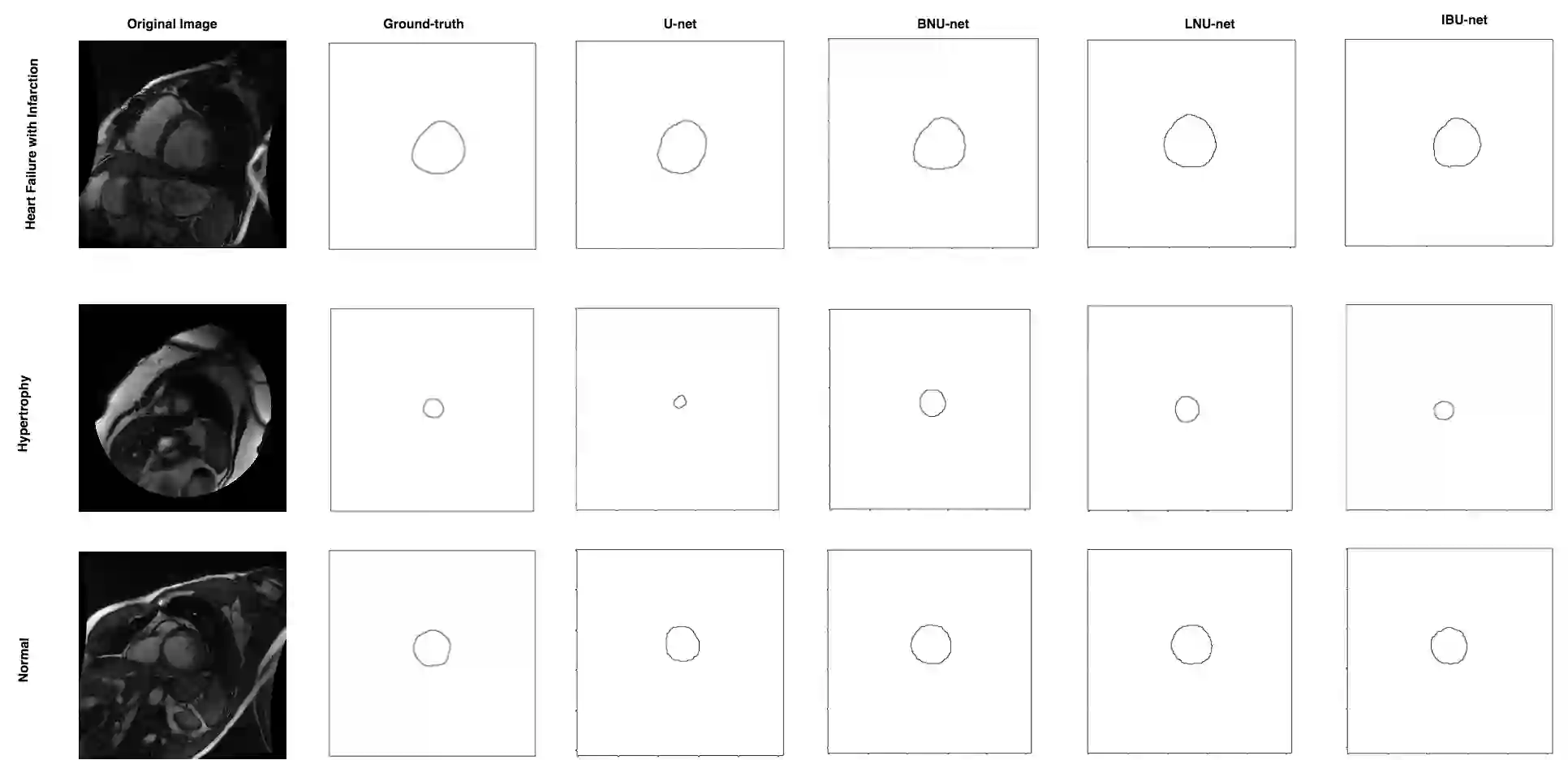
Left ventricle (LV) segmentation is critical for clinical quantification and diagnosis of cardiac images. In this work, we propose two novel deep learning architectures called LNU-Net and IBU-Net for left ventricle segmentation from short-axis cine MRI images. LNU-Net is derived from layer normalization (LN) U-Net architecture, while IBU-Net is derived from the instance-batch normalized (IB) U-Net for medical image segmentation. The architectures of LNU-Net and IBU-Net have a down-sampling path for feature extraction and an up-sampling path for precise localization. We use the original U-Net as the basic segmentation approach and compared it with our proposed architectures. Both LNU-Net and IBU-Net have left ventricle segmentation methods: LNU-Net applies layer normalization in each convolutional block, while IBU-Net incorporates instance and batch normalization together in the first convolutional block and passes its result to the next layer. Our method incorporates affine transformations and elastic deformations for image data processing. Our dataset that contains 805 MRI images regarding the left ventricle from 45 patients is used for evaluation. We experimentally evaluate the results of the proposed approaches outperforming the dice coefficient and the average perpendicular distance than other state-of-the-art approaches.
翻译:左心室分割对于心脏影像的临床量化与诊断至关重要。本研究针对短轴电影磁共振图像中的左心室分割问题,提出了两种新型深度学习架构:LNU-Net与IBU-Net。LNU-Net基于层归一化U-Net架构改进而来,而IBU-Net则源自医学图像分割中使用的实例-批量归一化U-Net架构。LNU-Net与IBU-Net均采用下采样路径进行特征提取,并利用上采样路径实现精确定位。我们以原始U-Net作为基础分割方法,并将其与所提出的架构进行比较。两种网络均具备左心室分割功能:LNU-Net在每个卷积块中应用层归一化,而IBU-Net则在首个卷积块中融合实例归一化与批量归一化,并将处理结果传递至后续层级。本方法在图像数据处理中整合了仿射变换与弹性形变技术。我们采用包含45名患者共805幅左心室磁共振图像的数据集进行评估。实验结果表明,所提出方法在Dice系数与平均垂直距离指标上均优于现有先进方法。




相关内容


 微信扫码咨询专知VIP会员