

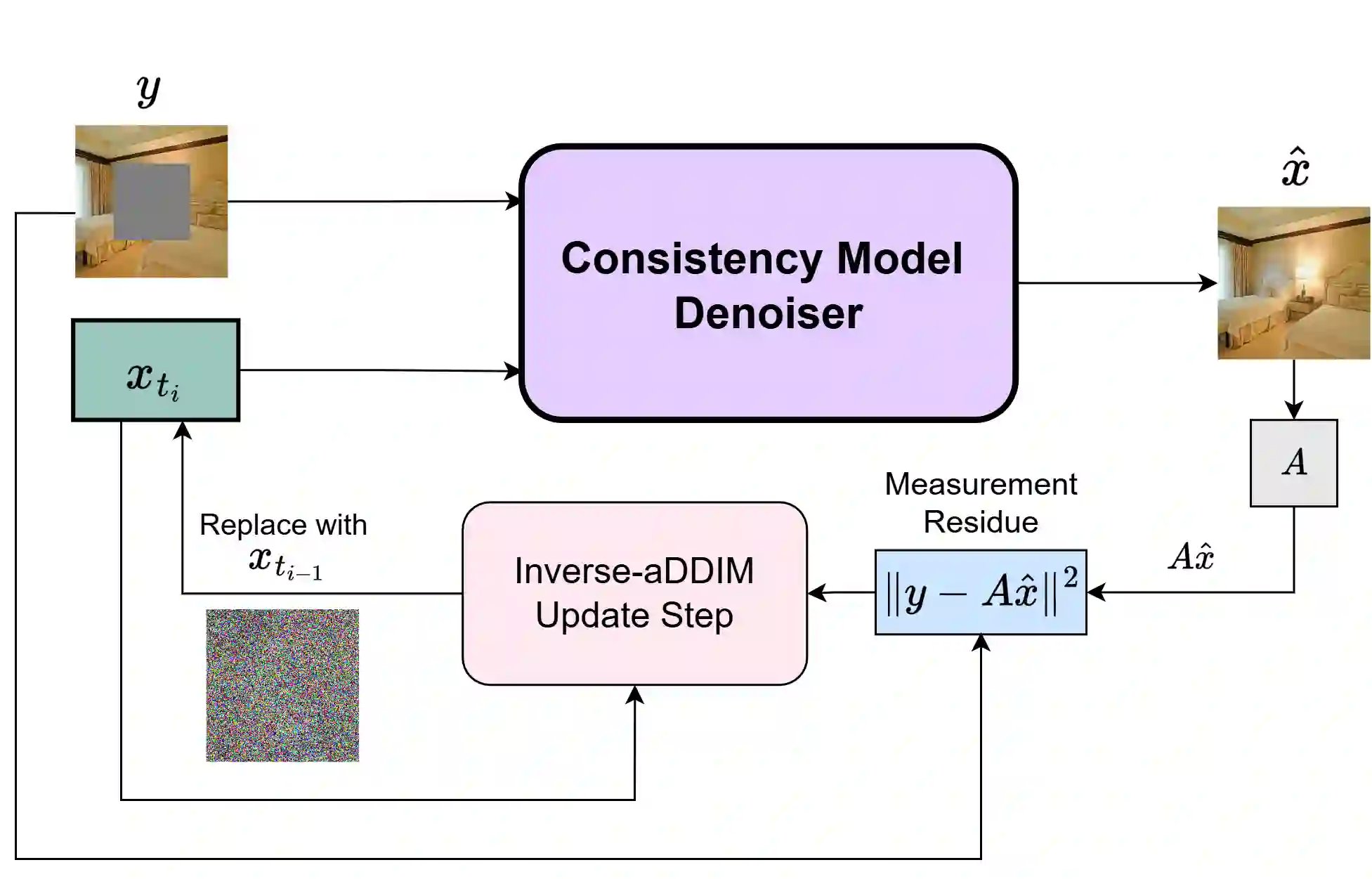
Diffusion models have become powerful generative priors for solving inverse imaging problems, but their reliance on slow multi-step sampling limits practical deployment. Consistency models address this bottleneck by enabling high-quality generation in a single or only a few steps, yet their direct adaptation to inverse problems is underexplored. In this paper, we present a modified consistency sampling approach tailored for inverse problem reconstruction: the sampler's stochasticity is guided by a measurement-consistency mechanism tied to the measurement operator, which enforces fidelity to the acquired measurements while retaining the efficiency of consistency-based generation. Experiments on Fashion-MNIST and LSUN Bedroom datasets demonstrate consistent improvements in perceptual and pixel-level metrics, including Fr\'echet Inception Distance, Kernel Inception Distance, peak signal-to-noise ratio, and structural similarity index measure, compared to baseline consistency sampling, yielding competitive or superior reconstructions with only a handful of steps.
翻译:扩散模型已成为解决逆成像问题的强大生成先验,但其依赖缓慢的多步采样限制了实际部署。一致性模型通过实现单步或仅需少数步骤的高质量生成解决了这一瓶颈,然而其在逆问题中的直接应用尚未得到充分探索。本文提出一种针对逆问题重建改进的一致性采样方法:采样器的随机性由与测量算子关联的测量一致性机制引导,该机制在保持基于一致性生成效率的同时,强制满足对已获取测量数据的保真度。在Fashion-MNIST和LSUN Bedroom数据集上的实验表明,相较于基线一致性采样方法,本方法在感知指标与像素级指标(包括Fr\'echet Inception距离、Kernel Inception距离、峰值信噪比和结构相似性指数)上均取得持续改进,仅需少量采样步骤即可获得具有竞争力或更优的重建结果。








相关内容




 微信扫码咨询专知VIP会员