

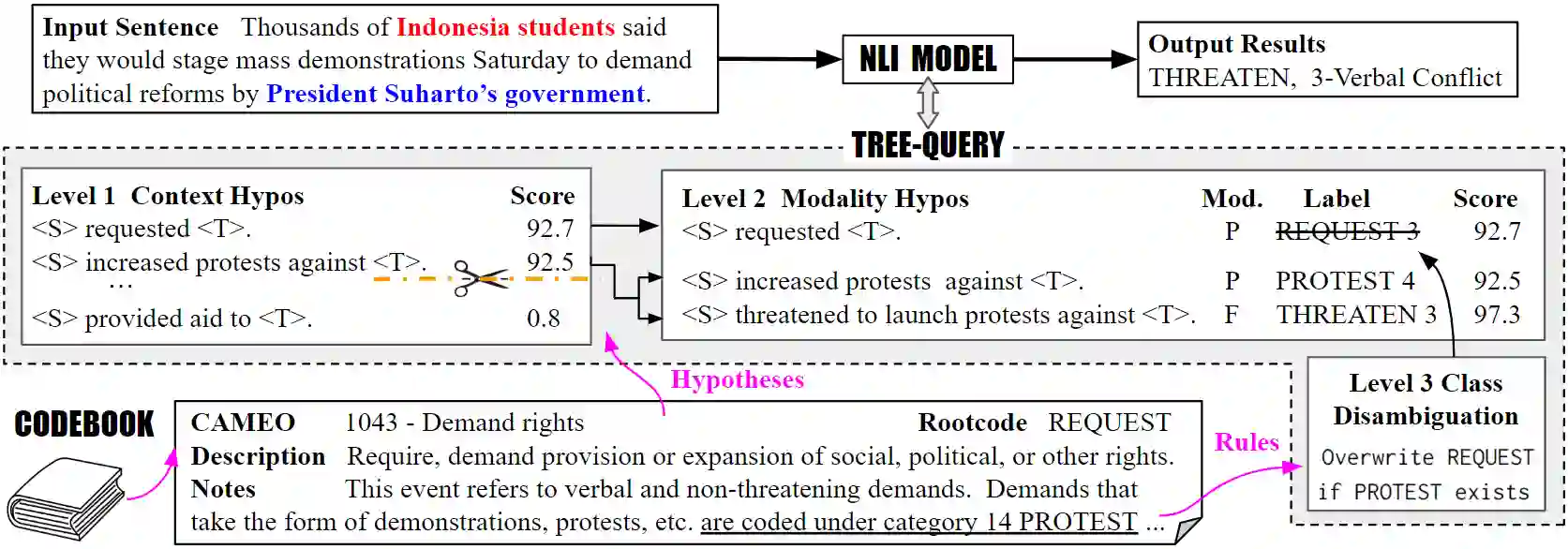
Recent supervised models for event coding vastly outperform pattern-matching methods. However, their reliance solely on new annotations disregards the vast knowledge within expert databases, hindering their applicability to fine-grained classification. To address these limitations, we explore zero-shot approaches for political event ontology relation classification, by leveraging knowledge from established annotation codebooks. Our study encompasses both ChatGPT and a novel natural language inference (NLI) based approach named ZSP. ZSP adopts a tree-query framework that deconstructs the task into context, modality, and class disambiguation levels. This framework improves interpretability, efficiency, and adaptability to schema changes. By conducting extensive experiments on our newly curated datasets, we pinpoint the instability issues within ChatGPT and highlight the superior performance of ZSP. ZSP achieves an impressive 40% improvement in F1 score for fine-grained Rootcode classification. ZSP demonstrates competitive performance compared to supervised BERT models, positioning it as a valuable tool for event record validation and ontology development. Our work underscores the potential of leveraging transfer learning and existing expertise to enhance the efficiency and scalability of research in the field.
翻译:近期基于事件编码的监督模型在性能上显著优于模式匹配方法。然而,此类模型完全依赖新标注数据,忽视了专家数据库中蕴含的丰富知识,制约了其在细粒度分类任务中的适用性。为应对上述局限,我们通过利用既有标注代码簿中的知识,探索了政治事件本体关系分类的零样本方法。本研究同时涵盖ChatGPT与基于自然语言推理(NLI)的新型方法ZSP。ZSP采用树形查询框架,将任务分解为上下文、模态和类别消歧三个层级,该框架提升了可解释性、运行效率及对模式变更的适应能力。通过在新构建数据集上开展大量实验,我们发现了ChatGPT存在的稳定性缺陷,并验证了ZSP的优越性能——在细粒度根码分类中,ZSP的F1值实现了40%的显著提升。与监督式BERT模型相比,ZSP展现出具有竞争力的表现,使其成为事件记录验证与本体开发的重要工具。本研究凸显了通过迁移学习与既有专业知识推进行政学领域研究效率与可扩展性的潜力。




相关内容





 微信扫码咨询专知VIP会员