

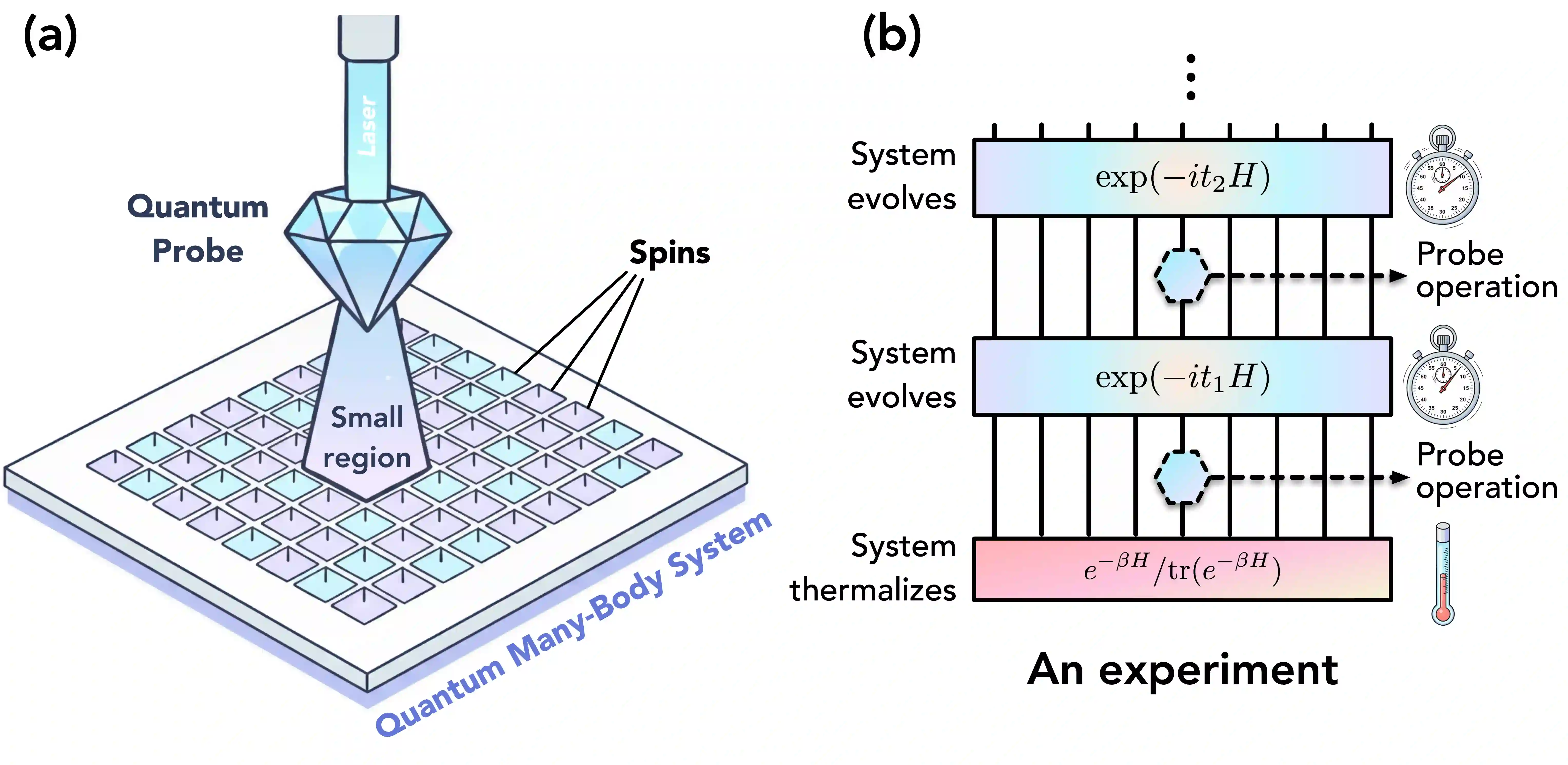
Characterizing quantum many-body systems is a fundamental problem across physics, chemistry, and materials science. While significant progress has been made, many existing Hamiltonian learning protocols demand digital quantum control over the entire system, creating a disconnect from many real-world settings that provide access only through small, local probes. Motivated by this, we introduce and formalize the problem of quantum probe tomography, where one seeks to learn the parameters of a many-body Hamiltonian using a single local probe access to a small subsystem of a many-body thermal state undergoing time evolution. We address the identifiability problem of determining which Hamiltonians can be distinguished from probe data through a new combination of tools from algebraic geometry and smoothed analysis. Using this approach, we prove that generic Hamiltonians in various physically natural families are identifiable up to simple, unavoidable structural symmetries. Building on these insights, we design the first efficient end-to-end algorithm for probe tomography that learns Hamiltonian parameters to accuracy $\varepsilon$, with query complexity scaling polynomially in $1/\varepsilon$ and classical post-processing time scaling polylogarithmically in $1/\varepsilon$. In particular, we demonstrate that translation- and rotation-invariant nearest-neighbor Hamiltonians on square lattices in one, two, and three dimensions can be efficiently reconstructed from single-site probes of the Gibbs state, up to inversion symmetry about the probed site. Our results demonstrate that robust Hamiltonian learning remains achievable even under severely constrained experimental access.
翻译:表征量子多体系统是贯穿物理学、化学和材料科学的一个基础性问题。尽管已取得显著进展,但许多现有的哈密顿量学习协议要求对整个系统进行数字量子控制,这与许多现实场景存在脱节,因为这些场景通常仅能通过小型局部探针进行访问。受此启发,我们引入并形式化了量子探针层析成像问题,其目标是通过对经历时间演化的多体热态的一个小子系统进行单点局部探针访问,来学习多体哈密顿量的参数。我们通过结合代数几何与平滑分析的新工具,解决了从探针数据中确定哪些哈密顿量可被区分的可辨识性问题。利用该方法,我们证明了各类物理自然族中的一般哈密顿量在除去简单且不可避免的结构对称性后是可辨识的。基于这些见解,我们设计了首个高效的端到端探针层析算法,该算法能以精度 $\varepsilon$ 学习哈密顿量参数,其查询复杂度按 $1/\varepsilon$ 的多项式增长,而经典后处理时间按 $1/\varepsilon$ 的多对数增长。特别地,我们证明了一维、二维和三维正方晶格上具有平移与旋转不变性的最近邻哈密顿量,可以从吉布斯态的单点探针数据中高效重构,仅存在关于探针位点的反演对称性这一不确定性。我们的结果表明,即使在实验访问受到严重限制的情况下,稳健的哈密顿量学习仍然是可能实现的。




相关内容



 微信扫码咨询专知VIP会员