

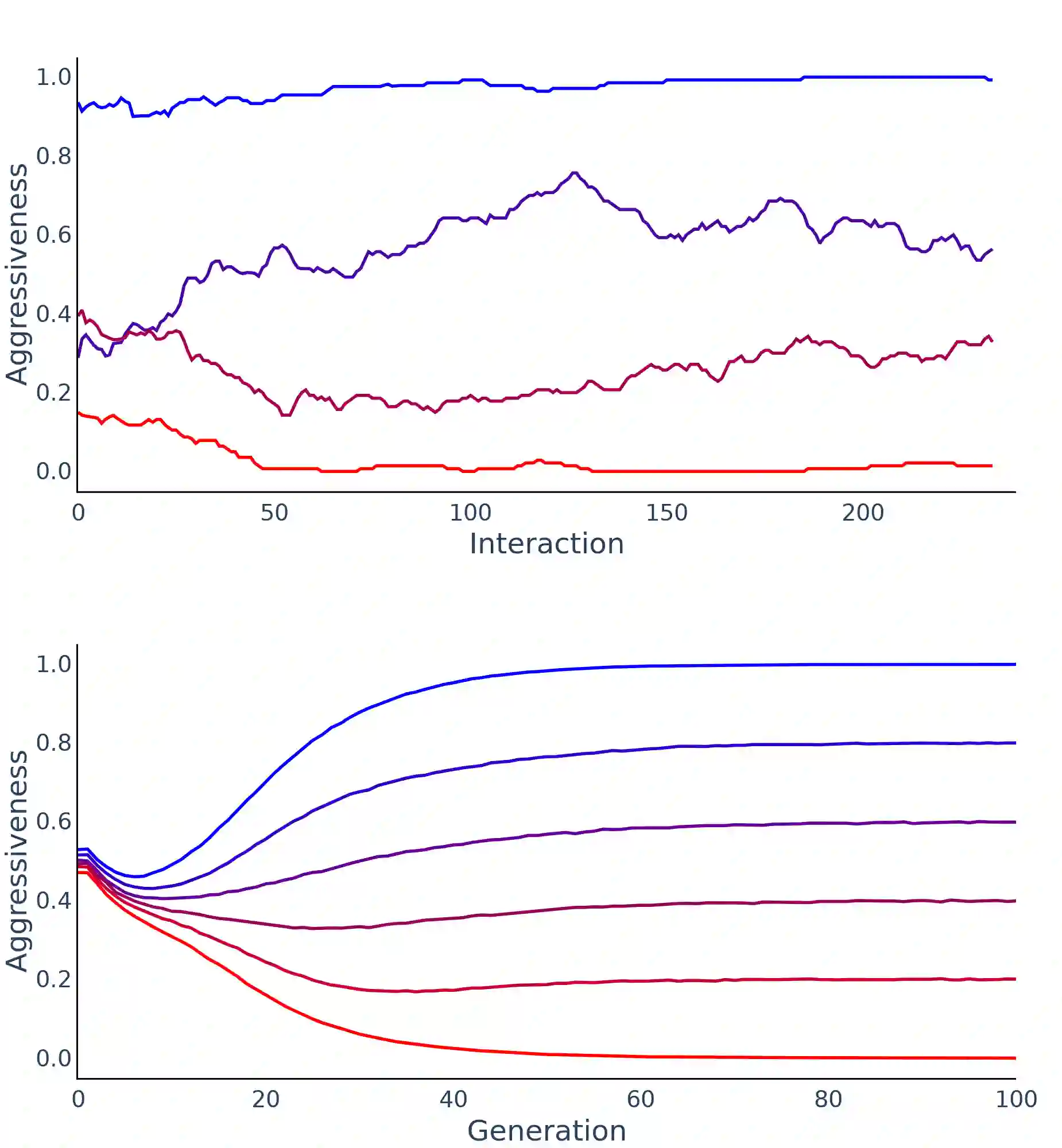
Modern Reinforcement Learning (RL) algorithms are able to outperform humans in a wide variety of tasks. Multi-agent reinforcement learning (MARL) settings present additional challenges, and successful cooperation in mixed-motive groups of agents depends on a delicate balancing act between individual and group objectives. Social conventions and norms, often inspired by human institutions, are used as tools for striking this balance. In this paper, we examine a fundamental, well-studied social convention that underlies cooperation in both animal and human societies: dominance hierarchies. We adapt the ethological theory of dominance hierarchies to artificial agents, borrowing the established terminology and definitions with as few amendments as possible. We demonstrate that populations of RL agents, operating without explicit programming or intrinsic rewards, can invent, learn, enforce, and transmit a dominance hierarchy to new populations. The dominance hierarchies that emerge have a similar structure to those studied in chickens, mice, fish, and other species.
翻译:暂无翻译




相关内容




 微信扫码咨询专知VIP会员