

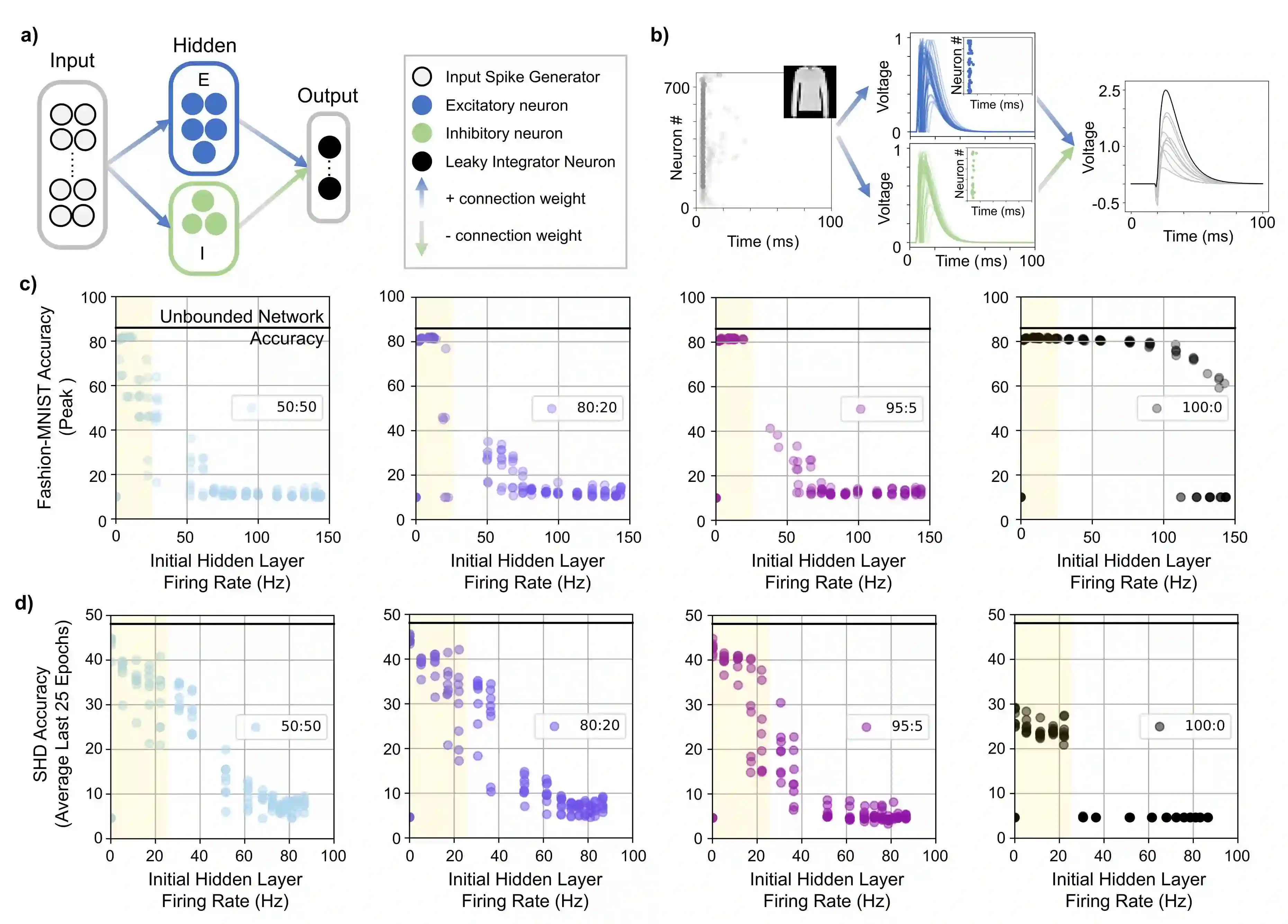
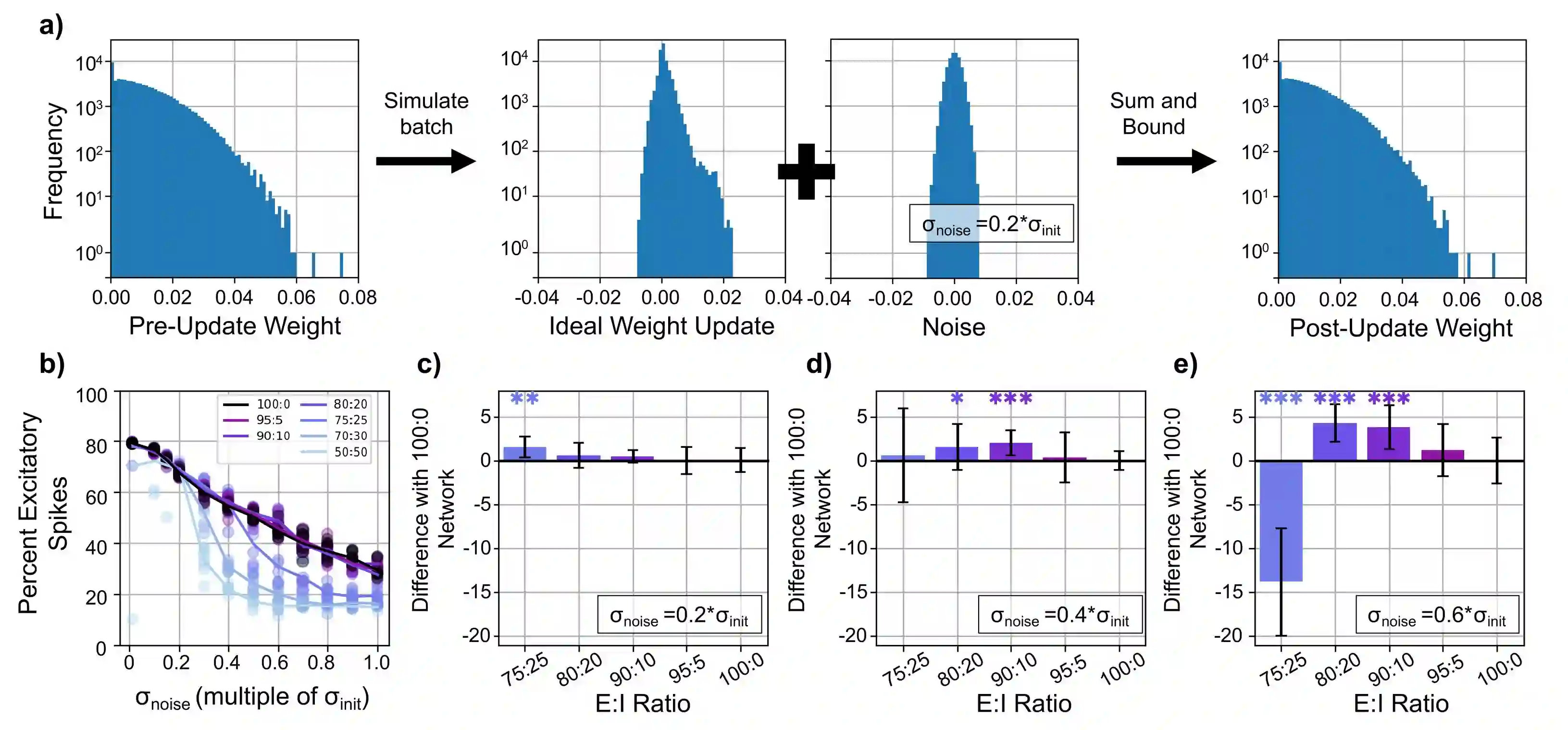
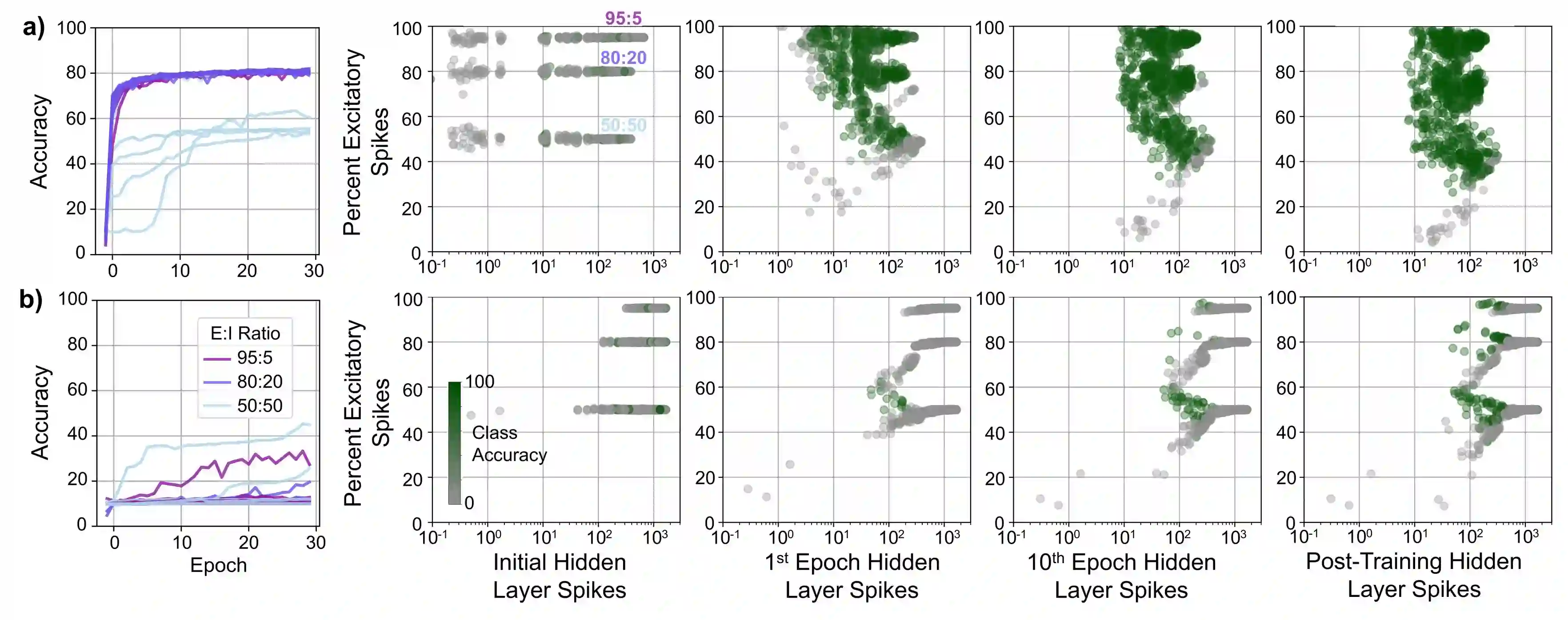
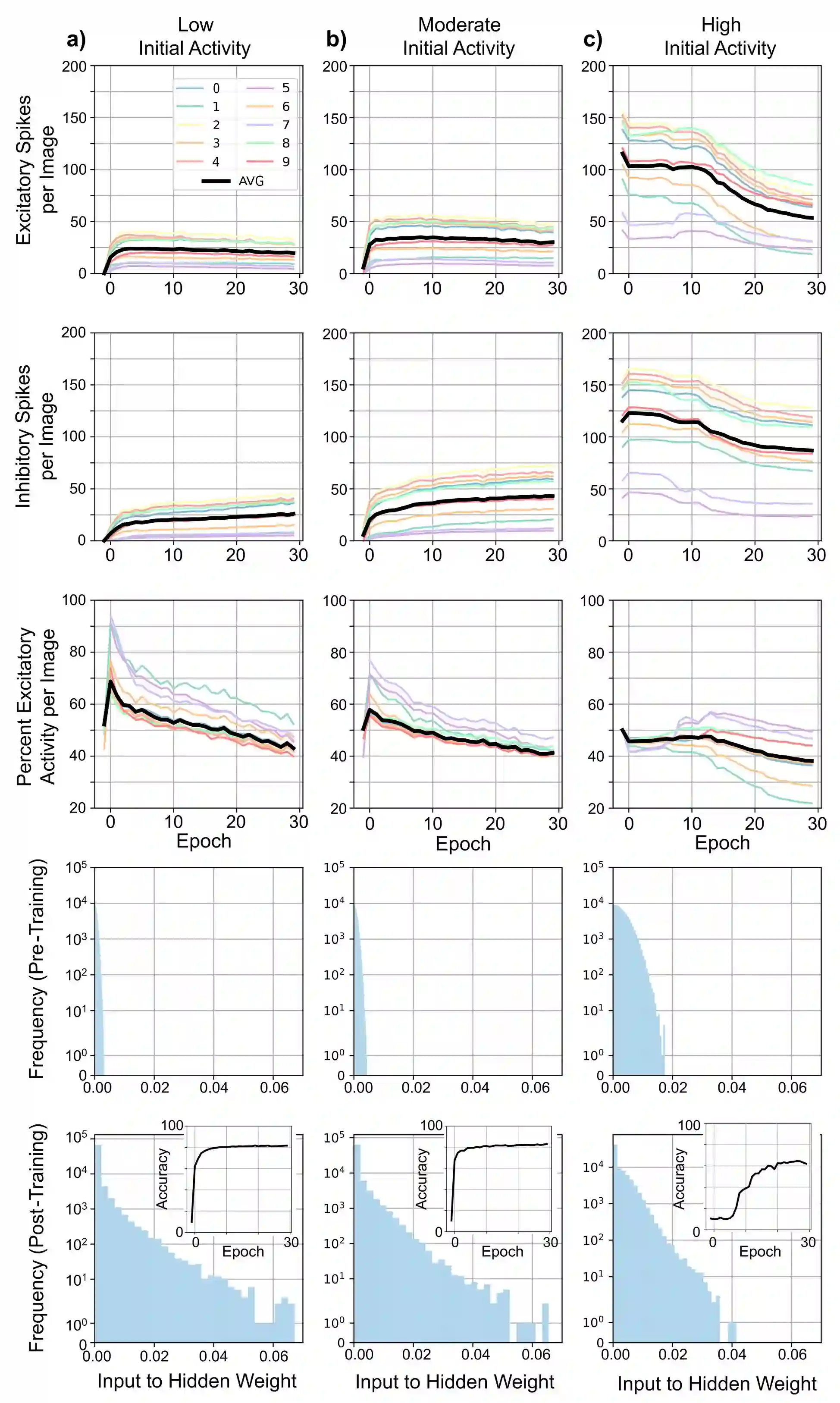
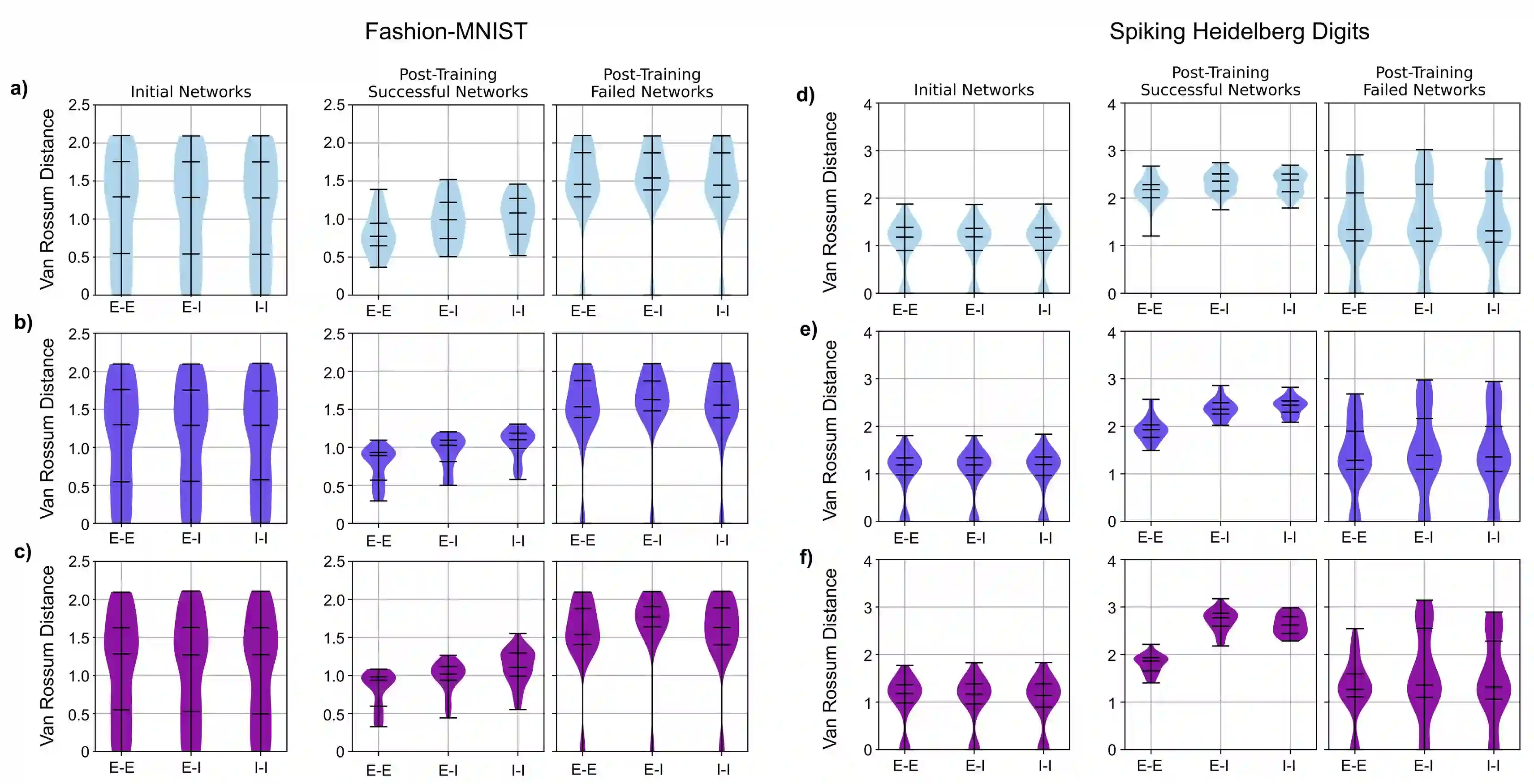
Spiking neural networks drawing inspiration from biological constraints of the brain promise an energy-efficient paradigm for artificial intelligence. However, challenges exist in identifying guiding principles to train these networks in a robust fashion. In addition, training becomes an even more difficult problem when incorporating biological constraints of excitatory and inhibitory connections. In this work, we identify several key factors, such as low initial firing rates and diverse inhibitory spiking patterns, that determine the overall ability to train spiking networks with various ratios of excitatory to inhibitory neurons on AI-relevant datasets. The results indicate networks with the biologically realistic 80:20 excitatory:inhibitory balance can reliably train at low activity levels and in noisy environments. Additionally, the Van Rossum distance, a measure of spike train synchrony, provides insight into the importance of inhibitory neurons to increase network robustness to noise. This work supports further biologically-informed large-scale networks and energy efficient hardware implementations.
翻译:脉冲神经网络借鉴了大脑的生物约束,为人工智能提供了一种能效高效的范式。然而,在确定鲁棒训练这些网络的指导原则方面仍存在挑战。此外,在纳入兴奋性和抑制性连接的生物约束时,训练问题变得更加困难。在本工作中,我们识别了几个关键因素,如低初始发放率和多样化的抑制性脉冲模式,这些因素决定了在AI相关数据集上以不同兴奋性/抑制性神经元比例训练脉冲网络的整体能力。结果表明,具有生物现实80:20兴奋-抑制平衡的网络能够在低活动水平和噪声环境中可靠地训练。此外,Van Rossum距离(一种脉冲序列同步性度量)揭示了抑制性神经元在增强网络对噪声鲁棒性方面的重要性。本研究进一步支持了生物启发的大规模网络和能效硬件实现。




相关内容




 微信扫码咨询专知VIP会员