

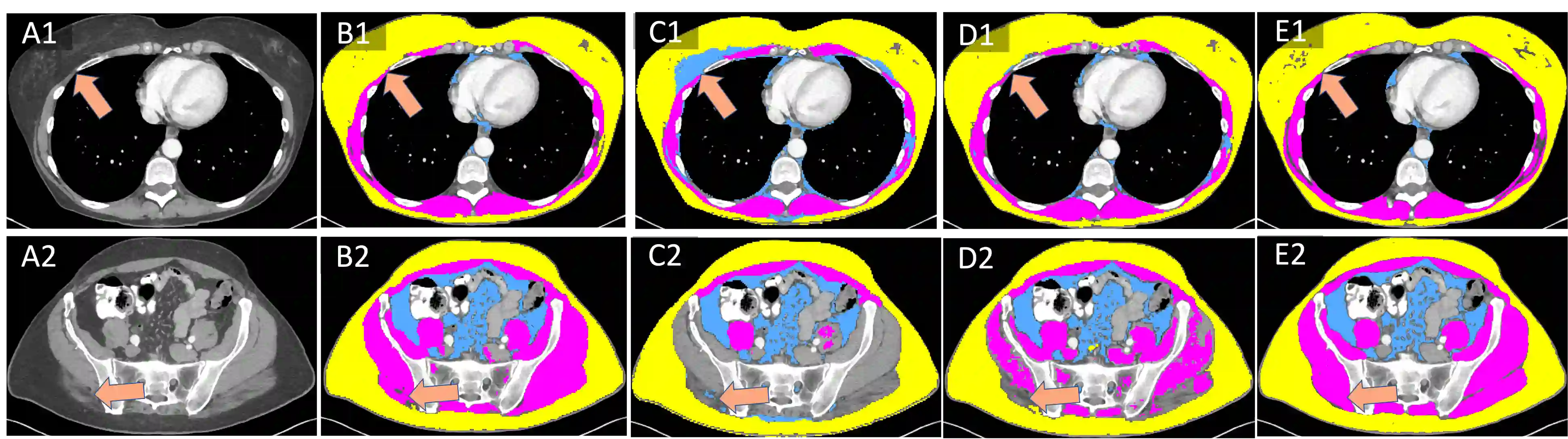
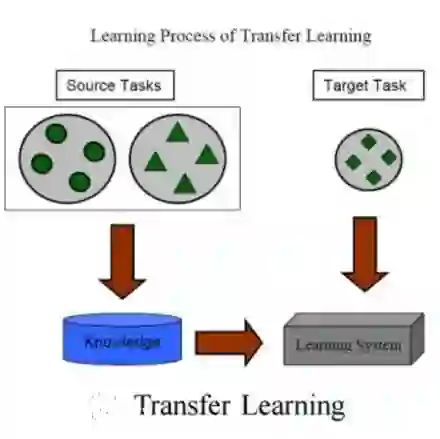
Accurate training labels are a key component for multi-class medical image segmentation. Their annotation is costly and time-consuming because it requires domain expertise. This work aims to develop a dual-branch network and automatically improve training labels for multi-class image segmentation. Transfer learning is used to train the network and improve inaccurate weak labels sequentially. The dual-branch network is first trained by weak labels alone to initialize model parameters. After the network is stabilized, the shared encoder is frozen, and strong and weak decoders are fine-tuned by strong and weak labels together. The accuracy of weak labels is iteratively improved in the fine-tuning process. The proposed method was applied to a three-class segmentation of muscle, subcutaneous and visceral adipose tissue on abdominal CT scans. Validation results on 11 patients showed that the accuracy of training labels was statistically significantly improved, with the Dice similarity coefficient of muscle, subcutaneous and visceral adipose tissue increased from 74.2% to 91.5%, 91.2% to 95.6%, and 77.6% to 88.5%, respectively (p<0.05). In comparison with our earlier method, the label accuracy was also significantly improved (p<0.05). These experimental results suggested that the combination of the dual-branch network and transfer learning is an efficient means to improve training labels for multi-class segmentation.
翻译:精确的训练标签是实现多类医学图像分割的关键要素。由于需要领域专业知识,其标注过程既昂贵又耗时。本研究旨在开发一种双分支网络,自动提升多类图像分割的训练标签质量。采用迁移学习依次训练网络并改进不准确的弱标签:首先仅使用弱标签训练双分支网络以初始化模型参数;网络稳定后冻结共享编码器,同时使用强标签和弱标签对强弱解码器进行微调。在微调过程中,弱标签的准确性通过迭代方式持续提升。该方法应用于腹部CT扫描中肌肉、皮下脂肪和内脏脂肪组织的三分类分割任务。对11例患者的验证结果显示,训练标签精度获得统计学显著提升:肌肉、皮下脂肪和内脏脂肪组织的Dice相似系数分别从74.2%提升至91.5%、从91.2%提升至95.6%、从77.6%提升至88.5%(p<0.05)。与前期方法相比,标签精度同样显著提高(p<0.05)。实验结果表明,双分支网络与迁移学习的结合是提升多类分割训练标签质量的有效手段。






相关内容



 微信扫码咨询专知VIP会员