

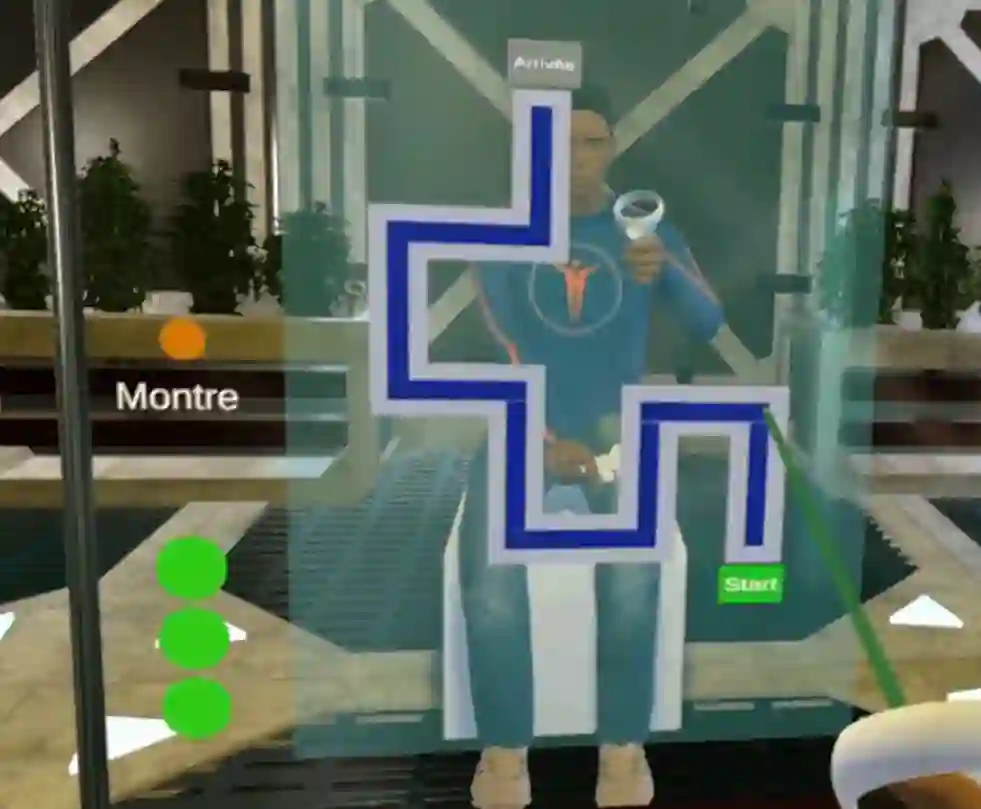
Understanding which factors could influence co-presence in Virtual Reality could help develop more qualitative social interactions, or social interactions that generate similar sensations, emotions and feelings than the ones generated during Face-to-Face interactions. Co-presence is studied since the beginning of Virtual Reality (VR); though, no consensus is identified on what factors could influence it, except the consensus on the definition of "being there together" inside the Virtual Environment. In this paper, we introduce the Koinos method to explain social interactions in VR through communication models, (i) theoretically, and (ii) on two VR experiments that change the virtual partner social and physical representations. These analyses lead us to propose an equation to predict and help manage the sense of co-presence in VR.
翻译:理解影响虚拟现实中共同临场感的因素,有助于开发更具质性的社交互动,或产生与面对面互动相似感知、情感和体验的社交互动。自虚拟现实技术诞生以来,共同临场感始终是研究焦点;然而除"在虚拟环境中共同存在"这一共识性定义外,学界尚未就影响因素达成一致。本文提出Koinos方法,通过传播模型阐释虚拟现实中的社交互动:(i)从理论层面构建分析框架,(ii)基于两项改变虚拟伙伴社会表征与物理表征的VR实验进行实证分析。这些研究最终推导出可预测并辅助调控VR共同临场感的量化方程。






相关内容


 微信扫码咨询专知VIP会员