

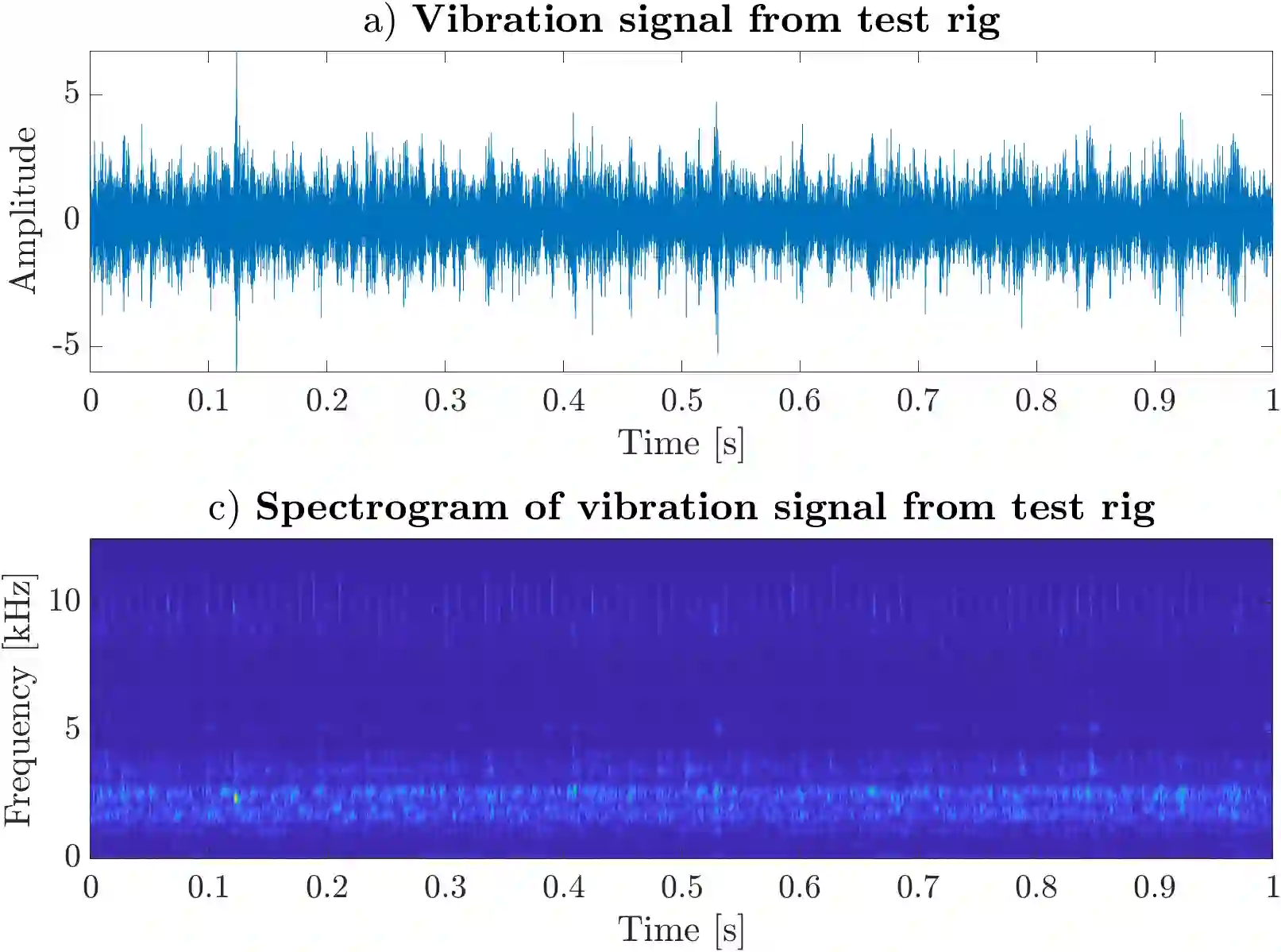
The selection of penalty hyperparameters is a critical aspect in Nonnegative Matrix Factorization (NMF), since these values control the trade-off between reconstruction accuracy and adherence to desired constraints. In this work, we focus on an NMF problem involving the Itakura-Saito (IS) divergence, which is particularly effective for extracting low spectral density components from spectrograms of mixed signals, and benefits from the introduction of sparsity constraints. We propose a new algorithm called SHINBO, which introduces a bi-level optimization framework to automatically and adaptively tune the row-dependent penalty hyperparameters, enhancing the ability of IS-NMF to isolate sparse, periodic signals in noisy environments. Experimental results demonstrate that SHINBO achieves accurate spectral decompositions and demonstrates superior performance in both synthetic and real-world applications. In the latter case, SHINBO is particularly useful for noninvasive vibration-based fault detection in rolling bearings, where the desired signal components often reside in high-frequency subbands but are obscured by stronger, spectrally broader noise. By addressing the critical issue of hyperparameter selection, SHINBO improves the state-of-the-art in signal recovery for complex, noise-dominated environments.
翻译:惩罚超参数的选择是非负矩阵分解(NMF)中的一个关键环节,因为这些参数控制着重建精度与满足期望约束之间的权衡。本文聚焦于一个涉及Itakura-Saito(IS)散度的NMF问题,该散度对于从混合信号的谱图中提取低谱密度分量特别有效,并能从引入稀疏约束中获益。我们提出了一种名为SHINBO的新算法,该算法引入了一个双层优化框架,以自动且自适应地调整与行相关的惩罚超参数,从而增强了IS-NMF在噪声环境中分离稀疏周期性信号的能力。实验结果表明,SHINBO实现了精确的谱分解,并在合成数据与实际应用场景中均表现出优越的性能。在实际应用中,SHINBO对于滚动轴承中基于振动的非侵入式故障检测尤为有用,因为期望的信号分量通常位于高频子带中,但被更强、频谱更宽的噪声所掩盖。通过解决超参数选择这一关键问题,SHINBO提升了在复杂、噪声主导环境下的信号恢复技术水平。








相关内容



 微信扫码咨询专知VIP会员