

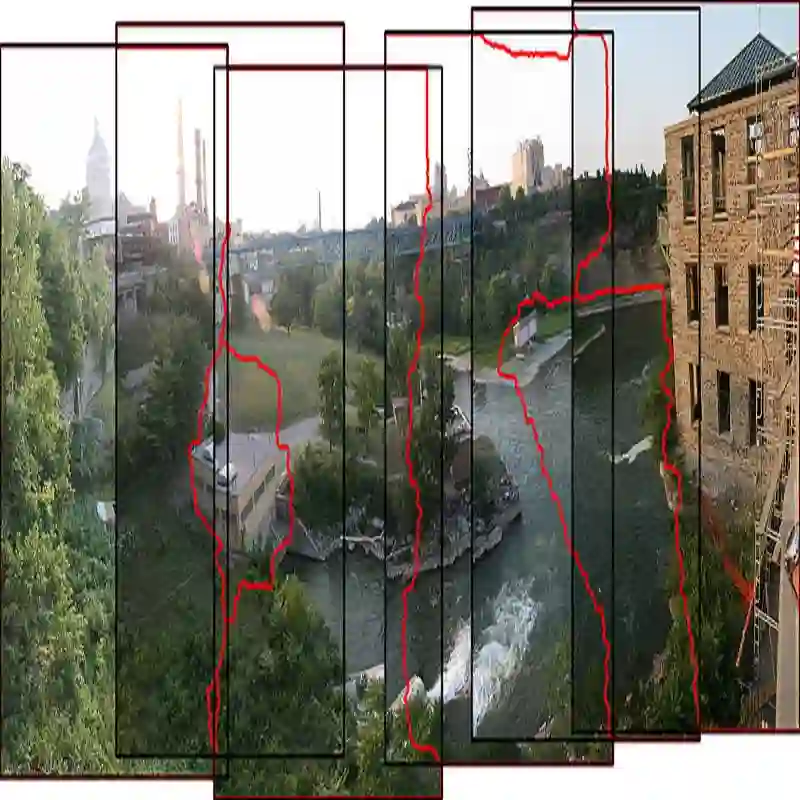
Traditional image stitching techniques have predominantly utilized two-dimensional homography transformations and mesh warping to achieve alignment on a planar surface. While effective for scenes that are approximately coplanar or exhibit minimal parallax, these approaches often result in ghosting, structural bending, and stretching distortions in non-overlapping regions when applied to real three-dimensional scenes characterized by multiple depth layers and occlusions. Such challenges are exacerbated in multi-view accumulations and 360° closed-loop stitching scenarios. In response, this study introduces a spatially lifted panoramic stitching framework that initially elevates each input image into a dense three-dimensional point representation within a unified coordinate system, facilitating global cross-view fusion augmented by confidence metrics. Subsequently, a unified projection center is established in three-dimensional space, and an equidistant cylindrical projection is employed to map the fused data onto a single panoramic manifold, thereby producing a geometrically consistent 360° panoramic layout. Finally, hole filling is conducted within the canvas domain to address unknown regions revealed by viewpoint transitions, restoring continuous texture and semantic coherence. This framework reconceptualizes stitching from a two-dimensional warping paradigm to a three-dimensional consistency paradigm and is designed to flexibly incorporate various three-dimensional lifting and completion modules. Experimental evaluations demonstrate that the proposed method substantially mitigates geometric distortions and ghosting artifacts in scenarios involving significant parallax and complex occlusions, yielding panoramic results that are more natural and consistent.
翻译:传统图像拼接技术主要采用二维单应性变换与网格变形,在平面表面实现对齐。尽管这些方法对于近似共面或视差极小的场景有效,但当应用于具有多重深度层与遮挡的真实三维场景时,常导致非重叠区域出现重影、结构弯曲与拉伸畸变。此类挑战在多视角累积与360°闭环拼接场景中尤为突出。为此,本研究提出一种空间提升的全景拼接框架:首先将每幅输入图像提升至统一坐标系下的密集三维点表示,通过置信度度量增强的全局跨视图融合;随后在三维空间中建立统一投影中心,采用等距柱面投影将融合数据映射至单一全景流形,从而生成几何一致的360°全景布局;最后在画布域内进行孔洞填充,以处理视角转换揭示的未知区域,恢复连续纹理与语义连贯性。该框架将拼接范式从二维变形重构为三维一致性范式,并可灵活集成各类三维提升与补全模块。实验评估表明,所提方法在显著视差与复杂遮挡场景中能大幅缓解几何畸变与重影伪影,生成更自然、一致的全景结果。




相关内容

 微信扫码咨询专知VIP会员