

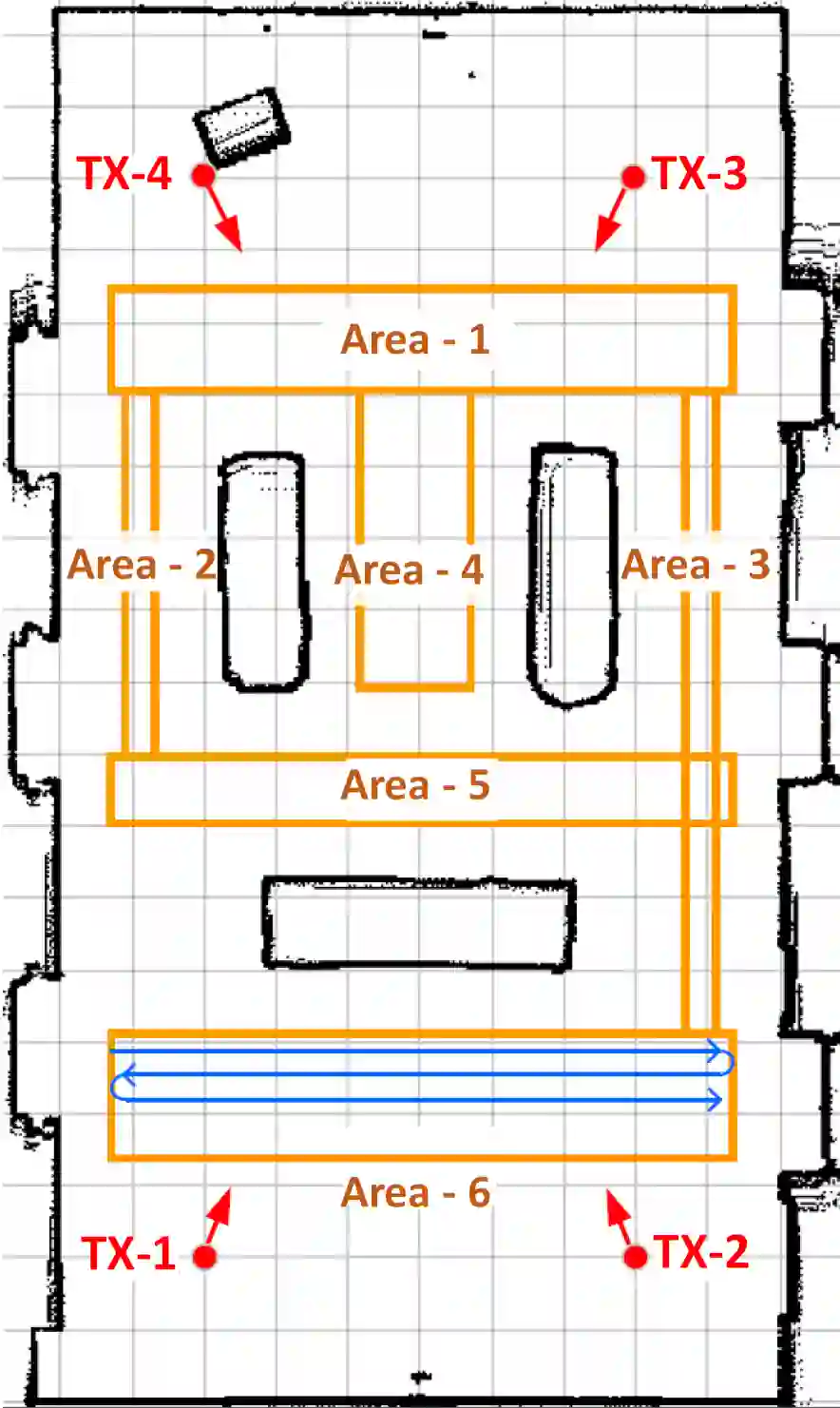
The quasi-optical propagation of millimeter-wave signals enables high-accuracy localization algorithms that employ geometric approaches or machine learning models. However, most algorithms require information on the indoor environment, may entail the collection of large training datasets, or bear an infeasible computational burden for commercial off-the-shelf (COTS) devices. In this work, we propose to use tiny neural networks (NNs) to learn the relationship between angle difference-of-arrival (ADoA) measurements and locations of a receiver in an indoor environment. To relieve training data collection efforts, we resort to a self-supervised approach by bootstrapping the training of our neural network through location estimates obtained from a state-of-the-art localization algorithm. We evaluate our scheme via mmWave measurements from indoor 60-GHz double-directional channel sounding. We process the measurements to yield dominant multipath components, use the corresponding angles to compute ADoA values, and finally obtain location fixes. Results show that the tiny NN achieves sub-meter errors in 74\% of the cases, thus performing as good as or even better than the state-of-the-art algorithm, with significantly lower computational complexity.
翻译:毫米波信号的准光学传播特性使得采用几何方法或机器学习模型的高精度定位算法成为可能。然而,大多数算法需要室内环境信息,可能需要收集大量训练数据集,或给商用现成设备带来不可行的计算负担。在本文中,我们提出使用微型神经网络学习角度到达差测量值与室内环境中接收器位置之间的关系。为减轻训练数据收集工作,我们采用自监督方法,通过从最先进的定位算法获得的位置估计来引导神经网络训练。我们利用来自60 GHz室内双方向信道探测的毫米波测量数据评估方案,通过处理测量数据提取主导多径分量,利用相应角度计算角度到达差值,最终获取位置坐标。结果表明,微型神经网络在74%的案例中实现了亚米级误差,其定位性能与最先进算法相当甚至更优,且计算复杂度显著降低。







相关内容




 微信扫码咨询专知VIP会员